

Why Finding the Right Catholic Therapist Matters
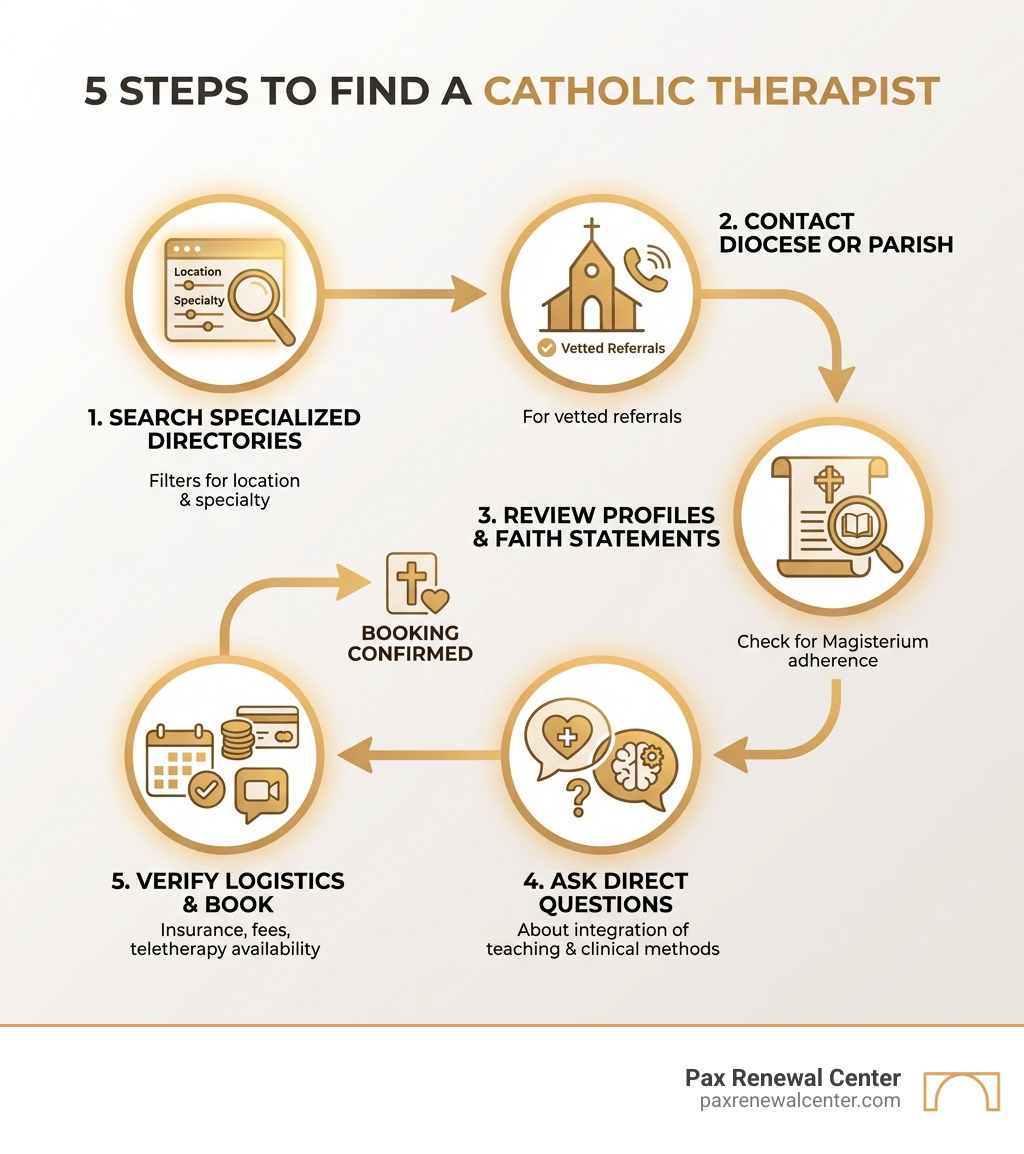
Catholic therapists can be found through specialized faith-based directories, diocesan resources, parish referrals, and online platforms that screen counselors for adherence to Catholic teachings. Here’s how to start your search:
- Search national Catholic directories like CatholicTherapists.com or the Catholic Psychotherapy Association
- Contact your local diocese or parish for pastoral referrals and family ministry resources
- Verify faith alignment by asking therapists about their adherence to Church teachings
- Review therapist profiles for specialties like marriage counseling, trauma therapy, or teen support
- Confirm logistics, including insurance, fees, and availability of teletherapy options
When you’re struggling with anxiety, relationship distance, trauma, or life transitions, you want more than clinical expertise. You want a counselor who understands that your faith isn’t separate from your healing—it’s central to it.
The challenge is finding a therapist who truly integrates Catholic values with proven clinical methods. Not every counselor who claims to be “faith-friendly” actually adheres to Church teachings. Some may incorporate New Age concepts or moral relativism that conflict with your beliefs. Others may be clinically excellent but treat your faith as something to work around rather than work with.
Catholic therapy at its best combines spiritual guidance with evidence-based care. It recognizes that faith and reason aren’t competing forces; they’re complementary paths to wholeness. Whether you’re facing marriage struggles, childhood trauma, depression, or parenting challenges, a truly Catholic approach honors both your psychological needs and your spiritual identity.
I’m Dan Jurek, a Licensed Professional Counselor and Marriage and Family Therapist with over 35 years helping individuals and couples in Lafayette, Louisiana, find healing through faith-integrated care. Throughout my career, including my time as a Catholic campus minister, I’ve specialized in connecting clients with catholic therapists who combine clinical excellence with authentic adherence to Church teaching. This guide will walk you through exactly how to find that kind of care in your area.
Finding Catholic Therapists Near Me: Where to Start Your Search
Searching for mental health support can feel overwhelming, especially when you are looking for a specific spiritual alignment. If you’ve ever typed “catholic therapists near me” into a search engine, you know that the results can be a mixed bag. To find a truly compatible match, we recommend starting with resources that understand the nuances of the Catholic faith.
A great place to begin is our Faith-Based Therapy Guide, which outlines how clinical techniques can be harmonized with spiritual growth. Beyond specialized guides, you should look toward established directories and local community networks.
Utilizing National Directories for Catholic Therapists Near Me
National directories are powerful tools because they often do the “heavy lifting” of vetting. Organizations like CatholicTherapists.com make a concerted effort to screen their members for faithful adherence to Church teaching.
When using these directories, look for:
- Magisterium Adherence: Many directories require therapists to sign a statement of faith or affirm their loyalty to the Magisterium (the teaching authority of the Church).
- Detailed Profiles: Look for therapists who explicitly mention their integration of Catholic values.
- Search Filters: You can usually filter by geographic location (like Lafayette, LA), but also by specialty, such as marriage counseling or adolescent care.
- The Catholic Psychotherapy Association: The Catholic Psychotherapy Association is another excellent resource where you can find professionals who are committed to both clinical excellence and Catholic anthropology.
Local Parish and Diocesan Resources
Don’t underestimate the power of your local “backyard.” Your parish priest or the diocesan office often maintains a list of trusted referrals. Many dioceses have a “Family Ministry” or “Respect Life” office that keeps a pulse on local providers who respect Catholic moral teaching.
In some regions, specialized search tools like the AOD Finder help parishioners locate everything from Mass times to counseling resources. Even if your local diocese doesn’t have a high-tech search tool, a simple phone call to the chancery or your parish secretary can often lead you to a therapist who has been vetted by the local Catholic community. These pastoral referrals are invaluable because they often come with a “stamp of approval” from those who know the therapist’s reputation in the pews.
What to Look for in a Faith-Aligned Counselor
Finding a therapist with a “Catholic” label is a start, but the real work lies in ensuring their approach matches your needs. You want a counselor who doesn’t just tolerate your faith but sees it as a vital resource for your recovery.
We believe in Understanding a Faith-Based Approach to Counseling in the Catholic Christian Tradition, which means looking for someone who views the human person through a lens of dignity and divine purpose.
Screening for Adherence to Church Teachings
It is your right and responsibility to ask questions before booking an appointment. When you find a potential catholic therapist, consider asking about their “Statement of Faith.”
Key screening criteria often include:
- Theological Vetting: Does the therapist hold all dogmatically defined teachings of the Catholic Church to be true?
- Application Review: Professional directories often review references and applications to ensure the therapist isn’t just “culturally Catholic” but actively practicing and faithful.
- Moral Alignment: On sensitive issues like marriage, bioethics, and human sexuality, does the therapist support the Church’s stance, or do they lean toward a secular “neutrality”?
This leads to an important question: Is therapist neutrality a fact or fiction? In the podcast Ep. 301 Therapist Neutrality: Fact or Fiction?, experts discuss how every therapist brings a worldview into the room. For a Catholic client, a “neutral” therapist might inadvertently lead you away from your values by failing to acknowledge objective moral truths.
Avoiding Secular Pitfalls and New Age Concepts
One of the biggest risks in the modern counseling world is the subtle creep of New Age philosophies. Concepts that seem helpful on the surface, like certain types of mindfulness or “self-manifestation,” can sometimes be rooted in a spiritual framework that is incompatible with Christianity.
As noted in The Raphael Remedy, we are always responsible for how we act, and a good Catholic therapist will help you align those actions with grace and reason. Avoid therapists who promote:
- Moral Relativism: The idea that “whatever feels right for you” is the only truth.
- Secular Bias: Treating religious devotion as a psychological “crutch” or a symptom of a disorder.
- New Age “Spirituality”: Practices that replace the Creator with “the universe” or emphasize self-deification.
A faithful therapist maintains a balance between faith and reason, ensuring that psychological techniques are used to support, not replace, your spiritual life.
The Integration of Faith and Clinical Excellence
The best catholic therapists are those who are both spiritually grounded and clinically elite. We don’t have to choose between the Rosary and modern psychology; we use both. This integration is often built on the foundation of “Personalism,” a philosophy championed by St. John Paul II.
Personalism teaches us that every human being is a unique person made in the image of God, deserving of total respect. This is the heart of Spirit & Science: How Christian Therapy Can Transform Your Mental Health. When we understand “Theology of the Body,” we see that our physical and emotional struggles are often connected to our deepest spiritual desires for love and communion.
Evidence-Based Modalities for Catholic Therapists Near Me
At Pax Renewal Center, we pride ourselves on using top-tier clinical methods that have been carefully screened for compatibility with a Catholic worldview. If you are looking for catholic therapists in Lafayette, LA, you should look for practitioners trained in:
- EMDR (Eye Movement Desensitization and Reprocessing): An incredible tool for trauma recovery. We provide a Faith-Based EMDR Complete Guide to show how this science-backed method can be used to clear the emotional blockages that hinder your relationship with God.
- CBT (Cognitive Behavioral Therapy): We utilize Faith-Based Cognitive Behavioral Therapy to help you identify “stinking thinking” and align your thoughts with the Truth of the Gospel.
- The Gottman Method and EFT (Emotionally Focused Therapy): These are the gold standards for marriage counseling, helping couples move from conflict to connection.
Specialized Care for Families and Couples
Faith-based therapy is particularly effective for family dynamics. Whether you are seeking Catholic Marriage Help for a relationship in crisis or looking for a Christian Counseling for Teens Guide, the goal is relational restoration.
We specialize in:
- Affair Recovery: Healing the deep wounds of betrayal through a process of repentance, forgiveness, and rebuilding.
- Play Therapy: Helping children express their emotions in a safe, faith-filled environment.
- Discernment Counseling: For couples who aren’t sure if they want to stay in the marriage, providing a space to look at all options through the lens of their vows.
Navigating Logistics: Insurance, Teletherapy, and Your Role
Choosing a therapist is a significant investment of time and resources. Because most Catholic therapists operate as independent contractors, their policies on fees and insurance will vary. It is your responsibility as the client to perform due diligence.
| Feature | In-Person Therapy | Teletherapy (Virtual) |
|---|---|---|
| Location | Local office (e.g., Lafayette, LA) | Anywhere with internet |
| Connection | Face-to-face, physical presence | Screen-to-screen, via secure video |
| Privacy | Professional office setting | Your choice of private space |
| Accessibility | Limited by travel/commute | High; great for rural areas |
| Best For | Deep trauma, play therapy, high-conflict couples | Busy schedules, mobility issues, distance |
Payment, Insurance, and Independent Practices
Most directories of catholic therapists clarify that the therapists listed are not employees of the directory itself. This means you must discuss the following directly with the provider:
- Fee Setting: What is the hourly rate?
- Sliding Scales: Do they offer lower rates for those in financial hardship?
- Insurance Panels: Do they accept your specific insurance, or are they “out-of-network”?
- Billing: Will they provide a “superbill” for you to submit to your insurance company for reimbursement?
The Benefits of Virtual Catholic Therapists Near Me
Sometimes, the best therapist for your specific needs might not be in your zip code. This is where Virtual Christian Therapy becomes a game-changer.
Teletherapy offers several benefits:
- Wider Selection: You can find a therapist who specializes in exactly what you need (like OCD or Scrupulosity), even if they live in another part of Louisiana.
- Privacy: Some people feel more comfortable speaking from the privacy of their own home.
- Rural Access: If you live far from a major city like Lafayette, virtual options ensure you don’t have to settle for a secular therapist just because they are the only ones nearby.
Frequently Asked Questions about Catholic Therapy
How do I know if a therapist is truly faithful to Catholic teachings?
Don’t be afraid to ask! A faithful therapist will welcome questions about their adherence to the Magisterium. You can also check if they are members of the Catholic Psychotherapy Association or listed on CatholicTherapists.com, as these organizations have their own screening processes.
Does insurance usually cover faith-based counseling?
Yes, in many cases. Insurance companies generally care about the clinical license of the therapist (LPC, LCSW, LMFT) and the diagnosis being treated, rather than the spiritual framework used. However, you should always verify with your provider and the therapist beforehand.
What is the difference between spiritual direction and Catholic therapy?
Spiritual direction focuses on your relationship with God and your prayer life. Catholic therapy focuses on your mental health, emotional wounds, and behavioral patterns. While they overlap, therapy is designed to treat psychological conditions, whereas spiritual direction is designed to foster spiritual growth. Many people find that doing both simultaneously is incredibly powerful.
Conclusion
Finding catholic therapists doesn’t have to be a shot in the dark. By using trusted directories, leaning on your local parish, and asking the right questions about faith integration and clinical methods, you can find a partner in your healing journey.
At Pax Renewal Center in Lafayette, Louisiana, we are committed to this mission. Led by Dan Jurek, our team provides professional, compassionate care that honors your Catholic values while utilizing the best that modern psychology has to offer. Whether you need Catholic Marriage Help, support for your teen, or individual trauma recovery, we are here to help you experience emotional healing and spiritual renewal.
If you’re ready to take the next step toward a more vibrant, faith-filled life, we invite you to reach out. Your path to healing is waiting.