

Why Faith-Based EMDR Offers a Unique Path to Healing
Faith-based EMDR combines the scientifically proven trauma therapy of Eye Movement Desensitization and Reprocessing with Christian values and spiritual integration. Here’s what makes it distinct:
- What it is: A trauma healing method that uses bilateral stimulation (like guided eye movements) to help your brain reprocess painful memories while inviting God into the healing process
- Who it’s for: Christians struggling with trauma, PTSD, anxiety, depression, church hurt, or spiritual wounds who want therapy that honors their faith
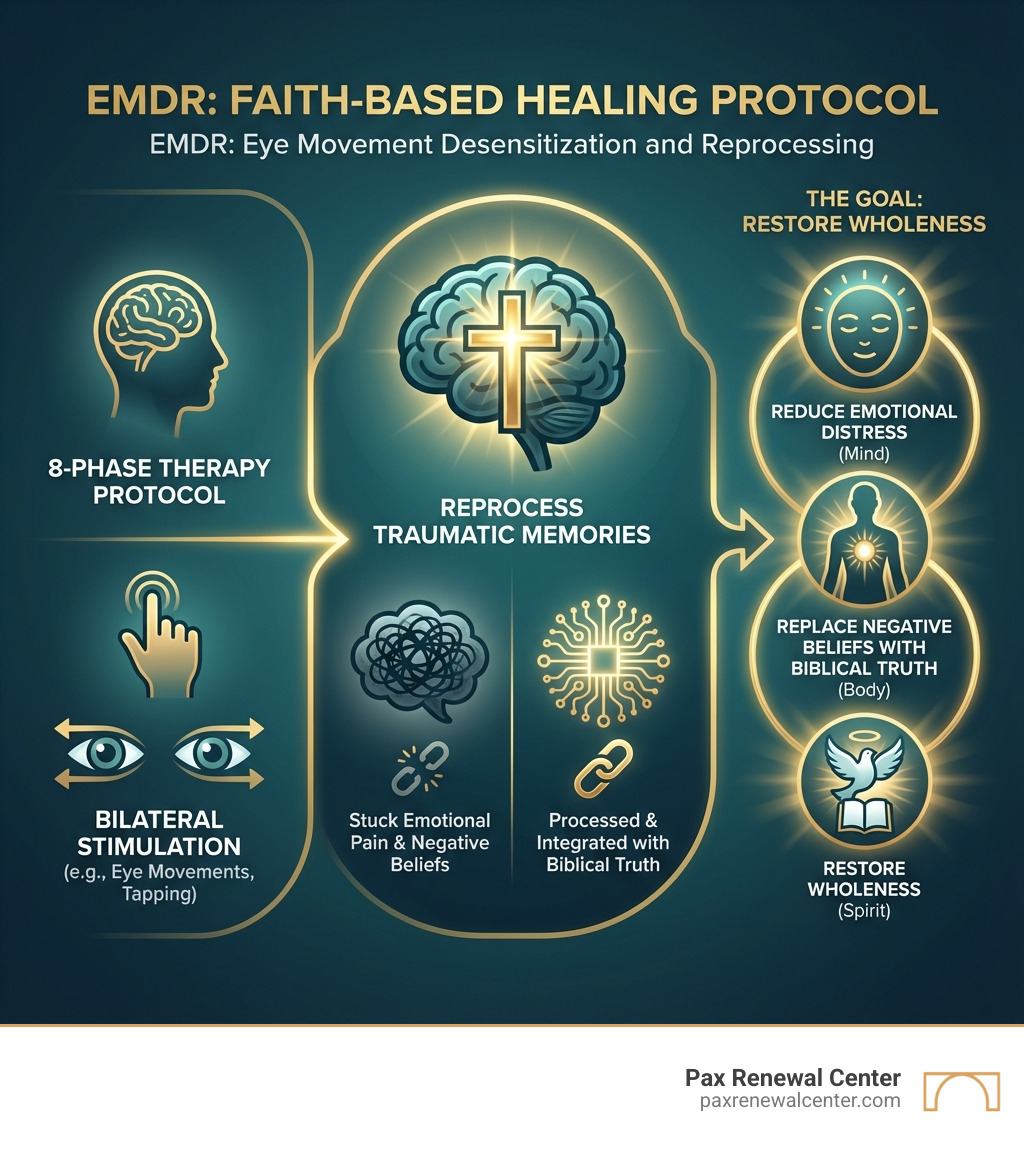
- How it works: Your therapist guides you through an 8-phase protocol that targets stuck emotional pain while integrating prayer, Scripture, and biblical truth
- Why it matters: It addresses both psychological wounds and spiritual barriers, helping you experience deeper freedom and intimacy with God
- Key difference: Unlike talk therapy alone, EMDR works directly with how your brain stores traumatic memories—and when combined with faith, it becomes a tool for soul-level change
Trauma doesn’t just leave emotional scars; it can create distance between you and God, making prayer feel empty and leaving you with shame or fear that won’t let go. You may have been told to “just trust God more,” but the pain persists in your body, relationships, and spiritual life.
You’re not broken. Your faith isn’t weak. Your brain is simply holding onto pain that needs to be processed.
Faith-based EMDR bridges science and spirituality. As a therapy recognized by the American Psychological Association and the World Health Organization, EMDR helps your brain reprocess traumatic memories so they no longer control you. When integrated with Christian faith, it becomes more than a clinical tool—it’s a way to invite Jesus into the parts of your story that need His healing.
I’m Dan Jurek, M.A., LPC-S, LMFT-S, founder and clinical director of Pax Renewal Center in Lafayette, Louisiana. Over my 35 years of clinical experience, I’ve witnessed countless individuals and couples find profound healing through faith-based EMDR, especially when traditional talk therapy alone wasn’t enough. My approach honors both the science of trauma treatment and the transformative power of faith, helping you heal emotionally and grow spiritually.
What is EMDR Therapy and How Does It Heal Trauma?
Eye Movement Desensitization and Reprocessing (EMDR) therapy is a powerful, evidence-based psychotherapy that helps individuals heal from trauma and other distressing life experiences. Developed by psychologist Francine Shapiro in 1987, EMDR has gained widespread recognition from leading health organizations such as the American Psychological Association (APA), the World Health Organization (WHO), and the U.S. Department of Veterans Affairs. This isn’t just a trendy technique; it’s a proven method to significantly reduce or even eliminate the ongoing disturbance from traumatic events.
EMDR is based on the Adaptive Information Processing (AIP) model. This model suggests that trauma can overwhelm the brain’s natural processing ability, causing the memory to get “stuck” with its original distressing images, thoughts, and feelings. This is why triggers can cause intense emotional reactions long after the event, making it feel like the trauma is happening again.
EMDR therapy works to “unfreeze” these memories and allows the brain to reprocess them. It does this through a structured, eight-phase protocol that guides you through recalling the traumatic memory while simultaneously engaging in bilateral stimulation. This stimulation often involves guided eye movements (similar to what happens during Rapid Eye Movement or REM sleep), but it can also include alternating tactile sensations (like tapping) or auditory tones. This bilateral stimulation helps the two hemispheres of the brain communicate and integrate the unprocessed memory.
Think of it like REM sleep, where your brain naturally processes daily events. EMDR kickstarts this healing process for stuck traumatic memories. By helping the brain make new connections, EMDR desensitizes the emotional distress linked to the memory. The goal isn’t to erase the memory but to reduce its overwhelming impact, allowing you to remember it without distress and replace negative beliefs with positive ones.
EMDR is one of the most effective and quickly relieving forms of trauma therapy available, empowering individuals to move past their pain. For in-depth research, explore resources from the EMDR International Association at Scientific research on EMDR therapy. If you’re struggling with past events, learn more about our Trauma Treatment options.
How EMDR Differs from Traditional Talk Therapy
While both EMDR and traditional talk therapy aim for healing and personal growth, their approaches and mechanisms differ significantly, especially when integrating faith. Here’s a comparison:
| Feature | EMDR Therapy | Traditional Talk Therapy |
|---|---|---|
| Focus | Processing maladaptively stored traumatic memories and associated distress. | Insight into thoughts, feelings, and behaviors; exploring root causes through verbal dialogue. |
| Mechanism | Bilateral Stimulation (eye movements, tapping, tones) to activate the brain’s natural healing process. | Verbal Dialogue and narrative exploration; therapist-guided conversation. |
| Timeframe | Often faster for trauma resolution; significant relief can be experienced in fewer sessions. | Generally longer-term; builds insight and coping skills over an extended period. |
| Role of Memory | Directly reprocessing distressing memories to reduce their emotional charge. | Discussing memories to gain understanding and develop new perspectives. |
| Client Role | Actively engages in bilateral stimulation while observing thoughts/feelings; less verbal processing during reprocessing. | Primarily verbalizes experiences, thoughts, and feelings; engages in reflective dialogue. |
| Trauma Focus | Directly targets and resolves specific traumatic memories. | Explores trauma’s impact on current life; may not directly “reprocess” the memory’s emotional charge. |
EMDR taps into the brain’s natural ability to heal itself by targeting “stuck” emotional pain through specific techniques. It’s not just about talking about the trauma; it’s about helping your brain move through it. This can be particularly beneficial for those who find it difficult to articulate their trauma verbally or who have experienced limited success with talk therapy alone.
Who Can Benefit from EMDR?
EMDR is a versatile therapy that can help a wide range of individuals struggling with various emotional and psychological challenges, including those seeking a faith-based approach. We often recommend EMDR for:
- Christians with trauma or PTSD: For those who have experienced deeply distressing events, including veterans. EMDR is highly effective for PTSD. See our guide on PTSD Awareness.
- Survivors of abuse: EMDR helps process painful memories of childhood abuse, domestic violence, or other mistreatment to reduce their lasting impact.
- Individuals with spiritual trauma: For those with “church hurt” or religious abuse, EMDR can help separate harmful experiences from core faith, an impact noted by the U.S. Department of Veterans Affairs.
- People with anxiety or depression: EMDR can address underlying trauma contributing to these conditions. Learn more about EMDR for Anxiety.
- Those struggling with grief or loss: EMDR can process trauma associated with loss to facilitate healthy grieving.
- Individuals with identity struggles: EMDR can reprocess past experiences to help foster a clearer, more positive identity and sense of purpose.
- Anyone who feels “stuck”: If other therapies or prayer haven’t brought relief from emotional burdens, EMDR offers a different path to renewal.
While EMDR is highly effective, it’s not suitable for everyone. We conduct a thorough assessment to determine if EMDR is the right approach for your specific situation.
Bridging the Gap: How EMDR Aligns with Christian Beliefs
Many Christians wonder if a psychological therapy like EMDR can align with their faith. We believe that when approached through a Christian lens, EMDR beautifully aligns with biblical principles and God’s design for healing.
God created our brains with an incredible capacity for healing. EMDR harnesses this natural, God-given ability to reprocess memories and renew our minds, reflecting His good design.
The Bible calls us to be “transformed by the renewal of your mind” (Romans 12:2) and to “take every thought captive to obey Christ” (2 Corinthians 10:5). Trauma often implants lies that contradict God’s truth. EMDR is a practical tool that facilitates this renewal, providing a structured way to identify these negative thoughts and replace them with biblical truth.
Healing is both a psychological and spiritual journey. By processing trauma, EMDR impacts the mind, body, and spirit, leading to deeper peace and a renewed connection with God. It supports biblical teachings on forgiveness and reconciliation, helping you move toward a hopeful future in Christ. Learn more in our Faith-Based Therapy Guide.

The Concept of ‘Common Grace’ in Healing
In Christian theology, “common grace” refers to the undeserved favor of God that is extended to all humanity, not just believers. This grace manifests in various ways, including the natural order, human reason, and the ability to create and find good things. We see EMDR as a profound example of common grace.
Just as medicine and science are gifts from God, so are insights into how our brains heal. EMDR is a neurologically based technique that works with the brain’s natural systems. It relies not on mystical practices, but on the mechanisms God built into our human design.
As one source notes, EMDR is considered a “common grace” from God, similar to medicine, usable by both believers and non-believers. The ability of the brain to reprocess memories points to the goodness of God’s design, a testament to His intricate creation. This perspective allows us to accept EMDR as a valuable tool for healing, recognizing it as a gift from God’s hand that benefits all who seek its aid. For a deeper understanding of this theological concept, we recommend reading about The goodness of God and common grace.
Addressing Common Misconceptions About Faith-Based EMDR
It’s common for Christians to have questions about EMDR and its compatibility with their beliefs. Let’s address some common misconceptions:
- “Is EMDR a form of hypnosis or mind control?” Absolutely not. EMDR is a neuroscience-based method that helps your brain reprocess painful memories. It does not involve hypnosis, altered states of consciousness, or any form of mind control. You remain fully conscious and in control throughout the session.
- “Is EMDR New Age or unbiblical?” This is a common concern due to the bilateral stimulation, which to some unfamiliar with it, can seem odd or even unspiritual. However, EMDR is rooted in how the brain naturally processes memories during REM sleep. It’s a scientifically backed therapy focused on healing trauma and does not contradict Christian beliefs. Instead, it offers a practical tool for emotional healing while respecting spiritual convictions. As Got Questions? affirms, It does not contradict Christian beliefs.
- “Does EMDR require ’emptying your mind’ or other non-Christian spiritual practices?” No. While EMDR involves focusing on a memory while engaging in bilateral stimulation, it is not about emptying your mind. It’s about allowing your brain to make new connections and integrate unprocessed information. From a Christian perspective, this process can be enriched by inviting God’s presence and truth into the space, rather than relying on any external, non-biblical spiritual techniques.
The controversy around EMDR sometimes stems from its unique methodology. However, it’s actually rooted in how the brain naturally processes memories during REM sleep. EMDR is endorsed by many respected health organizations, and when used responsibly in a Christian EMDR therapy setting, it aligns well with our calling to seek healing, wholeness, and truth.
The Process of Faith-Based EMDR: What to Expect
Starting faith-based EMDR at Pax Renewal Center means entering a compassionate, professional space where your mind, body, and spirit are honored. We take a holistic approach to healing at our practice in Lafayette, LA.
Initial sessions focus on building a strong, trusting relationship, which is crucial for trauma work. We take time to understand your history, faith journey, and therapeutic goals, including how your faith has been impacted by your experiences.
EMDR therapy is structured around an eight-phase protocol, but within that structure, we prioritize your comfort and pace. We ensure that you have adequate coping skills and resources before we begin directly reprocessing traumatic memories. This preparation phase is vital for creating a sense of safety and control.
During reprocessing, you’ll focus on a distressing memory while engaging in bilateral stimulation (like eye movements or gentle tapping). Your therapist will guide and support you, providing a grounding presence as you steer intense emotions. We ensure you feel safe every step of the way. For more details on our Lafayette, LA, practice, visit EMDR Therapy Lafayette LA.
The Role of Faith and Prayer in Sessions
A cornerstone of our faith-based EMDR approach is integrating your Christian faith. Inviting God into the healing journey provides profound comfort, reassurance, and guidance.
We often begin sessions with prayer, acknowledging God’s presence and asking for His guidance and comfort as you engage with difficult memories. This sets a sacred tone, reminding us that true healing comes from Him.
During the reprocessing phases, especially when identifying negative beliefs and developing positive cognitions, Scripture can be a powerful resource. Instead of solely relying on worldly wisdom, we encourage grounding your new, positive beliefs in biblical truth. For example, if a trauma has led to a belief like “I am worthless,” we might guide you to replace it with “I am fearfully and wonderfully made by God” (Psalm 139:14) or “I am loved by God” (John 3:16). This helps to replace the lies planted by trauma with God’s unshakable truth.
The Holy Spirit is honored as our Comforter and Counselor, providing strength and discernment. We believe that God can speak through His Word and be heard in prayer, even when emotions are intense. This integration of faith and prayer transforms EMDR from merely a clinical tool into a spiritual pathway for renewal and deeper intimacy with God. This approach fosters genuine Christian Spiritual Renewal.
Replacing Lies with God’s Truth
A transformative aspect of faith-based EMDR is its power to dismantle the lies trauma implants in our minds—like “I am unlovable” or “God abandoned me”—and replace them with God’s truth.
Through the EMDR process, we work to identify these specific negative cognitions. As we reprocess the traumatic memory, the goal is to alleviate these negative thoughts and replace them with positive beliefs that are both adaptive and biblically grounded. For example, a belief of “I am helpless” might be replaced with “I am strong in Christ,” or “God is always with me.”
This is a deliberate process of cognitive restructuring rooted in biblical principles. As EMDR desensitizes the memory’s emotional charge, it creates space for biblically-based truths to take root. This process can lead to a profound identity shift, moving from being trauma-defined to Christ-grounded. Forgiveness and reconciliation are also vital components of this journey.
Changes: Overcoming Barriers to Spiritual Growth
Trauma affects more than our mental health; it can create significant barriers to spiritual growth. Deep pain, especially from spiritual trauma or church hurt, can lead to shame, anger at God, or spiritual disconnection. Faith-based EMDR offers a powerful way to overcome these obstacles.
By processing the root causes of distress, EMDR helps individuals break free from emotional chains hindering their spiritual walk. For example, it can help someone carrying shame from abuse to internalize the truth of God’s unconditional love, leading to a more authentic connection with Him.
Healing from church hurt, for example, can involve separating the actions of imperfect people from the perfect character of God. EMDR can help reprocess the trauma associated with those experiences, removing the spiritual blockages that prevent individuals from engaging with their faith community or even with God Himself. This process can lead to a renewed sense of purpose, a deeper understanding of God’s character, and profound emotional freedom that allows faith to flourish.
The Unique Benefits of Faith-Based EMDR
The integration of EMDR with Christian faith offers unique and profound benefits that extend beyond typical symptom reduction:
- Soul-Level Change: Goes beyond symptom relief to foster deep, soul-level change, helping you become whole—mind, body, and spirit—in alignment with God’s design.
- Aligning Emotional and Spiritual Health: This approach aligns your emotional healing with your spiritual journey, ensuring that as you heal psychologically, your faith is strengthened.
- Restoring Faith, Hope, and Love: Trauma can disrupt our capacity for faith, hope, and love. By reprocessing experiences through a spiritual lens, faith-based EMDR helps restore these essential Christian virtues.
- Processing Trauma that Hinders Spiritual Intimacy: For Christians who struggle with prayer, reading Scripture, or feeling God’s presence due to trauma, EMDR can remove these internal barriers and restore a more unhindered relationship with God.
- Holistic Well-being: Acknowledging the intricate connection between body, mind, and spirit, this approach offers a comprehensive path to well-being. Learn more about our approach to Faith-Based Counseling in the Catholic Christian Tradition.
Frequently Asked Questions about Christian EMDR
We understand you might have more questions as you consider faith-based EMDR. Here are some common inquiries we receive:
Is EMDR therapy okay for Christians?
Yes, absolutely. EMDR is a neuroscience-based method that helps your brain reprocess painful memories without hypnosis, “emptying your mind,” or other spiritually questionable practices. We view it as a tool that works with the brain’s natural, God-given capacity for healing. When integrated with faith, EMDR becomes a powerful way to invite Jesus into your healing journey, aligning psychological recovery with spiritual renewal. It offers a practical path to emotional healing that respects and incorporates your Christian convictions.
What are the potential dangers or negative effects?
EMDR can be intense, as it stirs up buried emotions and memories to be processed and released. The primary risk is working with a therapist who doesn’t understand or respect your faith. It’s common to experience a temporary increase in emotional intensity or vivid dreams during reprocessing. However, a qualified Christian therapist provides a safe, grounding, and prayerful presence to guide you. At Pax Renewal Center, we ensure you move at a comfortable pace. Any discomfort is typically temporary, while the freedom gained is lasting. Leaning on God’s truth makes all the difference in navigating these moments.
How do I find a qualified Christian EMDR therapist?
Finding the right therapist is crucial. When seeking a Christian EMDR therapist in Lafayette, LA, or anywhere in Louisiana, we recommend the following:
- Seek EMDRIA-Approved Training: Ensure your therapist has completed an EMDR training program approved by EMDRIA (EMDR International Association). This signifies a high standard of clinical training in EMDR. You can find more information about these programs at EMDRIA approved program.
- Look for Faith Integration: Beyond EMDR training, find a counselor who shares your Christian values and understands how to ethically and effectively integrate faith into the therapeutic process. Ask prospective therapists about their approach to faith integration and how they incorporate prayer, Scripture, or spiritual principles into their EMDR sessions.
- Use Christian Counselor Networks: Resources like the Focus on the Family’s Christian Counselors Network can be excellent starting points for finding qualified Christian therapists who use EMDR in their practice.
- Consider Local Expertise: If you’re in Lafayette, Louisiana, or the surrounding areas, we invite you to connect with us at Pax Renewal Center. Our team of highly qualified, faith-based therapists specializes in integrating clinical best practices like EMDR with spiritual guidance rooted in Christian values. We are committed to providing a safe and effective space for your healing journey.
Trust your discernment when choosing a therapist. A consultation can help you assess if they are the right fit for your faith-based healing goals.
Conclusion: A Harmonious Path to Wholeness
Our journey through faith-based EMDR reveals a harmonious path to healing. It’s not about choosing between science and spirituality but embracing both as gifts from God for our restoration. EMDR is a scientifically validated therapy that works with the brain’s natural ability to heal from trauma. When integrated with Christian faith, it becomes a profound tool for holistic healing—nurturing the mind, body, and spirit.
Healing is possible, and you don’t have to carry the burdens of trauma alone. Through faith-based EMDR, you can move beyond being “stuck,” replace trauma’s lies with God’s truth, overcome spiritual barriers, and experience a deeper connection with God. This integrated approach leads to soul-level change and true wholeness.
At Pax Renewal Center in Lafayette, Louisiana, we are dedicated to helping you achieve this wholeness. Our team of compassionate, faith-based therapists is committed to providing professional care that honors your faith and supports your journey toward lasting healing. If you are ready to explore this harmonious path, we invite you to take the next step.
Learn more about our services and find how faith-based EMDR can help you find peace, purpose, and profound spiritual renewal.