

A New Path to Healing from Anxiety and Depression
EMDR for anxiety is a scientifically backed therapy that helps your brain reprocess distressing memories that fuel anxious thoughts and feelings. Instead of just managing symptoms, EMDR addresses the root causes by “unfreezing” memories that keep you stuck in cycles of worry and fear.
Quick Answer: Does EMDR Work for Anxiety?
- Yes, research shows EMDR is effective for various anxiety disorders, including GAD, panic disorder, phobias, and social anxiety
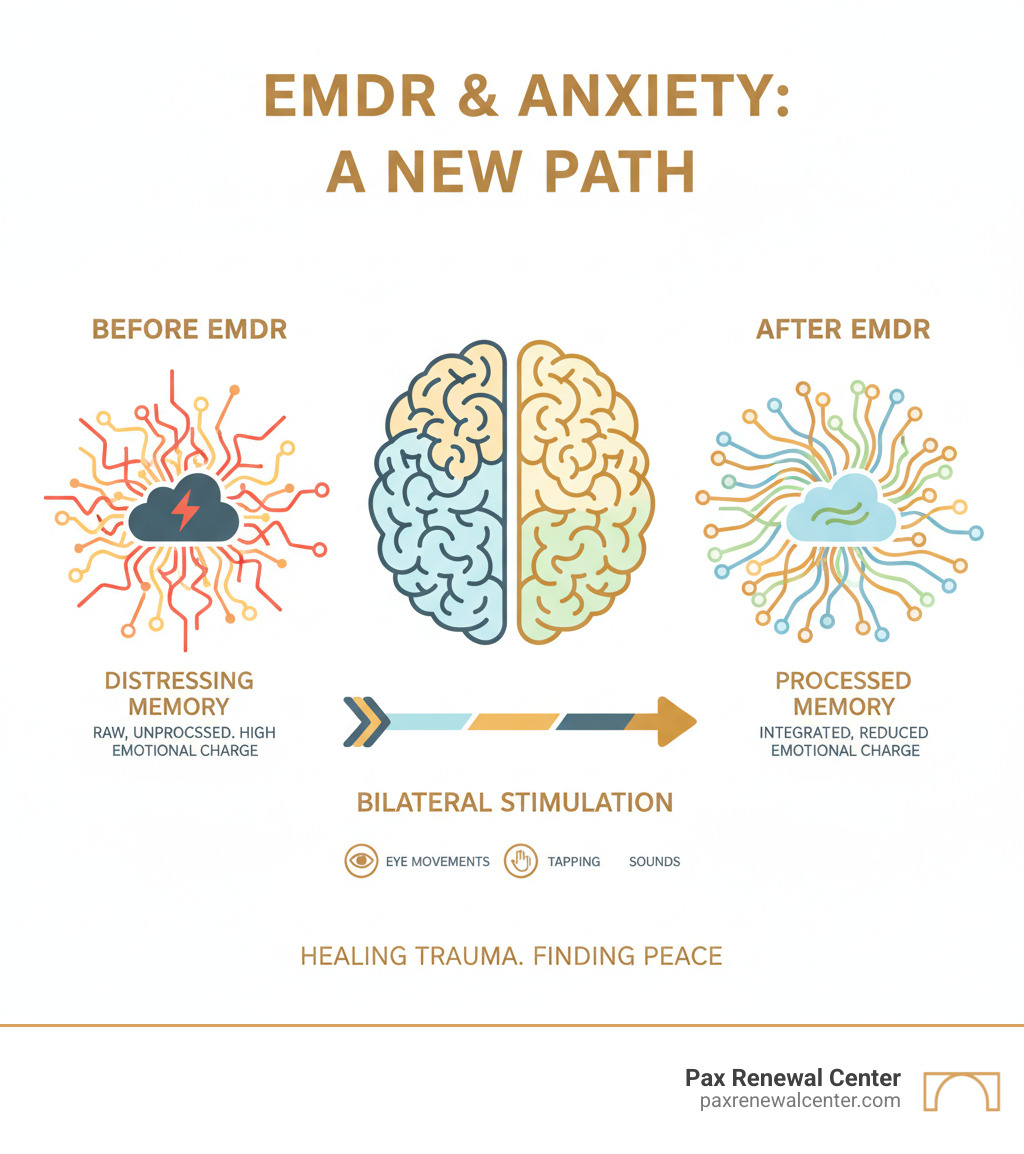
- How it works: Uses bilateral stimulation (eye movements, tapping, or sounds) while recalling anxiety triggers to help your brain reprocess and release them
- Results: Studies show anxiety symptoms can drop below diagnostic levels after treatment
- Timeline: Single-incident anxiety may improve in 3-6 sessions; complex anxiety typically takes 8-12+ sessions
- Key benefit: Addresses underlying causes, not just surface symptoms
If you feel trapped by anxiety or depression and traditional talk therapy or medication haven’t brought lasting relief, you’re not alone. Often, these struggles stem from unprocessed memories that remain “stuck” in the brain, triggering your nervous system long after an event has passed.
EMDR (Eye Movement Desensitization and Reprocessing) offers a different approach. Instead of just talking about your anxiety, EMDR helps your brain reprocess the experiences fueling it, allowing you to move forward with greater peace. The evidence is compelling, with organizations like the World Health Organization and the U.S. Department of Veterans Affairs recognizing EMDR as an effective treatment for trauma and anxiety-related conditions.
Understanding How EMDR Therapy Works for Anxiety
When you’re caught in anxiety, it can feel like your mind is stuck on repeat. EMDR for anxiety helps break that cycle by helping your brain process what’s been keeping you stuck.
EMDR is based on the Adaptive Information Processing (AIP) model. This model suggests your brain is naturally wired to heal itself. When you experience something distressing, your brain should process it and move on. But sometimes, that process gets interrupted, and the memory becomes “frozen” in its raw state, complete with the original intense emotions and negative beliefs.
These frozen memories act like triggers, causing anxiety long after the event. You might feel your heart race in safe situations or experience panic that feels out of proportion. EMDR therapy helps restart your brain’s healing process. Your therapist guides you to recall a distressing memory while engaging in bilateral stimulation (like following a finger with your eyes, alternating hand taps, or sounds). This stimulation seems to mimic the brain’s activity during REM sleep, when it naturally processes daily experiences. EMDR helps your brain complete the processing, so the memory loses its emotional punch. You’re essentially reprogramming your brain to respond differently to old triggers.
The Underlying Causes of Anxiety EMDR Can Address
Anxiety often has roots in past experiences. EMDR for anxiety is effective at addressing these underlying causes, not just the symptoms.
-
Traumatic events: This includes “big T” traumas like accidents or abuse, but also “small t” trauma, distressing life experiences that were overwhelming at the time, such as public humiliation, a painful betrayal, or a difficult divorce. Our guide, A Guide to Coping with Traumatic Stress, explores this further.
-
Childhood adversity: Even without overt abuse, experiences like having critical parents, an unstable home, or being bullied can create negative core beliefs. Beliefs like “I’m not safe” or “I’m not good enough” can fuel constant anxiety. EMDR targets these deeply stored memories and beliefs.
-
Distressing life experiences: Chronic stress, loss of a loved one, a major health diagnosis, or financial struggles can overwhelm your ability to cope, leaving unprocessed material that generates anxiety.
How EMDR Helps Reprocess Experiences and Shift Beliefs
EMDR actively helps your brain reorganize distressing memories and transform the negative beliefs attached to them.
During the desensitization phase, bilateral stimulation helps reduce the memory’s emotional intensity. The memory becomes less vivid and overwhelming. The reprocessing that follows helps your brain form new, healthier connections, moving the memory from a “frozen” state to proper long-term storage. Researchers call this memory reconsolidation.
In the installation phase, you strengthen a positive belief to replace the old negative one. Instead of “I’m not safe,” you work to install “I am capable and safe now.” This isn’t just positive thinking; it’s anchoring a new, healthier belief at a neural level.
The result is a significant reduction in emotional charge. The memory remains, but it no longer has the power to hijack your emotions. You can think about the event without reliving it. Research like this Systematic Review provides scientific backing for these outcomes.
Signs and Symptoms Indicating EMDR for Anxiety Could Help
How do you know if EMDR for anxiety is right for you? Consider it if you experience:
-
Persistent worry: Your mind races with “what ifs” and worst-case scenarios, interfering with your life. Research shows EMDR can be highly effective for Generalized Anxiety Disorder (GAD).
-
Panic attacks: You experience sudden waves of intense fear with physical symptoms like a racing heart, shortness of breath, or dizziness.
-
Phobias: Intense, irrational fears (flying, public speaking, social situations) keep you trapped and often trace back to unprocessed experiences.
-
Social anxiety: The fear of being judged or embarrassed is so overwhelming that you avoid social situations, impacting your relationships and career.
-
PTSD symptoms: If you struggle with flashbacks, nightmares, or hypervigilance, anxiety is likely a constant companion. Our PTSD Awareness page offers more information.
-
Feeling stuck: You’ve tried other therapies without lasting change. This often indicates unprocessed memories that need a different approach—exactly what EMDR provides.
What to Expect During an EMDR Session for Anxiety
If you’re considering EMDR for anxiety, you might wonder what a session is like. At Pax Renewal Center, our approach is safe, structured, and manageable. We follow a thoughtful, eight-phase model to ensure you’re ready for each step.
Building a trusting relationship is essential. Our goal is to help you feel at ease in our calm, professional therapy environment. For more on what to expect in early sessions, see our page on What You Can Expect From Psychotherapy: The First Sessions.

The 8 Phases of EMDR Therapy
EMDR therapy unfolds in eight distinct phases, making the process feel predictable and less overwhelming.
-
Phase 1: History-Taking and Treatment Planning. We’ll explore your background and anxiety symptoms to create a personalized treatment plan.
-
Phase 2: Preparation. Before addressing distressing memories, we’ll build your coping skills and grounding techniques so you feel equipped and stable.
-
Phase 3: Assessment. We identify a specific target memory linked to your anxiety, along with the negative belief it created (e.g., “I’m helpless”) and a positive belief you’d prefer (“I am capable”). We use the Subjective Units of Disturbance (SUD) scale (0-10) and Validity of Cognition (VOC) scale (1-7) to track your progress.
-
Phases 4-6: Desensitization, Installation, and Body Scan. This is the core of reprocessing. While you focus on the target memory, we’ll guide you through sets of bilateral stimulation (eye movements, taps, or tones). We work to reduce the SUD score to 0 or 1 and increase the VOC score to 6 or 7. We then strengthen the positive belief and do a body scan to check for any lingering physical tension.
-
Phase 7: Closure. At the end of every session, we ensure you feel calm and grounded before you leave. We’ll also reinforce coping strategies to handle any emotions that may surface between sessions.
-
Phase 8: Re-evaluation. At the start of each new session, we check your progress, ensure previous targets are still resolved, and determine the next steps.
Typical Duration and Frequency of EMDR for Anxiety
One of the most common questions is, “How long will this take?” The answer depends on your unique situation.
Sessions typically last 60 to 90 minutes. We usually recommend weekly sessions to maintain momentum, especially during the initial reprocessing phases.
The total treatment duration varies. If your anxiety stems from a single traumatic event, you might see significant improvement in just 3 to 6 sessions. For more complex anxiety rooted in childhood adversity or multiple distressing experiences, treatment typically takes 8 to 12 sessions or more. We move at a pace that feels right for you.
Our aim is to help you steer your journey from overwhelming Stress and Anxiety to a place of greater peace, efficiently and effectively.
The Science-Backed Effectiveness of EMDR for Anxiety
When you’re struggling with anxiety, you need a treatment that works. The good news is that EMDR for anxiety is backed by solid scientific evidence demonstrating real, measurable results. Major health organizations, including the World Health Organization (WHO) and the U.S. Department of Veterans Affairs, endorse EMDR for trauma-related conditions that often present as anxiety.
At Pax Renewal Center, we are committed to evidence-based practices because we want you to receive care that is not just compassionate but clinically proven.
Scientific Evidence and Key Statistics
The research supporting EMDR for anxiety tells a compelling story of healing.
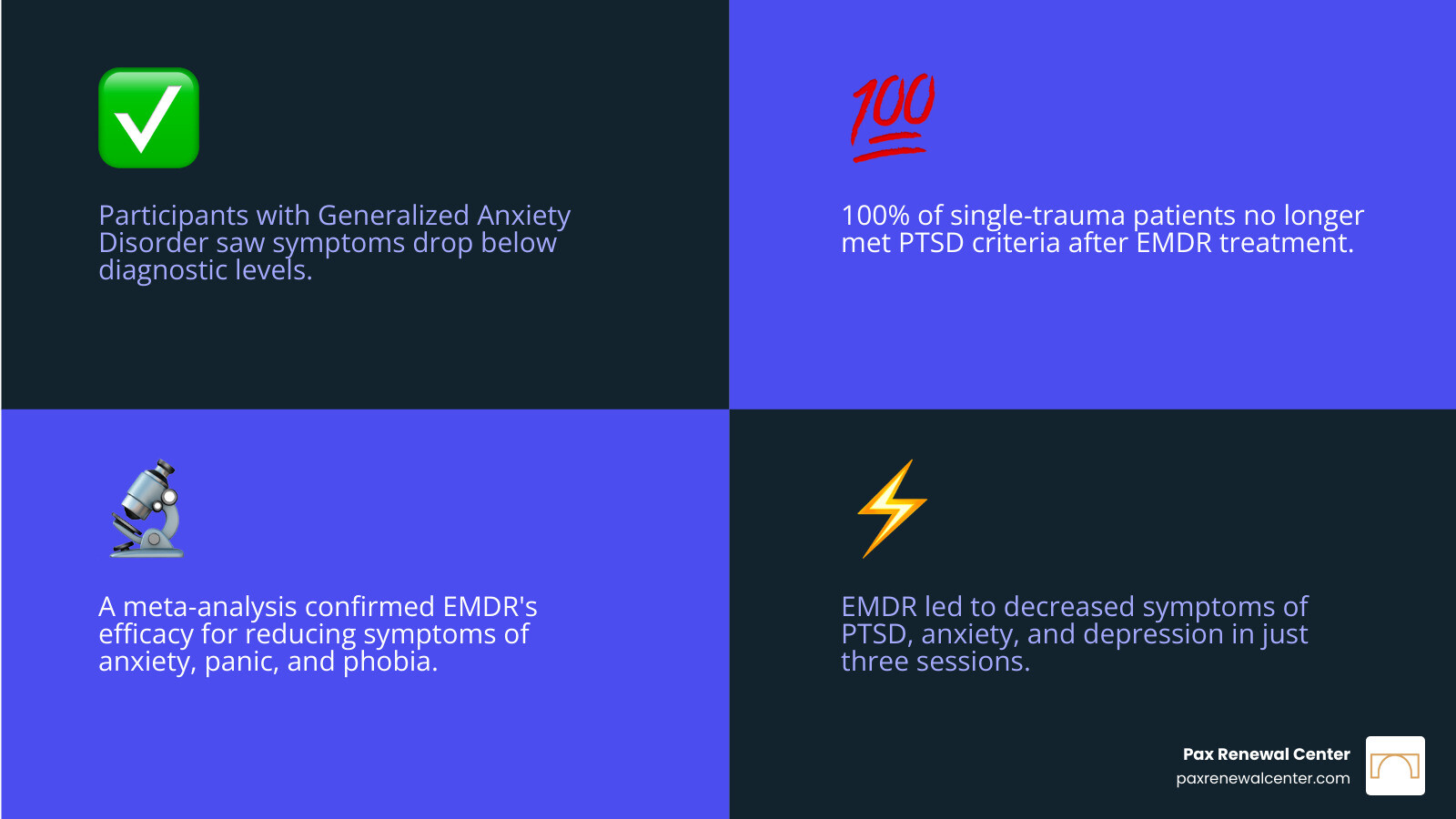
- A study on Generalized Anxiety Disorder (GAD) found that after EMDR treatment, participants’ anxiety symptoms dropped below the diagnostic level.
- A Kaiser Permanente study on PTSD (which is closely linked to anxiety) showed that 100% of participants with a single trauma no longer met PTSD criteria after EMDR. For those with repeated trauma, 77% achieved the same recovery.
- A comprehensive meta-analysis of EMDR for anxiety disorders concluded that EMDR effectively reduces symptoms of anxiety, panic, and phobia.
- Other research indicates that EMDR can lead to faster results, with participants showing decreased symptoms after just three sessions and requiring fewer medications and appointments afterward.
How EMDR Compares to Other Therapies
EMDR offers unique advantages compared to other approaches like Cognitive Behavioral Therapy (CBT) or traditional talk therapy.
- Different Focus: While CBT changes thought patterns, EMDR goes to the source by processing the distressing memories that fuel anxiety.
- No Detailed Retelling: You don’t have to talk extensively about painful experiences, which can feel re-traumatizing. The bilateral stimulation does much of the work internally.
- Less Homework: EMDR typically involves less traditional homework than therapies like CBT.
- Faster Change: Many people notice meaningful shifts and symptom reduction sooner than with other approaches.
Our Anxiety Counseling Complete Guide provides more information on different therapy options.
Key Differences: EMDR for Trauma vs. EMDR for Anxiety
While EMDR is well-known for treating “big T” trauma (accidents, abuse), its application for anxiety is broader.
When treating trauma, the focus is typically on a specific past event. Our Guide to Trauma Treatment explores this process.
EMDR for anxiety often targets more varied experiences:
- “Small t” traumas: Distressing life events like chronic criticism or humiliation that created negative core beliefs (“I’m not safe”).
- Future-oriented worries: We can reprocess the underlying beliefs that make future fears feel so real.
- Specific triggers: EMDR can reprocess triggers for public speaking, social gatherings, or driving, along with the negative beliefs connected to them (“I can’t cope”).
Therapists use specific protocols to identify what’s feeding your anxiety—whether past events, current triggers, or future fears—and help your brain develop a calmer response.
Benefits, Risks, and Finding the Right Support
EMDR therapy offers a form of holistic healing that recognizes the profound connection between your mind and body. Many of our clients at Pax Renewal Center move from feeling overwhelmed to experiencing genuine relief and a deeper sense of inner peace.

Potential Benefits of EMDR Therapy
EMDR for anxiety can create meaningful, lasting change by addressing the roots of your distress.
- Lasting relief: By targeting the underlying causes, improvements tend to stick.
- Reduced physical symptoms: Many people notice a decrease in somatic symptoms like muscle tension, racing heart, and stomach issues.
- Improved self-esteem: As you replace negative beliefs with positive ones, your confidence and sense of self-worth grow.
- Better emotional regulation: You develop a greater capacity to handle stressors with resilience and less overwhelm.
- Faster processing: Many clients experience quicker breakthroughs compared to other therapies.
- Less stressful processing: The bilateral stimulation helps you stay grounded while recalling distressing memories, making the work more manageable.
- Holistic healing and empowerment: This approach works with your mind, body, and emotions, shifting you from feeling like a victim of anxiety to an agent in your own healing.
These benefits complement other strategies for well-being, like those in our guide on 10 Simple Ways to Improve Your Mental Health Without Medication.
Are There Risks or Side Effects?
Like any effective therapy, EMDR can involve some temporary discomfort. These side effects are generally manageable with a trained therapist.
You might experience a temporary increase in distress, vivid dreams, or heightened emotions between sessions. This is a normal sign that your brain is processing the material. Occasionally, physical sensations or body memories may surface. This is why working with a qualified EMDR therapist is crucial. At Pax Renewal Center, we are trained to guide you with grounding techniques and ensure you leave each session feeling calm and stable.
EMDR isn’t right for everyone. If you are pregnant or have certain health conditions (like heart or eye problems), consult your doctor first. We always assess your readiness to ensure EMDR is appropriate for you.
Finding a Qualified EMDR Therapist
Choosing the right therapist is key to your healing. Look for someone with the right training, experience, and compassion.
- Certification: The gold standard is EMDRIA certification, which ensures a high level of expertise. You can search the EMDRIA directory.
- Experience: Find a therapist with specific experience treating anxiety and depression with EMDR.
- Rapport: The therapeutic relationship is vital. You need to feel safe and understood. Schedule consultations to find the right fit.
- Questions to Ask: Inquire about their training, approach to anxiety, and support between sessions.
At Pax Renewal Center in Lafayette, Louisiana, our EMDR-trained therapists combine clinical excellence with spiritual sensitivity, integrating evidence-based practices with Christian values. Our Faith-Based Therapy Guide explains how we weave spiritual guidance into the therapeutic process. Finding the right therapist is a personal decision, and we’re here to support you in that search.
Conclusion: Take the Next Step Towards Renewal
If anxiety or depression has been weighing you down, know that healing is possible. EMDR therapy offers an evidence-based path to addressing the root causes of your distress. By helping your brain reprocess painful memories and shift negative beliefs, EMDR for anxiety creates space for lasting peace and emotional resilience. You don’t have to just cope with anxiety; you can find freedom from it.
At Pax Renewal Center in Lafayette, Louisiana, our compassionate, faith-based therapists are extensively trained in EMDR for anxiety and other clinical best practices. We believe the God who created you also equipped your brain with an amazing capacity to heal, and EMDR helps activate that natural process.
We provide a safe, supportive space for the emotional healing, relational restoration, and spiritual renewal you’ve been longing for. You don’t have to do this alone. If you’re ready to break free from the cycle of anxiety, we invite you to take the next step.
Learn more about EMDR Therapy in Lafayette, LA, and begin your healing journey with us.
Your path to renewal starts here.