

Why Grief Support Matters in Lafayette
Grief counseling offers essential support when you’re navigating the loss of someone or something deeply important. Whether you’ve lost a loved one, experienced a divorce, or faced another significant life change, professional grief support can help you process your emotions and find a path forward.
Quick Guide to Grief Counseling in Lafayette, LA:
-
Free Community Resources: Local non-profits in the Acadiana area offer free bereavement services, including individual counseling, support groups, and workshops.
-
Children’s Grief Support: Specialized, free programs are available for grieving children and their caregivers, often using play therapy and peer support.
-
Faith-Based Counseling: Many local practices, including Pax Renewal Center, offer Christian-integrated grief counseling for individuals, couples, and families.
-
Private Practice Options: Licensed counselors throughout Lafayette specialize in grief therapy using proven approaches like CBT, EMDR, and trauma-informed care.
-
Flexible Formats: Services are available in-person, via telehealth, and through support groups to fit your comfort level and schedule.
Grief is a universal, yet deeply personal experience. The loss might be a death, a relationship ending, a job loss, or a serious illness diagnosis. Whatever the cause, the pain is real, and you don’t have to face it alone. Lafayette offers a rich network of grief support services, from free community resources to private practice therapists who specialize in loss and bereavement.
Understanding Grief: What It Is and How It Feels
Grief is your heart’s natural response to loss. It’s not a weakness or something to “get over quickly.” It’s a full-body, full-mind experience that can leave you feeling like a stranger to yourself.
While we often associate grief with the death of a loved one, it can arise from many other experiences: the end of a marriage, the loss of a job, a serious health diagnosis, a child leaving home, or even the death of a beloved pet. Any significant loss can trigger a grief response.
Physically, you might find yourself crying unexpectedly, feeling exhausted, or experiencing headaches and changes in appetite or sleep. Emotionally, grief is a storm of sadness, yearning, anger, and guilt. Socially, it can be isolating, as you may withdraw from others because you lack the energy to explain how you feel.
Grief vs. Depression
Grief and depression can look similar, but there are key differences. Grief is always tied to a specific loss and tends to come in waves, allowing for moments of joy or happy memories. Depression is often a more constant, pervasive sadness that can arise without a clear trigger and diminishes your capacity to feel any pleasure.
Grief doesn’t usually attack your overall self-worth, though you might feel guilty about specifics related to the loss. Depression, however, often brings pervasive feelings of worthlessness and hopelessness. While grief symptoms tend to soften over time, depression can persist for weeks or months without improvement.
| Symptom Category | Grief | Clinical Depression |
|---|---|---|
| Trigger | Always follows a specific, identifiable loss. | May or may not be tied to a specific event. |
| Mood | Sadness, yearning, anger, guilt, often comes in waves; capacity for joy/humor remains. | Persistent low mood, pervasive sadness, anhedonia (loss of pleasure). |
| Self-Esteem | Typically preserved, though may feel guilt related to the loss. | Feelings of worthlessness, self-blame, hopelessness. |
| Duration | Intense in early stages, gradually lessens over time; may be reactivated. | Sustained, persistent low mood for weeks or months, often without fluctuation. |
| Thoughts | Preoccupation with the deceased/loss, memories. | Negative thoughts about self, world, future; suicidal ideation more common. |
| Functioning | May struggle with daily tasks but often maintains some function. | Significant impairment in daily functioning, difficulty initiating tasks. |
The Personal Journey of Grieving
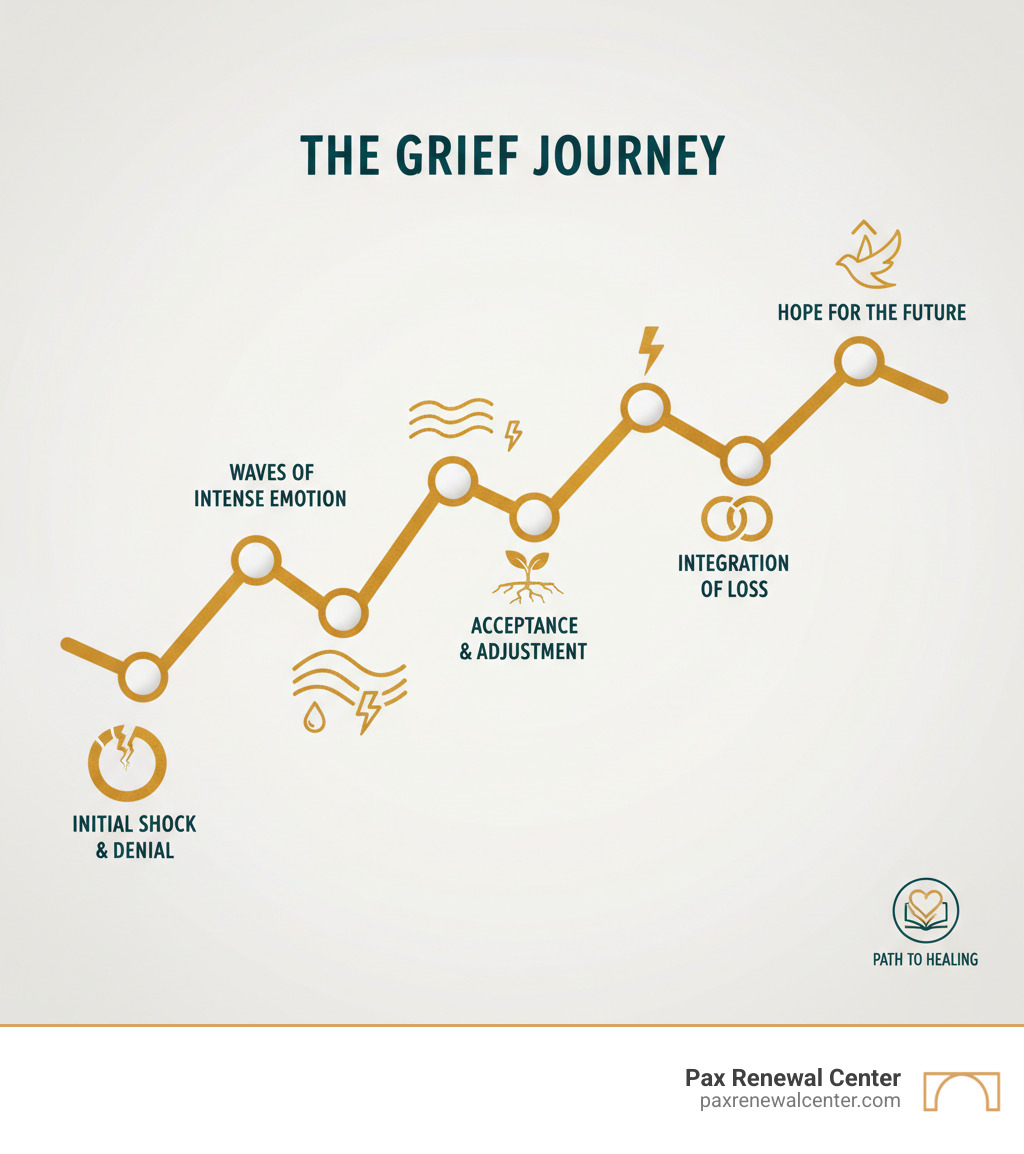
You’ve likely heard of the “stages of grief,” but grieving isn’t a neat, linear process. Your journey is uniquely yours. You might cycle through emotions, skip some “stages” entirely, or revisit feelings you thought you’d worked through. All of this is normal.
People often ask, “How long will this last?” The acute phase of grief, that raw, all-consuming pain, typically lasts for weeks to months. Over time, you learn to live with the loss. The pain doesn’t vanish; it becomes part of your story. You don’t “get over” someone you loved; instead, you find a way to carry them with you while still living your life. This journey of integration takes time, patience, and often, support.
When grief feels stuck or is complicated by trauma, professional support can make all the difference. Our approach to trauma treatment addresses these deeper wounds with both clinical expertise and compassionate care.
The Role of Grief Counseling in the Healing Process
When loss enters our lives, the pain can be so overwhelming that we don’t know how to move forward. This is where grief counseling can make a profound difference.
Grief counseling is specialized therapy designed to walk with you through the complex landscape of loss. The goal isn’t to erase your pain or rush you past your feelings. Instead, counseling creates a safe, non-judgmental space where you can be honest about your experience. In this protected environment, we help you process your emotions and develop healthy ways to carry your grief forward.
Counseling helps by validating your experience, affirming that your feelings make sense. We also provide practical coping tools to manage overwhelming emotions and the physical symptoms of grief. Most importantly, we offer a neutral space to express feelings that may be too raw or complicated to share with friends and family. A professional can also help distinguish between grief and depression, guiding you to the right interventions if needed.
Signs You Might Need Support
While many people steer through grief without professional help, seeking support is a sign of strength. Consider reaching out if you’re experiencing:
- Difficulty with daily functioning: Struggling to work, care for your family, or manage basic responsibilities for weeks on end.
- Prolonged and intense emotions: Feeling stuck in deep despair, anger, or guilt that doesn’t ease over time.
- Avoidance or preoccupation: Either avoiding anything that reminds you of the loss or being unable to stop reliving it.
- Destructive behaviors: Turning to alcohol, drugs, or other unhealthy habits to numb the pain.
- Thoughts of self-harm: If you have these thoughts, please seek immediate help. This is a crucial sign that professional intervention is needed.
The duration of grief therapy varies. For many, it might last around six months, but it can be shorter or longer depending on your unique needs. We walk alongside you for as long as you need us. You can learn more about our general approach on our About page.
Therapeutic Approaches for Grief and Loss
At Pax Renewal Center, we craft personalized treatment plans that meet you where you are. We integrate clinical best practices with spiritual guidance, drawing from various therapeutic methods proven to be effective for grief.
- Cognitive Behavioral Therapy (CBT) helps identify and reframe negative thought patterns, such as self-blame, that can prolong pain.
- Acceptance and Commitment Therapy (ACT) teaches you to accept difficult emotions while committing to actions that align with your values, helping you live meaningfully with loss.
- Art therapy for grief provides a creative outlet for expressing emotions that are too deep for words.
- Trauma-Informed Care is essential when a loss is sudden or violent. We use techniques like EMDR to process traumatic memories and reduce their intensity. We specialize in Trauma Treatment and can guide you through this complex journey.
- Faith-Based Approaches integrate spiritual guidance with clinical excellence. We create a space to explore spiritual questions, find solace in faith, and rebuild hope, as detailed in our Faith-Based Therapy Guide.
Our goal is to help you develop healthier ways of carrying your grief, rebuild trust, and find a hopeful path forward.
Finding Grief Counseling in Lafayette: A Directory of Hope

When you’re navigating the pain of loss, finding help can feel overwhelming. The good news is that Lafayette and the Acadiana area have a compassionate community ready to support you. Options for grief counseling exist to meet you where you are, whether you prefer in-person sessions, convenient online telehealth, or the shared understanding of group settings.
Free and Community-Based Bereavement Services
If finances are a concern, Lafayette has remarkable organizations offering free grief support. No one should have to grieve alone because they can’t afford help.
Several local non-profits provide completely free bereavement services to residents in the Acadiana area. These services often include individual counseling with trained professionals, support groups led by licensed counselors, and educational workshops on loss and healing. They are typically available to anyone in the community who has experienced a loss.
For children who are grieving, there are specialized local programs and day camps that use play therapy, art activities, and peer support to help kids express their feelings. These child-focused services provide gentle, age-appropriate ways for children to honor what they’ve lost and feel understood.
Many of these community organizations also offer creative therapies and social connection programs to combat the isolation of grief. For those who find comfort in faith, many local churches and religious organizations also provide parish support groups, grief retreats, and other resources. These community services embody the heart of Lafayette: neighbors caring for neighbors.
Finding a Private Practice for Grief Counseling in Lafayette

Sometimes you need personalized, ongoing support that addresses your specific situation. That’s where private practice grief counseling comes in. Finding the right therapist is a personal decision, and it’s important to find a good fit.
When considering a therapist, ask about their experience with grief, the therapeutic approaches they use, and the session formats they offer. A good therapist will respect that there’s no “right” way to grieve and won’t rush you. If faith is important to you, ask if they can integrate spirituality into your sessions.
At Pax Renewal Center, we offer this kind of personalized, faith-integrated support. Our qualified therapists specialize in walking with individuals, couples, and families through profound loss. We integrate proven clinical approaches like EMDR and CBT with spiritual guidance rooted in Catholic and Christian values. We honor your whole self—mind, body, and spirit—as you heal in a safe, welcoming space.
If you’re drawn to Christian-integrated support, our Christian Counseling Lafayette LA Guide offers more information about how we weave faith and clinical excellence together.
Frequently Asked Questions about Grief Support
When you’re navigating grief, questions naturally arise. We hear these concerns regularly from those seeking grief counseling, and we want to offer honest, compassionate answers.
How long does grief last?
There is no set timeline for grief. The acute phase, when pain is most intense, often lasts for weeks to several months. During this time, it’s normal to struggle with daily life. Over time, the pain doesn’t disappear, but it does transform. You learn to carry the loss as part of your story, rather than it controlling your life.
Eventually, you will feel like yourself again—a changed version, shaped by both the love you experienced and the loss you’ve endured. You’ll find moments of joy, laugh without guilt, and make plans for the future. This integration process is deeply personal and unfolds at its own pace.
For more insight, we encourage you to explore our resources on Finding Hope and Healing: A Guide to Trauma Treatment.
What is the difference between grief and complicated grief?
Most people experience normal grief, where intense symptoms gradually decrease over time as they adapt to the loss. Complicated grief (or prolonged grief disorder) is different. It occurs when you feel stuck in intense grief for many months or even years, unable to move forward. The pain remains as raw as it was in the early days.
Signs of complicated grief include persistent, intense yearning for what was lost, an inability to accept the reality of the loss, and feeling that life is meaningless. You may find yourself avoiding all reminders of the loss or becoming excessively preoccupied with them. Feeling frozen and unable to re-engage with life is the hallmark of complicated grief. This isn’t a sign of weakness; it’s a signal that your grief needs specialized attention.
Complicated grief often benefits from trauma-informed therapy. If this description resonates with you, we strongly encourage you to reach out. Our specialized Trauma Treatment approaches can help you find a path forward.
Can grief counseling help with losses other than death?
Yes, absolutely. Grief is a reaction to any significant loss, and counseling can help you steer through any major life transition causing you distress. Many people suffer in silence, thinking their loss “doesn’t count,” but your pain is valid.
Counseling can help with the grief that follows:
- Relationship endings, such as a divorce, breakup, or loss of a friendship.
- Job loss can shake your sense of identity and routine.
- Loss of health or independence due to chronic illness, disability, or aging.
- Pet loss can be as painful as losing a human family member.
- Major life transitions, like moving, children leaving home, or financial changes.
Grief counseling provides tools and support for any of these losses. If a loss is impacting your well-being, you don’t have to face it alone.
Your Path to Healing Starts Here

You’ve walked through this guide, and we hope you see that you don’t have to face grief alone. Whether you’re dealing with a death, the end of a marriage, or another significant life change, your pain is real and deserves attention.
Lafayette is blessed with a caring community that offers genuine support. From free resources offered by local non-profits to specialized children’s programs and faith-based guidance, our community wraps its arms around those who are hurting.
Asking for help takes tremendous courage. It means choosing to believe that healing is possible, even when the pain feels permanent. That’s not weakness, that’s strength.
At Pax Renewal Center, we understand that faith can be a powerful source of comfort during loss. Our approach honors both the clinical side of healing and the spiritual journey of grief. We integrate proven therapeutic methods with spiritual guidance rooted in Catholic and Christian values. Whether you’re struggling with complicated grief, navigating trauma, or simply need someone to walk beside you, our experienced and compassionate team is here.
Your grief is unique, and your path to healing will be too. We’ll meet you exactly where you are and help you find your way forward, one step at a time.
If you’re ready to take that courageous first step, we invite you to explore our services. Begin your journey with our Grief Counseling Lafayette Complete Guide, where you’ll find comprehensive information about getting started with grief support that honors both your emotional needs and your faith.
You deserve peace, healing, and hope. We’re here to help you get there.