When Grief Feels Isolating: How to Find a Support Group Near You
Finding a grief support group near me is one of the most powerful steps you can take after losing someone you love. You don’t have to navigate loss alone — and in most areas, help is closer than you think.
Here are the fastest ways to find a grief support group near you:
- Visit griefshare.org — search by zip code for weekly in-person or online groups
- Call 2-1-1 — a free helpline that connects you to local grief and mental health resources
- Contact your local hospice — most offer free bereavement groups open to the community
- Search Psychology Today — find clinician-facilitated grief groups in your area
- Ask your church or faith community — many sponsor structured programs like GriefShare
- Check with The Compassionate Friends — over 600 chapters across the U.S. for those who’ve lost a child
Grief is not a neat, orderly process. It shows up physically, emotionally, and behaviorally — often in ways that feel overwhelming and disorienting. Whether you lost a spouse, a parent, a child, or a close friend, the pain is real. And research consistently shows that walking alongside others who understand that pain accelerates healing in ways that going it alone simply cannot.
Over one million people have found hope through structured grief support programs. Many groups are free, meet weekly, and welcome newcomers at any point.
I’m Dan Jurek, M.A., LPC-S, LMFT-S, founder and clinical director of Pax Renewal Center in Lafayette, Louisiana, with over 35 years of clinical experience supporting individuals and families through grief, trauma, and life transitions. In this guide, I’ll walk you through exactly how to find the right grief support group near me — whether you’re in Acadiana, elsewhere in Louisiana, or searching for a virtual option that fits your life.
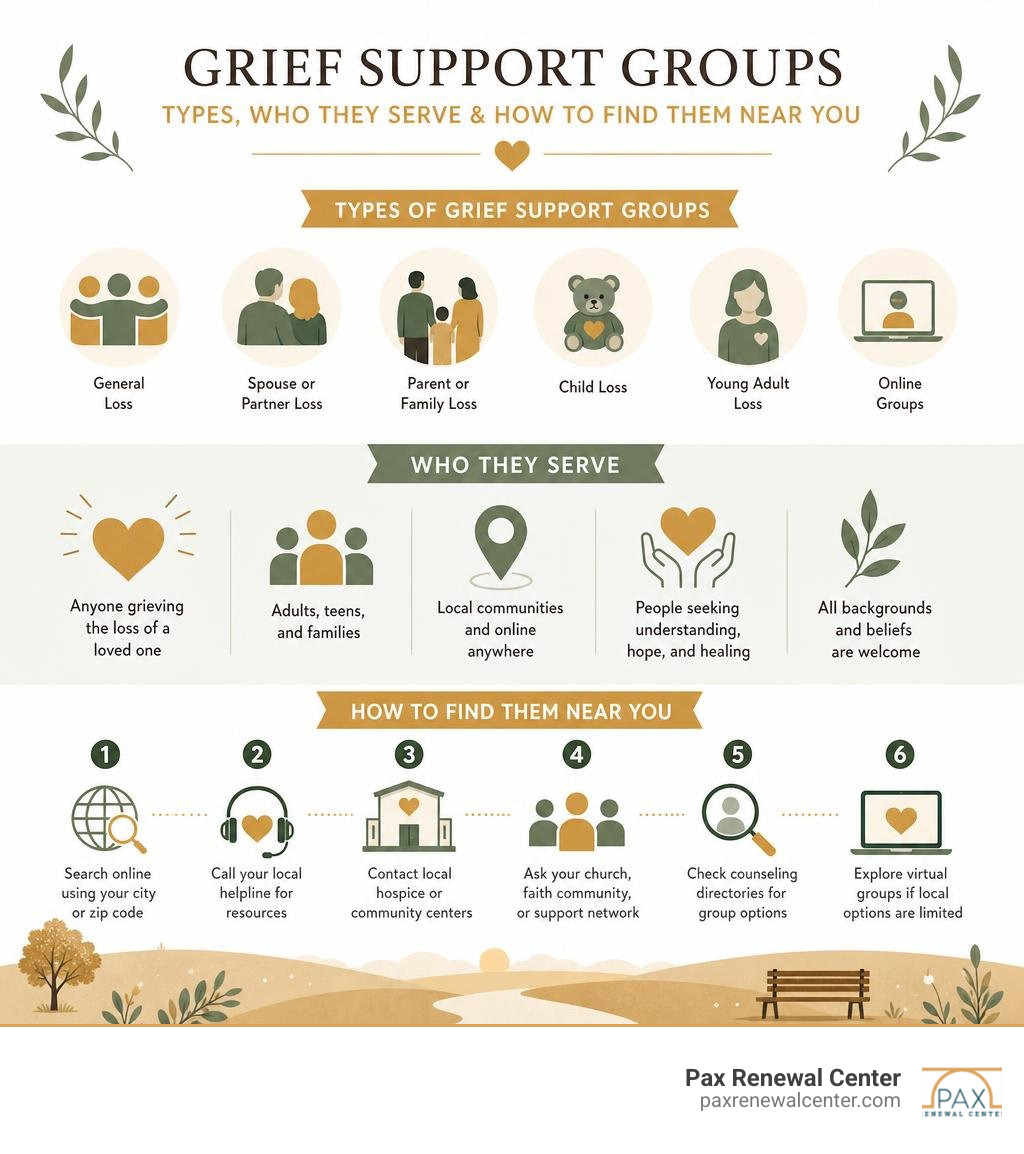
Grief support group near me basics:
Understanding the Types of Grief Support Groups Available
Grief is highly personal, but it is also diverse. While a general loss group can provide immense comfort, many people find that joining a specialized group tailored to their specific type of loss helps them feel more deeply understood. When we sit in a room with individuals who have walked a similar path, we don’t have to spend energy explaining the unique nuances of our pain.
Common types of grief support groups include:
- General Loss Groups: These are open to anyone who has lost a loved one, whether a parent, sibling, grandparent, or friend. They focus on the universal aspects of the grieving process, such as navigating loneliness, managing anger, and finding hope.
- Spouse and Partner Loss Groups: Losing a spouse means losing your daily companion, your co-planner, and often a primary source of identity. These groups address the daily logistics of rebuilding a life solo, managing secondary losses, and navigating deep loneliness. If you are experiencing this unique pain, you can learn more about how to navigate life after loss with a spouse grief support group.
- Perinatal and Infant Loss Groups: These groups support parents who have experienced miscarriage, stillbirth, or the loss of an infant.
- Child Loss Groups: Designed for parents who have lost a child of any age, these spaces acknowledge the devastating, out-of-order nature of parental bereavement.
Specialized Support for Traumatic and Suicide Loss
Some losses carry a heavy burden of trauma, suddenness, or social stigma. Survivors of suicide loss and those who have lost loved ones to traumatic events (such as accidents or sudden violence) often struggle with complex bereavement.
In these specialized groups, the focus is not only on processing sadness but also on working through “what ifs,” feelings of guilt, anger, and the trauma of the event itself. These groups provide a highly secure, non-judgmental environment where survivors can speak openly about things they might feel uncomfortable sharing in a general grief group.
Finding a Specialized Grief Support Group Near Me for Perinatal and Child Loss
The loss of a child or an unborn baby is a profound grief that alters a family’s trajectory forever. Peer-based support in this area is incredibly healing. Parents can share their raw emotions, honor their children’s memories, and find a community that understands the unique, enduring nature of this grief.
These specialized groups help parents transition from the initial shock of loss toward a long-term healing journey, showing them that while the pain may never completely disappear, it is possible to carry it with strength and eventually rediscover moments of joy.
How to Find a Grief Support Group Near Me
When you are in the depths of grief, even a simple internet search can feel like climbing a mountain. Knowing exactly where to look can save you time and energy.
To find local and virtual meetings, we recommend starting with established directories and national networks. The most reliable resources include:
- GriefShare: A worldwide network of thousands of weekly, faith-based groups meeting both in-person and online.
- The Compassionate Friends: A national organization offering peer support for families grieving the death of a child, sibling, or grandchild.
- National Alliance on Mental Illness (NAMI): Local affiliates across the country often host free mental health and grief support groups.
- Psychology Today: An excellent directory where you can filter local search results specifically for “Support Groups” led by licensed clinicians.
If you find that peer support groups aren’t quite enough, or if you prefer a more customized approach to your healing, you can also search for licensed grief therapists near me to work one-on-one with a professional.
Utilizing Local Hospices and Community Centers
You do not need to have used a specific hospice’s services for your loved one to access their bereavement programs. Most local hospices are funded to provide free or low-cost grief support groups, workshops, and counseling to the entire community.
Hospice-led groups are typically facilitated by trained grief counselors or licensed social workers, making them an excellent middle ground between peer-led support and formal clinical therapy. Community centers, local health departments, and public libraries also frequently host community-based grief programs.
Faith-Based and Church-Sponsored Grief Support
For many individuals, grief is not just an emotional challenge; it is a spiritual one. Faith-based support groups integrate biblical principles, prayer, and spiritual guidance into the healing process.
Programs like GriefShare, which are hosted by local churches, are nondenominational but biblically based. They provide a structured, 13-week curriculum that addresses both the psychological and spiritual aspects of loss. Integrating your faith into your grief journey can offer a profound sense of comfort, anchoring your healing in eternal hope. To explore this approach further, read about finding comfort in faith-based grief therapy and spiritual guidance.
What to Expect at Your First Grief Support Meeting
It is completely normal to feel a wave of anxiety before walking into your first meeting. You might wonder: Will I be forced to speak? Will I just cry the whole time? What if my grief is too heavy for the room?
Knowing what to expect can help ease those fears and prepare you to take that first step.

When you walk in, you will find a safe, non-judgmental environment. Most groups are set up in a casual circle. There is absolutely no pressure to share your story on day one. You are entirely welcome to sit, listen, and simply absorb the comfort of being around others who “get it.”
Group Size, Confidentiality, and Meeting Formats
To ensure everyone has an opportunity to share and feels safe doing so, most effective grief support groups limit their size to about 6 to 12 participants.
Confidentiality is the golden rule of any reputable support group: what is shared in the room stays in the room.
Meetings generally follow one of two formats:
- Open Groups: These function as drop-in sessions. New members can join at any time, and the weekly topics are usually self-contained.
- Closed Groups: These require pre-registration and run for a set number of weeks (such as 6, 8, or 13 weeks) with the same group of people. This format fosters deep trust and consistent relationships.
Cost and Accessibility of Peer-Based Support
One of the greatest benefits of peer-based grief support groups is that they are highly accessible. Many community, hospice, and church-sponsored groups are offered entirely free of charge.
For structured programs like GriefShare, there may be a nominal fee to cover the cost of the participant guide or workbook, though scholarships are often available for those who need them. Peer support is designed to be low-barrier, ensuring that financial constraints never stand in the way of emotional healing.
Comparing In-Person vs. Virtual Grief Support Groups
With the rise of virtual platforms, you now have the option to attend meetings from the comfort of your own home. Both formats offer distinct advantages, and the right choice depends on your personality, lifestyle, and emotional needs.
We can compare these two options to help you decide:
| Feature | In-Person Support Groups | Virtual/Online Support Groups |
|---|---|---|
| Physical Presence | Deep sense of physical connection; shared quiet moments; comforting body language. | Convenient; no commute; participate from your safest space (your home). |
| Geographic Flexibility | Limited to your local area. | Access to specialized groups nationwide or globally. |
| Anonymity Level | Face-to-face interaction with local community members. | Higher degree of initial privacy; option to turn off your camera if overwhelmed. |
| Scheduling | Set times; requires travel and prep time. | Highly flexible; easier to fit into a busy working schedule. |
To visualize how these two pathways lead to the same goal of healing, consider the following journey map:
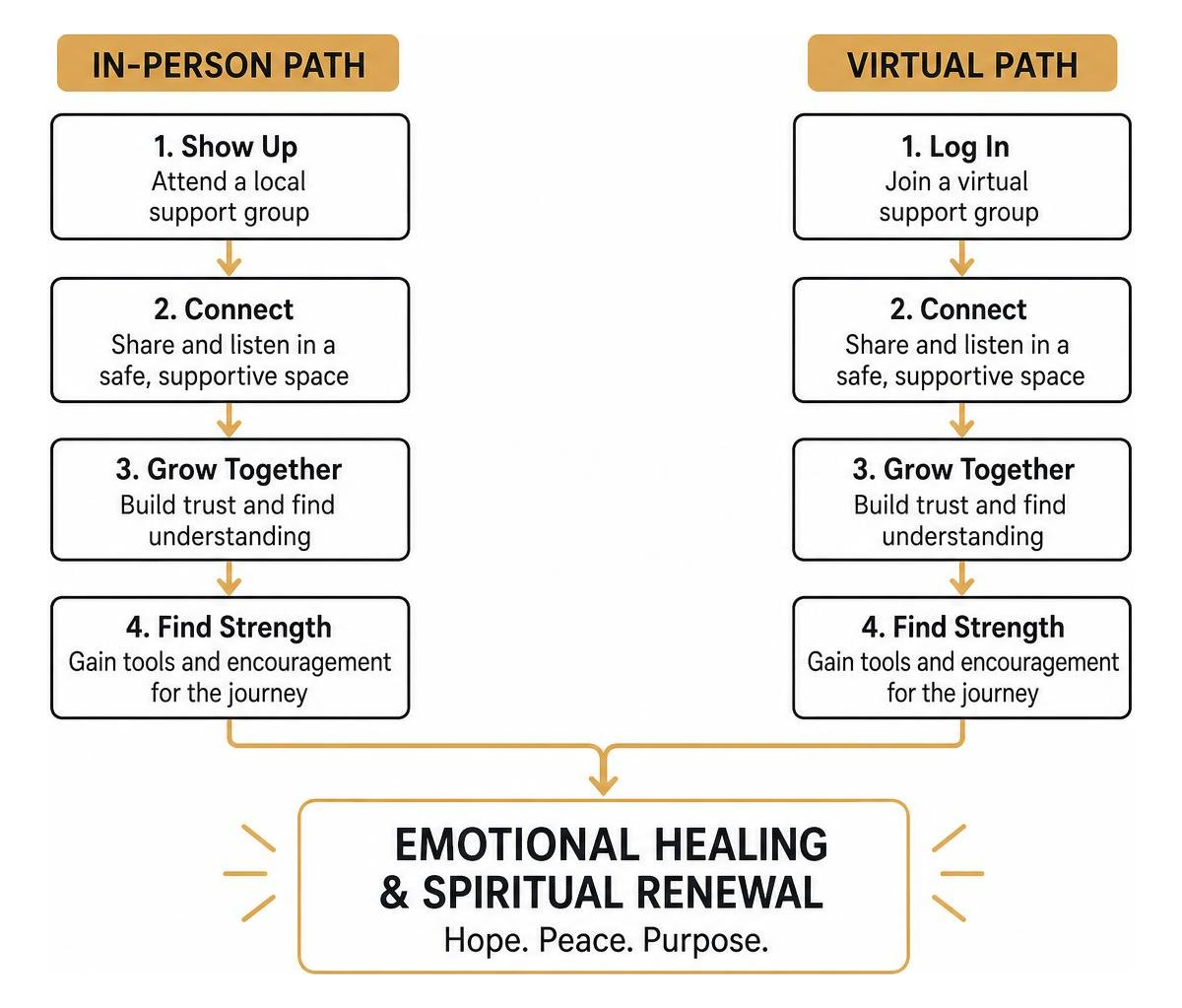
At Pax Renewal Center, we recognize the value of both models. While we provide deeply personal, in-person counseling in Lafayette, Louisiana, we also understand the need for flexible, accessible support. That is why we offer online community spaces, such as our interactive platform on Skool, allowing individuals to connect, heal, and grow regardless of their physical location.
Age-Specific Grief Programs and Additional Healing Resources
Grief does not look the same at age 8 as it does at age 48. Children, teenagers, and adults process loss through entirely different developmental lenses. Recognizing these differences is vital for family-wide healing.

When a family experiences a loss, children and teens are sometimes overlooked because they may “mask” their grief through play, withdrawal, or behavioral changes. Providing age-appropriate care ensures that younger family members learn healthy coping mechanisms early on.
If your family is navigating the aftermath of a traumatic loss, you can read more about finding peace after pain with Christian trauma support groups.
Support Programs for Grieving Children and Teens
Children process grief in “puddles” — they may cry for a few minutes and then immediately want to go play. Teenagers, on the other hand, often experience intense, volatile emotions and may pull away from family members, preferring to process their pain with peers.
Specialized youth grief programs utilize play therapy, creative arts, and peer-to-peer activities to help kids and teens express their emotions safely. These programs help children realize they are not the only ones in their school or community who have lost a parent, sibling, or caregiver.
Integrating One-on-One Therapy with a Grief Support Group Near Me
While peer-based support groups are incredibly valuable for community and validation, they are not a replacement for professional, clinical therapy. Many individuals find the greatest healing by combining both.
In a support group, you receive peer empathy and shared wisdom. In one-on-one clinical therapy, a licensed therapist can help you address deep-seated trauma, depression, or anxiety using evidence-based clinical modalities:
- EMDR (Eye Movement Desensitization and Reprocessing): Highly effective for processing the traumatic memories associated with sudden or violent loss.
- CBT (Cognitive Behavioral Therapy): Helps you identify and reframe negative thought patterns, guilt, and overwhelming anxiety related to grief.
- EFT (Emotionally Focused Therapy): Helps individuals and couples process deep relational wounds and rebuild secure emotional bonds after a shared loss.
Regional Directories and Local Grief Support Options
If you are looking for local support groups, utilizing regional directories is a highly effective way to find active, trusted meetings nearby.
For those located in Louisiana, we have compiled a targeted list of regional resources to help you find the right local fit. If you are starting your search in our area, a great place to begin is our comprehensive grief counseling Lafayette LA guide.
Finding Local Support in Louisiana
If you are in Lafayette, the Acadiana region, or surrounding areas like Baton Rouge, there are several highly respected local organizations and directories available to help you navigate your loss:
- Lafayette GriefShare Groups: You can easily find active, weekly church-sponsored groups in our area by visiting the Lafayette, Louisiana GriefShare Groups – Grief Recovery Support directory.
- The Center for Loss and Transition: Offered by the Hospice of Acadiana, this center provides exceptional community bereavement services, including workshops and support groups. Learn more by visiting The Center for Loss and Transition | Hospice of Acadiana .
- Diocese of Lafayette Grief Resources: For those seeking Catholic-aligned support, the diocese offers excellent spiritual and emotional resources. Explore their programs at Grief Resources | Roman Catholic Diocese of Lafayette, Louisiana .
- Baton Rouge Healing Hearts: A dedicated local support group focused on peer-based healing. You can find their meeting details through the Healing Hearts Grief Support Group | Baton Rouge page.
- The Retreat at Quarters Lake: Located in Baton Rouge, this center offers professional, structured support groups for various life challenges. Find out more at Support Groups – The Retreat at Quarters Lake .
Frequently Asked Questions about Grief Support Groups
How much does it cost to attend a grief support group?
Many community-based, hospice, and peer-led grief support groups are offered entirely free of charge. For structured programs like GriefShare, there is typically a very low-cost, nominal fee to cover the workbook or participant guide. Financial assistance or scholarships are almost always available through the hosting organization or church so that cost is never a barrier to receiving help.
Can I join a grief support group at any time?
Yes, if it is an “open” or “drop-in” group. These groups are designed so that you can attend whenever you feel the need. For “closed” or highly structured groups (like a 13-week GriefShare cycle), it is often best to register near the start of a cycle, though many groups still warmly welcome new members to jump in at any point during the program.
What is the difference between a support group and individual therapy?
A support group is focused on peer connection, shared experiences, and mutual encouragement. It is usually led by a trained volunteer or peer facilitator. Individual therapy is a one-on-one clinical relationship with a licensed professional therapist. Therapy is designed to treat specific mental health conditions, address deep psychological trauma using clinical modalities like EMDR or CBT, and provide highly customized coping strategies tailored specifically to your life.
Conclusion
Grief can make you feel entirely isolated, but you do not have to carry this heavy burden alone. Finding a grief support group near me can connect you with a community of individuals who truly understand your pain, offering a safe space to process your loss, honor your loved one, and gradually rebuild your life.
At Pax Renewal Center in Lafayette, Louisiana, our mission is to walk alongside you on this sacred journey of healing. Led by Dan Jurek and our team of highly qualified, faith-based therapists, we specialize in integrating clinical best practices — such as EMDR, CBT, and Gottman Method couples therapy — with spiritual guidance rooted in Catholic and Christian values.
Whether you are looking for local, in-person counseling in Acadiana, specialized trauma therapy, or virtual support through our online couples and individual programs, we are here to help you experience emotional healing, relational restoration, and spiritual renewal.
To learn more about navigating your grief journey with professional support, read our grief counseling Lafayette complete guide. When you are ready to take the next step toward hope and healing, we invite you to explore our professional services at Pax Renewal Center Services.