

Why Gottman Method Therapy Transforms Struggling Relationships
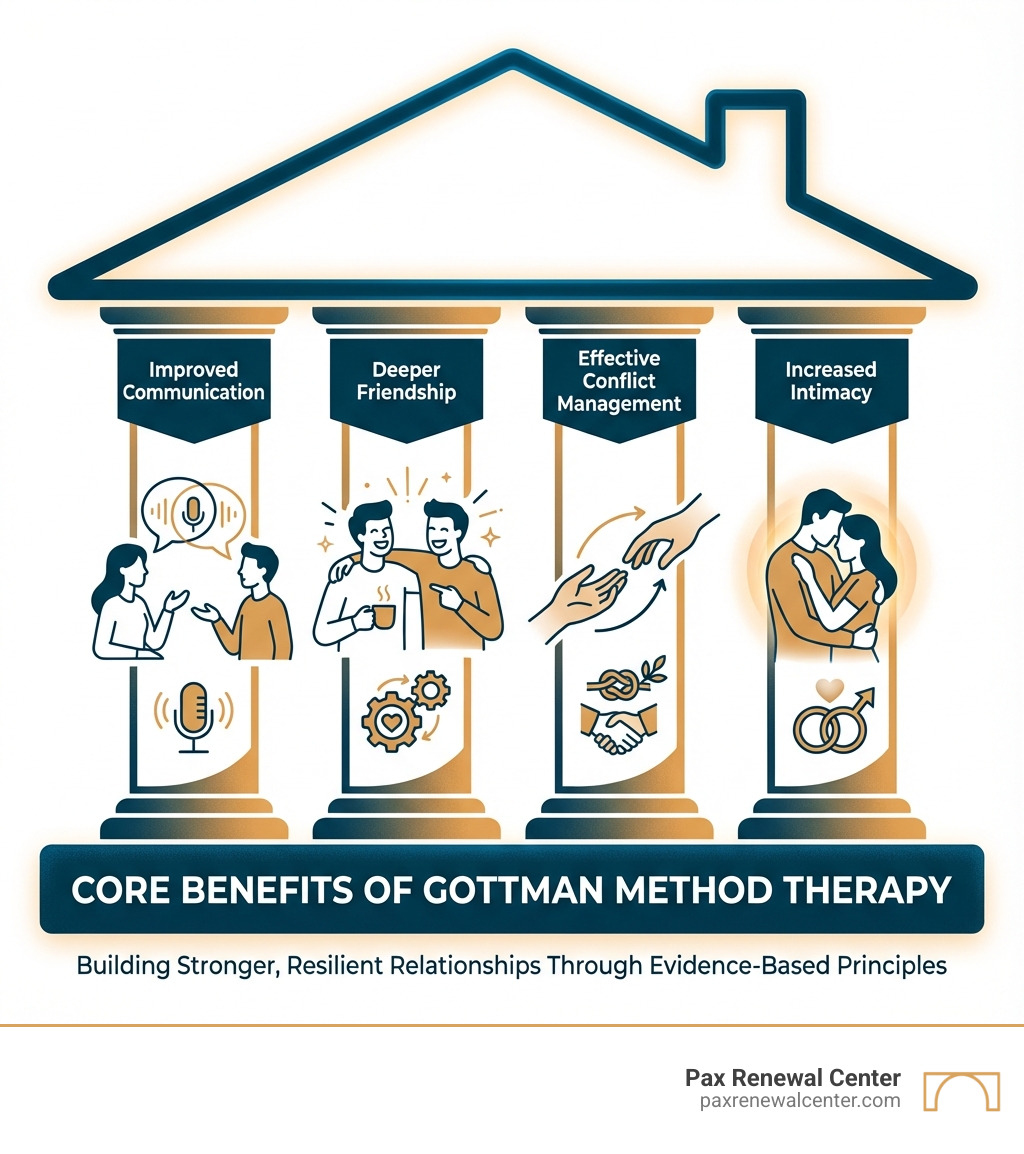
Gottman Method Therapy is a research-based approach to couples counseling that helps partners improve communication, manage conflict, and rebuild emotional connection. Developed by Drs. John and Julie Gottman after 40+ years of studying thousands of couples, this method provides practical, proven tools to strengthen relationships at any stage.
Quick Answer: What Is Gottman Method Therapy?
- Foundation: Built on 50 years of scientific research with over 3,000 couples
- Core Focus: Friendship, conflict management, and shared meaning in relationships
- Key Framework: The Sound Relationship House Theory with nine essential components
- Effectiveness: 94% accuracy in predicting relationship outcomes based on communication patterns
- Who It Helps: All couples—married, engaged, same-sex, or dating—at any relationship stage
- Common Issues Addressed: Communication breakdowns, infidelity recovery, emotional distance, parenting conflicts, financial stress
Maybe you’ve been fighting with your spouse about the same issues for years. Or perhaps you feel like roommates instead of romantic partners. You might be recovering from a betrayal, struggling to reconnect after having kids, or simply wanting to build a stronger foundation before marriage.
The Gottman Method doesn’t just tell you what’s wrong—it shows you how to fix it.
Unlike traditional talk therapy that focuses on the past, this approach gives you specific skills you can use immediately. You’ll learn to recognize destructive patterns (like criticism and defensiveness), replace them with healthy habits, and create lasting positive change. The research is clear: couples who maintain at least five positive interactions for every negative one during conflict stay together and stay happy.
What makes this method particularly powerful is its foundation in real science. Dr. John Gottman spent decades in his “Love Lab” observing couples in action, measuring everything from heart rates to facial expressions to conversational patterns. He finded he could predict divorce with remarkable accuracy just by watching how couples communicate. But more importantly, he identified exactly what happy, stable couples do differently—and created a roadmap anyone can follow.
The Gottman Method addresses both the symptoms (the fights, the silence, the hurt feelings) and the root causes (unmet emotional needs, poor conflict skills, eroded friendship). Whether you’re in crisis or just want to strengthen an already good relationship, these principles work.
I’m Dan Jurek, M.A., LPC-S, LMFT-S, founder and clinical director of Pax Renewal Center in Lafayette, Louisiana, where I’ve spent over 35 years helping couples rebuild connection using evidence-based approaches including Gottman Method Therapy integrated with faith-based counseling. As one of the few therapists in Louisiana certified in Discernment Counseling and trained in Gottman Method Therapy, I’ve witnessed how these practical, research-backed tools transform even the most distressed relationships when couples commit to the process.
The Science and Founders Behind the Gottman Method
At Pax Renewal Center, we believe in approaches grounded in solid evidence, and the Gottman Method stands out as one of the most rigorously researched couples therapies in the world. Its origins trace back to the groundbreaking work of Drs. John and Julie Gottman. Dr. John Gottman, an American psychological researcher and clinician, dedicated over 40 years to studying what makes relationships thrive or fail. Alongside his partner, Dr. Julie Gottman, a clinical psychologist, researcher, speaker, and author, they co-founded The Gottman Institute.
Their extensive research, often conducted in what became known as the “Love Lab,” involved observing thousands of couples over decades. They carefully recorded interactions, physiological responses, and communication patterns. These studies revealed startling insights into relationship dynamics, allowing Dr. John Gottman to predict a couple’s likelihood of divorce with an astounding 94% accuracy after just a few minutes of observation. This remarkable ability even earned him a profile in Malcolm Gladwell’s bestseller Blink.
The Gottman Method Therapy is the practical application of this half-century of research. It’s not just a set of theories; it’s a comprehensive approach that transforms scientific findings on marital stability and divorce prediction into actionable strategies for couples. Our goal at Pax Renewal Center is to help you apply these insights to your relationship, fostering deeper understanding and lasting connection. You can learn more about their incredible journey and contributions to relationship science by visiting Scientific research on marital stability.
The Sound Relationship House: A Blueprint for Success
The cornerstone of the Gottman Method is the “Sound Relationship House Theory.” This metaphor provides a clear, structured framework for understanding the essential components of a healthy, stable, and fulfilling relationship. Imagine a house with seven floors built upon two weight-bearing walls—each element is crucial for a strong foundation and a thriving connection.
Let’s explore each component:
- Build Love Maps: This is the first floor, and it’s all about knowing your partner’s inner world. How well do you know their hopes, dreams, worries, preferences, and history? Strong relationships are built on constantly updating these “maps” of each other’s psychological landscape.
- Share Fondness & Admiration: The second floor focuses on expressing appreciation and respect for your partner. This acts as a powerful antidote to contempt and helps maintain a positive emotional climate.
- Turn Towards Instead of Away: This third floor highlights the importance of responding to your partner’s “bids” for emotional connection—small gestures, comments, or requests for attention. Turning towards these bids strengthens your bond and emotional bank account.
- The Positive Perspective: On the fourth floor, couples maintain a positive view of each other and their relationship, even during conflict. This means giving your partner the benefit of the doubt and assuming positive intent.
- Manage Conflict: The fifth floor is about learning healthy ways to address disagreements. This doesn’t mean avoiding conflict, but rather engaging in it respectfully and productively, understanding that some issues are perpetual.
- Make Life Dreams Come True: The sixth floor encourages partners to support each other’s aspirations and dreams, creating an atmosphere where both individuals feel encouraged to pursue their personal goals within the relationship.
- Create Shared Meaning: The top floor involves establishing a sense of shared purpose, values, rituals, and myths that bind the couple together, giving their relationship deeper significance.
- Trust: This is one of the two weight-bearing walls. Trust is built when partners consistently act and think in ways that maximize each other’s best interests, knowing “my partner has my back.”
- Commitment: The second weight-bearing wall, commitment, means cherishing your partner’s positive qualities, nurturing gratitude, and working through difficulties with the belief that your relationship is a lifelong journey.
At Pax Renewal Center, we help couples in Lafayette, LA, identify where their relationship house might have cracks and provide the tools to reinforce each of these crucial components.
The Four Horsemen: Identifying and Countering Destructive Patterns
Just as the Sound Relationship House outlines the elements of a healthy relationship, Dr. Gottman also identified specific negative communication patterns that are highly predictive of relationship breakdown. He famously called these the “Four Horsemen of the Apocalypse” because, like their biblical counterparts, they signal imminent destruction if left unchecked. Understanding and actively countering these patterns is a vital part of Gottman Method Therapy.
Here are the Four Horsemen and their powerful antidotes:
- Criticism vs. Gentle Start-Up:
- Criticism: Attacking your partner’s personality or character, rather than the specific behavior that bothers you. (e.g., “You always forget to do your chores, you’re so lazy!”)
- Antidote: Gentle Start-Up: State your feelings without blame, express a positive need, and use “I” statements. (e.g., “I feel overwhelmed when the chores aren’t done, and I would really appreciate it if we could tackle them together.”)
- Contempt vs. Build Culture of Appreciation:
- Contempt: Treating your partner with disrespect, mocking them, sneering, or using sarcasm. It’s fueled by long-simmering negative thoughts about the partner and is the single greatest predictor of divorce. (e.g., “Oh, you’re going to tell me how to manage money? That’s rich, coming from someone who can’t even balance a checkbook.”)
- Antidote: Build Culture of Appreciation: Focus on building fondness and admiration. Express gratitude, respect, and affection regularly. Actively look for things to appreciate in your partner.
- Defensiveness vs. Take Responsibility:
- Defensiveness: Protecting yourself by making excuses, cross-complaining, or blaming your partner. (e.g., “It’s not my fault! You always nag me so much that I just tune you out.”)
- Antidote: Take Responsibility: Accept even a small part of the responsibility for the problem. Listen to your partner’s perspective and acknowledge their feelings. (e.g., “You’re right, I could have handled that better. I’m sorry.”)
- Stonewalling vs. Physiological Self-Soothing:
- Stonewalling: Withdrawing from the conversation, shutting down, or becoming unresponsive. This often happens when one partner feels emotionally overwhelmed. (e.g., Turning away, giving silent treatment, or walking out of a heated discussion without a word.)
- Antidote: Physiological Self-Soothing: Take a break from the conversation (at least 20 minutes) to calm down. Engage in activities that relax you, then return to the discussion when you’re both physiologically regulated.
By recognizing these destructive patterns and consciously practicing their antidotes, couples can transform their interactions and prevent further damage to their relationship. The goal isn’t to eliminate conflict entirely, but to manage it in a way that strengthens, rather than erodes, your bond. Even highly successful couples keep a 5:1 ratio of positive to negative interactions during conflict discussions, demonstrating the power of these antidotes.

Core Principles of Gottman Method Therapy
The Gottman Method Therapy is built on several fundamental principles derived from decades of observing successful relationships. These principles guide our work at Pax Renewal Center, offering couples in Lafayette, LA, a clear path to fostering stronger, more resilient connections.
One of the most profound insights from the Gottman research is The Magic 5:1 Ratio. This principle states that in stable, happy relationships, there are at least five positive interactions for every one negative interaction, especially during conflict. This doesn’t mean avoiding arguments, but rather ensuring that a strong foundation of positivity, affection, and appreciation buffers the inevitable disagreements. It’s about maintaining a healthy emotional climate where love and respect outweigh irritation and negativity.
Another crucial concept is the Emotional Bank Account. Just like a financial bank account, you make deposits and withdrawals in your relationship. Positive interactions—a kind word, a shared laugh, a thoughtful gesture—are deposits that build trust and goodwill. Negative interactions—a critical comment, an ignored request, a harsh tone—are withdrawals. When your emotional bank account is healthy, you have reserves to draw upon during tough times. When it’s overdrawn, even minor conflicts can feel catastrophic.
Central to maintaining this positive balance is Turning Towards your partner’s “bids for connection.” These are the small, everyday attempts your partner makes to get your attention, affection, humor, or support. It could be a sigh, a comment about the news, a request for a hug, or an observation about something outside. Successful couples “turn towards” these bids, acknowledging and responding to them, demonstrating interest and care. Research shows that couples who successfully maintain a 20:1 ratio of expressing interest or acknowledgment versus ignoring conversational gambits significantly strengthen their bond.
A core principle is that friendship is the foundation of a thriving relationship. This involves mutual respect, enjoyment of each other’s company, and a deep understanding of each other’s inner world (Love Maps). When couples prioritize their friendship, they build resilience, intimacy, and a shared sense of meaning that can weather life’s challenges.
At Pax Renewal Center, we help you understand these principles and integrate them into your daily life, changing insights into action for a truly satisfying connection. For more insights on building a fulfilling partnership, explore More info about achieving emotional satisfaction in marriage.
How Does Gottman Therapy Work in Practice?
When you engage in Gottman Method Therapy with us at Pax Renewal Center, you’re starting on a structured, evidence-based journey designed to equip you with lasting relationship skills. The process involves a thorough assessment phase, followed by targeted therapeutic interventions and skill-building exercises, all guided by a Gottman-trained therapist committed to your growth.
Our therapists in Lafayette, LA, are trained to implement the Gottman Method‘s research-based strategies, ensuring you receive care that is both compassionate and effective. We focus on teaching you practical tools you can use outside of therapy sessions to sustain positive changes.
The Assessment Process in Gottman Method Therapy
The journey begins with a comprehensive assessment to understand your relationship’s unique dynamics, strengths, and challenges. This phase is crucial for tailoring the therapy to your specific needs.
Here’s what you can expect:
- Initial Joint Session: We’ll meet with both partners together to discuss your relationship history, current concerns, and individual goals for therapy. This helps us get a broad overview of where you are now and where you want to go.
- Individual Interviews: Following the joint session, we’ll meet with each partner individually. This provides a safe space for each person to share their perspectives, feelings, and personal history without the immediate presence of their partner. These sessions are also vital for assessing for any issues that might contraindicate couples therapy, such as domestic violence.
- Gottman Relationship Checkup Questionnaire: You’ll complete a detailed, online relationship questionnaire. This comprehensive tool, developed from Gottman’s research, provides an in-depth analysis of your relationship’s strengths and weaknesses across various dimensions. It’s a powerful way to gain objective insights.
- Therapeutic Feedback Session: After reviewing all the information from the joint session, individual interviews, and questionnaires, we’ll meet again as a couple to provide detailed feedback. We’ll present a clear picture of your relationship’s dynamics, highlighting areas of concern (like the Four Horsemen) and areas of strength.
- Creating a Treatment Plan: Based on the assessment, we’ll collaborate with you to create a personalized treatment plan. This plan outlines specific goals and the Gottman Method interventions we’ll use to help you achieve them.
This thorough assessment ensures that our approach is precise and effective, giving you a clear roadmap for your therapeutic journey.
Therapeutic Interventions and Goals in Gottman Method Therapy
Once the assessment is complete and a treatment plan is in place, we move into the intervention phase of Gottman Method Therapy. Our primary goals are to empower you with the skills to disarm conflicting verbal communication, increase intimacy and affection, and build a heightened sense of empathy and understanding within your relationship.
Key interventions and goals include:
- Disarming Conflict: Learning to manage conflict constructively, rather than letting it escalate into destructive patterns. We’ll guide you through techniques like using a gentle start-up for difficult conversations and making effective repair attempts to de-escalate tension.
- Increasing Intimacy and Affection: Rebuilding emotional and physical closeness through intentional acts of kindness, appreciation, and responsiveness to each other’s needs.
- Overcoming Gridlock: Addressing perpetual problems—those recurring issues that often feel impossible. The Gottman Method recognizes that about 69% of marital conflicts are perpetual. Instead of trying to “solve” them, we help you dialogue about them, understand their deeper meaning, and learn to live with them in a way that doesn’t damage your relationship.
- Enhancing Empathy and Understanding: Developing a deeper capacity to understand and validate your partner’s feelings and perspectives, even when you disagree.
- Repair Attempts: Learning to use specific phrases and actions to de-escalate arguments and reconnect during conflict. These “repair attempts” are crucial for preventing negative interactions from spiraling out of control.
These interventions are all based on the principles outlined in Dr. Gottman’s influential work, The Seven Principles for Making Marriage Work. We will guide you through these principles, helping you apply them in real-time to your relationship challenges.
At Pax Renewal Center, we integrate these evidence-based techniques with our faith-based approach, providing holistic support for your relationship’s healing and growth. For more information on how we can support your journey, please visit More info about our marriage counseling services.
Who Can Benefit and What Issues Can It Address?
One of the beautiful strengths of Gottman Method Therapy is its universal applicability. Our research-backed approach is designed to support all couples across various economic, racial, sexual orientation, and cultural sectors. Whether you are newlyweds, long-term partners, or somewhere in between, couples at any relationship stage can benefit from this method. Outcome research has even shown Gottman Method Couples Therapy to be effective for treating same-sex relationships, reinforcing its broad utility.
At Pax Renewal Center in Lafayette, LA, we welcome all couples seeking to strengthen their bond and address a wide range of relationship issues, including:
- Frequent Arguments and Conflict: If you find yourselves stuck in recurring arguments, the Gottman Method provides tools to manage conflict productively and prevent emotional escalation.
- Poor Communication: For couples struggling to express their needs, feelings, or listen effectively, this therapy teaches practical communication skills.
- Emotional Distance and Disconnection: If you feel like roommates or have lost your spark, the method helps rebuild intimacy, affection, and a deeper emotional connection.
- Infidelity and Betrayal: While challenging, the Gottman Method provides a framework for processing the trauma of infidelity, rebuilding trust, and fostering forgiveness.
- Financial Stress: Money issues are a common source of conflict. We help couples steer financial disagreements and create shared goals.
- Parenting Disagreements: Learning to co-parent effectively and present a united front can significantly reduce family stress and strengthen your partnership.
- Preparing for Marriage: Even couples with “normal” levels of conflict can benefit from premarital counseling using the Gottman Method to build a strong foundation and develop healthy coping mechanisms for future challenges.
For more information on how we approach supporting couples, please visit More info about couples counseling.
When It’s Not Recommended
While the Gottman Method is incredibly versatile, it is not recommended for couples where there is ongoing physical domestic violence. Couples counseling cannot change patterns of physical violence. In such cases, individual therapy and ensuring the safety of all parties are paramount. If you or a loved one are experiencing domestic violence, please contact the National Domestic Violence Hotline at 1-800-799-7233 for confidential assistance. Our priority at Pax Renewal Center is always safety and well-being, and we can help connect individuals to appropriate resources if needed.
Frequently Asked Questions about the Gottman Method
We often hear common questions from couples in Lafayette, LA, curious about Gottman Method Therapy. Here are some of the most frequent inquiries and our answers:
How long does Gottman therapy usually take?
The duration of Gottman Method Therapy can vary significantly depending on the couple’s specific needs, the complexity of their issues, and their commitment to the process. There isn’t a one-size-fits-all answer, but clinical studies often use a benchmark of 10-12 sessions to demonstrate effectiveness. Some couples may find significant improvement in fewer sessions, while others with deeper-rooted issues may benefit from a longer engagement.
At Pax Renewal Center, we also offer more intensive formats, such as our Marriage Intensives, which can provide a concentrated period of therapeutic work for couples in crisis or those who want to accelerate their progress. We work collaboratively with you to determine a realistic timeline that aligns with your goals and progress.
What is the difference between solvable and perpetual problems?
This is a key distinction in the Gottman Method and often a huge relief for couples! Dr. Gottman’s research revealed that approximately 69% of all marital conflicts are perpetual problems. These are issues rooted in fundamental personality differences, values, or deeply held needs that will likely always be present in some form throughout the relationship. Think of it like this: if you’re a neat freak and your partner is messy, that’s probably a perpetual problem.
- Solvable Problems: These are specific, situational issues with clear solutions that can be resolved through compromise and negotiation. (e.g., “Who’s taking out the trash this week?”)
- Perpetual Problems: These are ongoing, often deeply embedded issues that reappear throughout the relationship. The goal with perpetual problems is not to “solve” them and make them disappear, but rather to manage them through dialogue, understanding, and acceptance. It’s about finding a way to live with the issue, respecting each other’s perspectives, and preventing it from becoming a source of gridlock or resentment.
Recognizing this distinction helps couples shift from a frustrating cycle of trying to “fix” what can’t be fixed, to a more productive approach of understanding and navigating these differences with empathy.
Can we use Gottman principles without going to therapy?
Absolutely! While engaging in Gottman Method Therapy with a trained professional offers the most comprehensive and guided experience, many of the principles and tools are accessible for couples to use on their own. Drs. John and Julie Gottman have made their research widely available through various resources:
- Books: Dr. Gottman’s book, The Seven Principles for Making Marriage Work, is a fantastic starting point for understanding and applying the core concepts.
- Workshops and Webinars: The Gottman Institute offers workshops, retreats, and webinars that teach couples practical skills.
- Online Resources and Self-Help Tools: There are numerous articles, relationship coaches, and even assessment tools available online to help couples identify areas for growth and implement strategies.
At Pax Renewal Center, we encourage couples to explore these resources. We also provide guidance and support, whether through direct therapy or by pointing you to relevant self-help tools that align with our faith-based approach to strengthening relationships. Our aim is to empower you to build a thriving connection, however you choose to engage with these powerful principles.
Conclusion: Building a Stronger, More Connected Relationship
The journey to a deeply connected and fulfilling relationship is one of the most rewarding endeavors in life. Gottman Method Therapy offers a proven, science-backed roadmap to steer this journey successfully. It’s about moving beyond surface-level conflicts to understand the heart of your relationship, cultivating friendship, managing disagreements with grace, and creating a shared life filled with meaning and purpose.
At Pax Renewal Center in Lafayette, Louisiana, we’ve seen how these practical skills empower couples to transform their interactions, rebuild trust, and deepen their love. By turning insights into action, you can replace destructive patterns with positive habits, ensuring your relationship is not just surviving, but truly thriving. Our compassionate, faith-based approach integrates these clinical best practices with spiritual guidance, offering holistic support for your relational restoration and spiritual renewal.
We are committed to helping couples in our community build lasting, joyful partnerships. If you’re ready to invest in your relationship and experience the transformative power of the Gottman Method, we are here to walk alongside you.
Ready to strengthen your connection? Explore our Couples Counseling services in Lafayette, LA.