

Why Anxiety Counseling Can Transform Your Life
Anxiety counseling is a proven form of therapy that helps people overcome persistent worry, fear, and panic using evidence-based techniques like Cognitive Behavioral Therapy (CBT) and exposure therapy. Here’s what you need to know:
Key Facts About Anxiety Counseling:
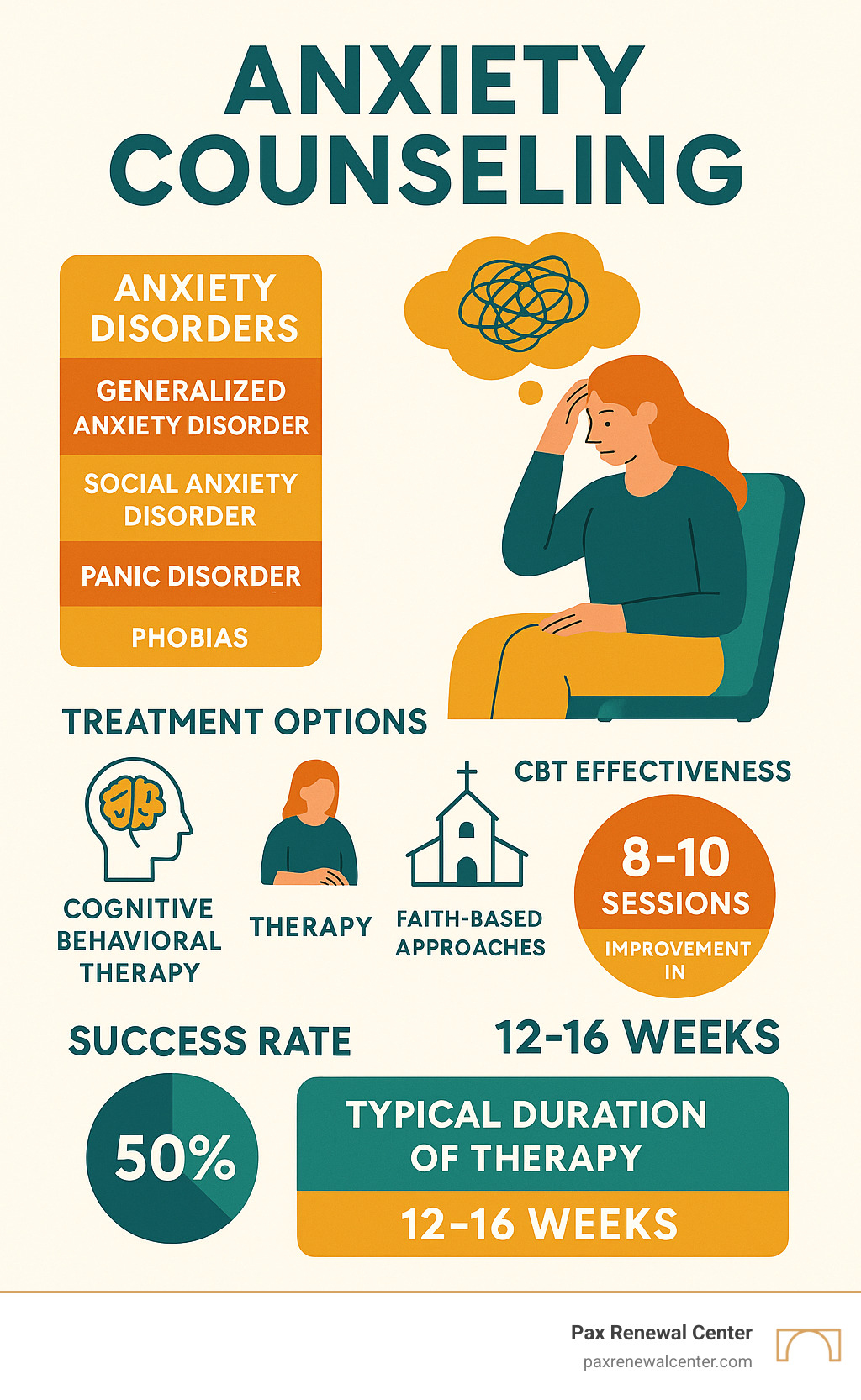
- Most effective treatment: CBT shows significant improvement in 8-10 sessions for many anxiety disorders
- Better than medication alone: Therapy addresses root causes, not just symptoms, with lasting results
- Success rate: Research shows 50% of patients recover within 20 sessions
- Relapse prevention: Therapy skills last long after treatment ends, unlike medication
Anxiety affects up to one in four adults at some point in their lives, making it one of the most common mental health challenges we face. The good news? Anxiety doesn’t have to control your story.
When everyday worry becomes overwhelming – when it stops you from enjoying relationships, work, or daily activities – that’s when normal stress crosses into anxiety territory. You might find yourself avoiding social situations, losing sleep over “what if” scenarios, or feeling your heart race for no clear reason.
That’s where anxiety counseling comes in. It’s not about telling you to “just relax” or “think positive.” Real anxiety counseling gives you concrete tools to understand your thoughts, face your fears gradually, and regain control over your emotional responses.
Understanding Anxiety: More Than Everyday Worry
Think of anxiety as your body’s built-in security system. When your brain senses danger, it instantly triggers what we call the fight-or-flight response. Your heart starts racing, muscles tense up, breathing gets shallow, and stress hormones surge through your system. This ancient alarm system kept our ancestors alive when they faced real threats like wild animals.
But here’s where things get tricky in our modern world. Your brain can’t tell the difference between a genuine emergency and giving a presentation at work. It treats both situations like your life is on the line, flooding your body with the same intense physical reactions.
Normal stress serves a purpose, it helps you stay alert and perform better when you need to. The problem starts when your internal alarm system becomes oversensitive, going off constantly even when there’s no real danger present.
Mental health professionals use specific criteria from the DSM-5 to identify when worry crosses into anxiety disorder territory. We’re looking for excessive fear and worry that sticks around for at least six months and seriously disrupts your daily life.
The numbers are eye-opening. Generalized anxiety disorder affects millions of Americans, while panic attacks can strike without warning. Phobias can become so intense that people completely avoid certain situations, and social anxiety can make even simple interactions feel impossible.
Scientific research on anxiety disorders continues to deepen our understanding of these conditions and improve how we approach anxiety counseling.
Anxiety vs “Good” Stress
Not all anxiety is your enemy. In the right amounts, adaptive arousal can actually give you a performance boost. This “good stress” keeps you sharp during important moments and helps you stay focused when it matters most.
Problematic anxiety, however, overstays its welcome. It shows up uninvited, feels overwhelming instead of motivating, and interferes with your ability to function normally.
Common Anxiety Disorders at a Glance
GAD (Generalized Anxiety Disorder) is like having a worry machine that never shuts off. People describe feeling like they’re constantly waiting for something terrible to happen.
Panic disorder brings unexpected waves of intense fear that peak within minutes. Your chest might feel tight, you could feel dizzy or nauseous, and there’s often an overwhelming sense that something catastrophic is about to happen.
Social phobia goes far beyond normal shyness. The fear of being judged or embarrassed in social situations becomes so intense that it can prevent people from working, going to school, or maintaining friendships.
Specific phobia involves intense, irrational fears of particular things – heights, flying, medical procedures, or certain animals. The fear is so powerful that people will go to extraordinary lengths to avoid their triggers.
Anxiety Counseling: When, Why, and What to Expect

Taking that first step toward anxiety counseling can feel overwhelming – especially when anxiety itself might be making the decision harder. At Pax Renewal Center, we see this paradox every day, and we’ve learned how to make that first contact as comfortable as possible.
Think of your first session as sitting down with a trusted friend who happens to have professional training in anxiety treatment. We’re not here to judge or analyze you under a microscope. Instead, we’re creating a safe space where you can finally put words to what you’ve been experiencing.
The assessment process is really about getting to know your unique story. We’ll explore when your anxiety started, what triggers it, how it shows up in your daily life, and what you’ve already tried to manage it. This isn’t a test – it’s more like drawing a map of where you’ve been so we can chart the best course forward together.
Many of our clients find relief just in having their experiences validated and understood. That constant worry you’ve been carrying? The way your heart races in certain situations? These aren’t character flaws or signs of weakness – they’re symptoms of a treatable condition.
As a faith-based practice, we also understand that anxiety often brings up deeper spiritual questions. You might wonder where God is in your struggle, or feel frustrated that prayer alone hasn’t solved the problem. These are normal, important questions that we can explore together as part of your healing journey.
More info about Stress and Anxiety
Signs It’s Time for Anxiety Counseling
Persistent worry that feels uncontrollable is often the first sign. This goes beyond normal concern about real problems – we’re talking about worry that sticks around most days and feels impossible to turn off.
Avoidance starts small but can gradually shrink your world. Maybe you’ve stopped taking certain routes to work, declined social invitations, or passed up opportunities because of anxiety.
Physical symptoms can be just as disruptive as emotional ones. Chronic headaches, muscle tension, exhaustion from poor sleep, or stomach problems related to anxiety can significantly impact your quality of life.
Daily functioning becomes harder when anxiety is in the driver’s seat. Work performance might suffer, relationships feel strained, or activities you once enjoyed feel overwhelming.
The First Session: Road-Mapping Recovery
Your first anxiety counseling session is about connection and understanding. Intake forms help us understand your background, but the meaningful work happens in conversation. Goal setting starts early because it gives direction to our work together. Assessment tools like symptom scales help us establish a baseline and track your progress over time.
Proven Treatments: Therapy, Medication & Beyond
When it comes to treating anxiety, you have more options today than ever before. The good news? Anxiety counseling consistently outperforms medication in long-term studies, and the benefits stick around long after your last session.
At Pax Renewal Center, we’ve seen how the right combination of treatments can transform lives. Our approach draws from several proven methods, but we always tailor treatment to fit your unique situation and faith journey.
Cognitive Behavioral Therapy (CBT) remains the gold standard for anxiety treatment. Research shows it’s as effective as medication for most anxiety disorders, but with one crucial advantage – the skills you learn continue working long after therapy ends.
Exposure therapy might sound intimidating, but it’s actually one of the most compassionate ways to overcome fear. We help you face anxiety-provoking situations gradually and safely, building confidence one small step at a time.
For trauma-related anxiety, EMDR (Eye Movement Desensitization and Reprocessing) can be remarkably effective. This approach helps your brain process difficult memories in a way that reduces their emotional impact.
Acceptance and Commitment Therapy (ACT) teaches you to accept anxious feelings without being controlled by them. Instead of fighting anxiety, you learn to move forward with your values even when anxiety shows up.
When it comes to medication, SSRIs (like Prozac or Zoloft) and SNRIs (like Effexor) are typically the first medications doctors recommend. These can be especially helpful for severe symptoms, giving you enough relief to engage fully in therapy.
| Treatment Approach | Timeline for Results | Long-term Effectiveness | Best For |
|---|---|---|---|
| CBT Therapy | 6-12 sessions | Excellent (skills last years) | Most anxiety disorders |
| Medication (SSRIs) | 4-6 weeks | Good with continued use | Severe symptoms, multiple conditions |
| Combined Approach | 8-16 sessions | Excellent | Complex cases, severe impairment |
Scientific research on CBT effectiveness continues to validate what we see in our practice – therapy doesn’t just manage symptoms, it actually changes how your brain responds to stress and uncertainty.
Cognitive Behavioral Therapy and Anxiety Counseling
CBT works because it tackles anxiety at its roots – the connection between your thoughts, feelings, and actions. When anxious thoughts spiral out of control, they create a cycle that feeds on itself. CBT helps you step out of that cycle.
Cognitive restructuring is where we examine those anxious thoughts together. That voice in your head saying “Something terrible is going to happen” – we learn to question it. Is there real evidence for this fear?
Behavioral experiments take this work out of the therapy room and into real life. If you believe that people will judge you harshly for showing anxiety, we might design a small experiment to test that belief.
Exposure Therapy: Facing Fears Step-by-Step
Exposure therapy might sound scary, but it’s actually built on kindness and gradual progress. The basic idea is simple: avoidance keeps fear alive, while gentle, repeated exposure helps it fade away.
We always start by creating a fear hierarchy together – a list of situations that trigger your anxiety, ranked from mildly uncomfortable to very distressing. Systematic desensitization combines relaxation skills with gradual exposure.
When to Combine Counseling & Medication
Severe symptoms that significantly interfere with daily functioning often benefit from medication alongside therapy. Comorbidity – having anxiety along with depression or other conditions – often makes combination treatment the most practical choice.
Making the Most of Your Healing Journey
Your healing journey from anxiety isn’t a straight path – it’s more like climbing a mountain with switchbacks and rest stops along the way. Some days you’ll feel like you’re making great progress, while others might feel like you’re sliding backward. This is completely normal and part of the process.
At Pax Renewal Center, we know that anxiety counseling works best when you’re actively engaged in your own healing. Think of therapy as a partnership – we provide the roadmap and tools, but you’re the one taking the steps forward.
Commitment to the process makes all the difference. People who show up consistently, complete their homework assignments, and practice new skills between sessions see much better results.
Lifestyle changes can dramatically boost the effectiveness of your counseling. When you’re taking care of your body through regular exercise, good sleep, and balanced nutrition, your mind has a much better foundation for healing.
More info about coping at work
Tracking Progress and Measuring Success
One of the trickiest parts of anxiety recovery is recognizing progress when you’re in the middle of it. Symptom rating scales help us see the bigger picture. Goal review sessions keep us focused on what matters most to you. Therapist feedback provides an outside perspective on changes we observe.
Self-Help & Lifestyle Habits That Boost Therapy
While professional anxiety counseling is essential for significant anxiety disorders, there’s so much you can do between sessions to support your healing.
Exercise acts like a natural anxiety medication. Just thirty minutes of moderate activity three to five times per week can significantly reduce anxiety symptoms.
Sleep hygiene becomes crucial because anxiety and poor sleep create a vicious cycle. Creating consistent bedtime routines and making your bedroom a calm sanctuary can break this cycle.
Prayer and meditation offer both spiritual comfort and practical anxiety management. Research shows that regular meditation actually changes brain structure in ways that reduce anxiety.
Breathing exercises give you a tool you can use anywhere, anytime. The 4-7-8 technique – inhale for four counts, hold for seven, exhale for eight – activates your body’s relaxation response.
Quick calm techniques include:
- 5-4-3-2-1 grounding method (name five things you can see, four you can touch, three you can hear, two you can smell, one you can taste)
- Progressive muscle relaxation
- Splashing cold water on your wrists
- Reciting comforting scripture verses
Is Group or Online Anxiety Counseling Right for You?
Group therapy for anxiety offers something individual sessions can’t – the healing power of shared experience. Peer support in group settings provides hope in a uniquely powerful way.
Online anxiety counseling has proven just as effective as in-person sessions for many anxiety disorders. This format works particularly well for people with agoraphobia or social anxiety who find it difficult to leave home.
Frequently Asked Questions about Anxiety Counseling
What type of therapy is best for anxiety counseling?
Cognitive Behavioral Therapy (CBT) consistently emerges as the most researched and effective approach for anxiety counseling. This isn’t just academic theory – it’s backed by decades of studies showing that CBT helps people identify and change the thought patterns that fuel anxiety while building practical skills they can use every day.
What makes CBT so effective is its focus on the connection between thoughts, feelings, and behaviors. When you learn to recognize anxious thinking patterns like catastrophizing, you can challenge these thoughts and develop more balanced perspectives.
Exposure therapy shines particularly bright for specific phobias, social anxiety, and panic disorder. This approach might sound scary at first, but it’s done gradually and safely, helping you build confidence step by step.
Acceptance and Commitment Therapy (ACT) offers a different but equally valuable approach. Instead of fighting anxious thoughts and feelings, ACT teaches you to accept them while still moving toward what matters most to you.
At Pax Renewal Center, we don’t believe in one-size-fits-all solutions. We often blend approaches based on your unique situation, combining our faith-based perspective to help address both emotional and spiritual aspects of healing.
How long before I feel better with anxiety counseling?
This is probably the question we hear most often. Research from the American Psychological Association shows that many people notice meaningful improvement within 8-10 therapy sessions. But everyone’s journey looks different.
Several factors influence how quickly you’ll see progress. The severity and duration of your symptoms play a role. If you’re dealing with other challenges like depression alongside anxiety, the timeline might be longer.
Here’s what really makes a difference: practice matters. The clients who see the fastest progress are those who actively engage with therapy techniques between sessions. This might mean completing thought records, practicing relaxation exercises, or gradually facing feared situations.
Some people notice improvements within the first few sessions as they gain understanding about their anxiety. Others need several months of consistent work before experiencing significant relief. Both timelines are completely normal.
Can anxiety counseling cure anxiety completely?
Anxiety counseling is incredibly effective at helping people manage anxiety symptoms and reclaim their lives. However, thinking about a complete “cure” might not be the most helpful framework for understanding anxiety treatment.
Anxiety actually serves important purposes. It alerts us to potential problems and motivates us to take protective action. The goal isn’t to eliminate all anxiety but to reduce it to manageable levels and develop skills to handle it when it shows up.
Many people achieve what we call “functional recovery” – they’re able to work effectively, maintain loving relationships, and enjoy life without anxiety calling the shots. Some find their anxiety symptoms become so minimal that they rarely think about them.
Management versus cure is really about developing a sustainable relationship with anxiety. Relapse prevention tools are a crucial part of our work together, and maintenance care often looks like periodic check-ins during stressful life transitions.
Conclusion
Your journey with anxiety doesn’t end here – in many ways, it’s just beginning. But this time, you’re not walking alone into uncertainty. You’re stepping forward with knowledge, hope, and a clear path toward anxiety counseling that can truly transform your life.
At Pax Renewal Center, we’ve witnessed countless individuals break free from the chains of anxiety that once seemed unbreakable. We’ve seen people who couldn’t leave their homes become confident public speakers. We’ve watched parents paralyzed by worry about their children learn to trust God’s protection while still being responsible caregivers. We’ve celebrated with clients who thought they’d never sleep peacefully again as they find rest and renewal.
Hope and renewal aren’t just nice concepts – they’re the foundation of everything we do. When anxiety tells you that things will never get better, we stand as living proof that change is possible. When fear whispers that you’re too broken to heal, we remind you of the countless others who felt exactly the same way before finding freedom.
Our faith-aligned care sets us apart because we understand that you’re not just a collection of symptoms to be managed. You’re a beloved child of God, created for purpose, joy, and abundant life. Your anxiety may feel overwhelming today, but it doesn’t define your worth or determine your future.
The Pax Renewal Center difference lies in our commitment to treating the whole person – mind, body, and spirit. We combine the most effective clinical approaches like CBT, exposure therapy, and EMDR with the timeless wisdom of faith. This isn’t about adding a prayer to the end of a secular therapy session. It’s about recognizing that true healing often involves spiritual restoration alongside emotional and psychological growth.
Dan Jurek and our team of experienced therapists bring over 35 years of combined expertise to your healing journey. We’re not just professionally qualified – we’re personally committed to walking alongside you with compassion, understanding, and unwavering hope.
Whether you’re struggling with generalized anxiety, panic attacks, social fears, or trauma-related anxiety, we have the tools and heart to help you find your way back to peace. Our approach isn’t one-size-fits-all because your story is unique, and your healing journey should be too.
The first phone call might feel scary – anxiety often makes us want to avoid the very things that could help us most. But remember, that’s just anxiety talking. The real you, the person God created you to be, wants freedom, peace, and the ability to live fully without fear calling the shots.
More info about our counseling services
Life truly is too short to spend it imprisoned by worry and fear. God has plans for you – plans for hope and a future, not for harm. Let us help you find what that abundant life looks like when anxiety no longer controls your decisions, relationships, or dreams.
Your story of freedom is waiting to be written. We’d be honored to help you turn the page.