

Why LPC Supervision Louisiana is Essential for Your Professional Journey
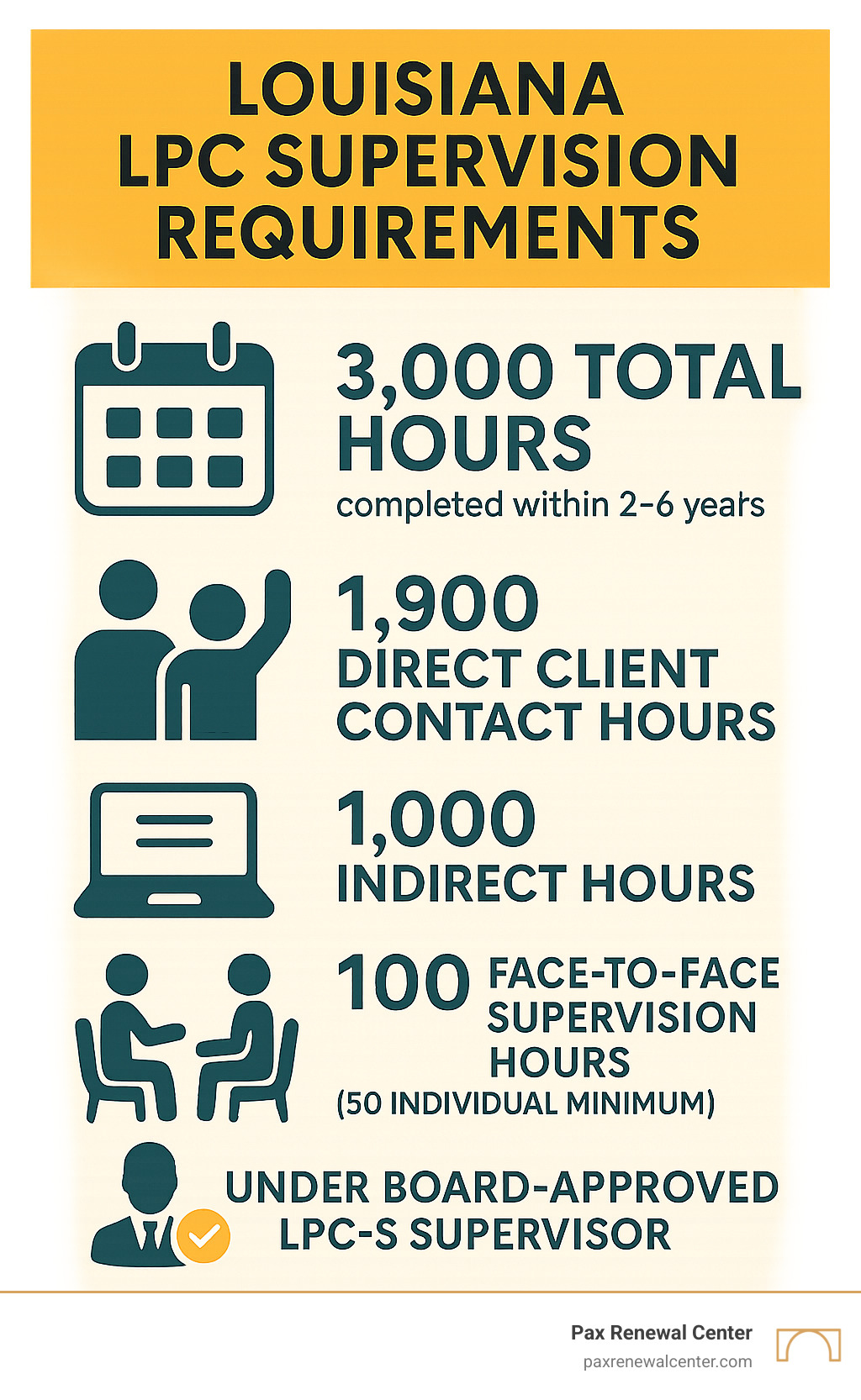
LPC Supervision is a mandatory requirement for Provisional Licensed Professional Counselors (PLPCs) seeking full licensure. The Louisiana Licensed Professional Counselors Board of Examiners requires PLPCs to complete 3,000 hours of supervised experience under a Board-Approved Supervisor (LPC-S) within 2-6 years. This includes:
- 3,000 total supervised hours (minimum 2 years, maximum 6 years)
- 1,900 direct client contact hours minimum
- 1,000 indirect hours maximum
- 100 face-to-face supervision hours (at least 50 individual supervision)
- Board-approved supervisor with LPC-S designation required
The supervision process is defined by the Louisiana board as “a collaborative relationship with a goal to improve and evaluate the PLPC’s professional competence, monitor the quality of services provided, maintain ethical standards of practice, protect the welfare of the public, and provide a gatekeeping function for entry into the mental health profession.”
Choosing the right supervisor is more than meeting requirements; it’s about finding a mentor to shape your clinical identity and prepare you for a successful career. As one supervisor noted, “selecting your LPC Supervisor is one of the most important steps in your career.”
The Roadmap to Licensure: Understanding Louisiana’s Supervision Requirements
Think of Louisiana’s supervision requirements as a professional GPS, guiding you toward becoming a competent counselor. The state board created these standards to ensure every LPC is ready to serve clients with integrity.
Understanding these requirements is about embracing a structured path to professional growth. Let’s break down what you need to know.
Cracking the Code: Supervised Hour Requirements
Your LPC Supervision journey requires 3,000 post-master’s hours of supervised experience. While it sounds like a lot, each hour is an investment in your future.
The 3,000 hours include a minimum of 1,900 direct client contact hours. This is where you apply theoretical knowledge, build therapeutic relationships, and develop your clinical style.
Up to 1,000 indirect hours can be included. This crucial work includes case conceptualization, treatment planning, record-keeping, and professional development, all of which support your direct client work.
You must also complete 100 face-to-face supervision hours with your Board-Approved Supervisor. This essential time is for processing cases, getting feedback, and developing your professional identity.
The board allows graduate hour credit: 500 hours can be earned for every 30 graduate semester hours beyond your master’s degree. However, a minimum of 2,000 hours must come from supervised experience.
The board recommends one hour of supervision for every 20 hours of direct client contact to ensure adequate support. For more insights into various counseling approaches and topics that might come up in your supervision, explore more info about counseling topics.
The Supervision Timeline and Structure
The journey must be completed in no less than two years and no more than six years from your approval date, balancing thorough preparation with timely licensure.
At least 50 of your 100 supervision hours must be individual supervision. This one-on-one time is invaluable for in-depth case discussion and personalized feedback.
The rest can be group supervision (with no more than ten interns). Group sessions offer peer learning, diverse perspectives, and professional networking.
Active supervision requires at least one hour of face-to-face supervision per 20 hours of direct client contact, or one session every three months, whichever is first. This ensures consistent support.
Understanding what to expect from these supervision sessions, much like understanding the therapeutic process itself, can help you make the most of this experience. If you’re curious about how professional guidance unfolds, consider reading What You Can Expect From Psychotherapy: The First Sessions.
The Final Step: Required Examinations
Near the end of your supervised hours, you must pass a national examination. Louisiana requires either the National Counselor Examination (NCE) or the National Clinical Mental Health Counseling Examination (NCMHCE).
The NCE is a comprehensive exam assessing foundational counseling knowledge, from human development to research.
The NCMHCE focuses on clinical application, testing your ability to make diagnostic and treatment decisions in clinical scenarios.
Both examinations are administered by the National Board for Certified Counselors, and you can find detailed information about exam administration, registration, and preparation at the National Board for Certified Counselors website.
Passing an exam is the final step, validating your readiness for independent practice and marking your entry as a fully licensed professional counselor in Louisiana.
The Role of the Supervisor: Who Can Guide Your Journey?

Your supervisor is more than someone who signs paperwork; they are a mentor, guide, and safety net who helps you develop into a competent therapist.
Not every LPC can fill this role. Louisiana has specific standards to ensure quality guidance. When seeking LPC Supervision, you’re looking for a qualified professional who has earned the right to train new counselors.
Qualifying as a Board-Approved Supervisor (LPC-S)
Becoming a Board-Approved Supervisor (LPC-S) in Louisiana is a mark of distinction, signifying an LPC has the experience and training to guide others.
The path to the LPC-S designation requires three years of post-LPC experience in mental health counseling, demonstrating the clinical wisdom gained from independent practice.
Experience alone isn’t enough. The board requires specialized supervisor training via one of two pathways: a 45-hour graduate-level academic course in counseling supervision or a 25-hour board-approved professional training program in supervision that includes direct, face-to-face interaction with the instructor.
After meeting these requirements, an LPC can apply for the official LPC-S designation, signaling to PLPCs that they are board-vetted and approved. As outlined in the Declaratory Statement on LPC-S Title, qualified supervisors can use this designation for all professional purposes.
Responsibilities and Best Practices in Supervision
An LPC-S does more than sign off on hours. They focus on developing expertise in their supervisee, helping them master techniques and understand the ‘why’ behind clinical decisions.
Ethical practice is a cornerstone of supervision. The supervisor acts as an ethical compass, guiding you through gray areas and protecting both you and your clients.
Supervision also focuses on self-appraisal strategies. A good supervisor helps you reflect on your work, recognize strengths, and identify growth areas, fostering invaluable self-awareness for independent practice.
The collaborative relationship is transformative. It’s a partnership, not a one-way street, where both parties learn and grow.
Documentation and accurate hour logs are essential administrative tasks that demonstrate compliance and track your professional development.
The impact of quality supervision extends far beyond meeting licensure requirements. When done well, it creates a foundation for a lifetime of professional growth and client care. To understand more about how this kind of professional guidance can transform lives, explore Finding Hope and Empowerment Through Professional Counseling.
Finding Your Fit: A Guide to Choosing Your LPC Supervision in Louisiana
Selecting a supervisor is a critical early-career decision. It impacts your clinical development, ethical foundation, and the type of counselor you become. It’s a chance to find a mentor who aligns with your goals and sets you up for a successful career.
This 2–6-year professional partnership is key to your growth. A good supervisor invests in your future, challenges your thinking, and helps shape your clinical identity.
Key Qualities to Look for in an LPC Supervisor
When seeking LPC Supervision, look for these qualities to ensure a rich supervision experience.
- Alignment in theoretical orientation is crucial. A supervisor proficient in modalities you want to learn, like CBT, EMDR, EFT, or the Gottman Method, can accelerate your growth.
- Alignment in values or worldview is also important. For those wanting to integrate faith into their practice, like we do at Pax Renewal Center, finding a supervisor who supports this can create a more meaningful experience.
- Experience in your area of interest is invaluable. If you want to work with specific populations (children, couples) or issues (trauma, addiction), find a supervisor with expertise in those areas.
- A teaching style that matches your learning style is key. Some supervisors are directive, others collaborative. Consider whether you learn best with structured feedback or open-ended exploration and self-findy.
- Clear expectations and fee structure show professionalism. A good supervisor is transparent about their philosophy, expectations, and fees, which prevents misunderstandings.
- Availability and accessibility are practical necessities. Your supervisor must be available for regular sessions and urgent consultations.
- Adherence to Louisiana LPC Board standards is non-negotiable. Verify your potential supervisor is a Board-Approved LPC-S and compliant with all regulations.
Questions to Ask a Potential Supervisor for LPC Supervision

Entering a supervision relationship is a significant commitment. Asking thoughtful questions in an initial conversation is your chance to assess compatibility and set expectations.
- Ask about their supervision philosophy, how they structure sessions, and provide feedback.
- Inquire about their experience handling ethical dilemmas to understand their problem-solving approach.
- Discuss their experience with specific populations or clinical issues that interest you, as well as the therapeutic modalities they emphasize.
- Clarify the fees and structure, including costs for individual vs. group sessions, frequency, and what’s included, such as emergency consultations.
- Ask about their feedback methods, evaluation process, and expectations for your caseload, documentation, and session preparation.
- Inquire how they support supervisees in developing their professional identity. A great supervisor helps you find your strengths and unique clinical style.
- Ask about a challenging supervision situation they’ve faced and how they steered it. This can reveal their problem-solving skills and commitment to your growth.
These questions will help you assess compatibility. Finding the right person to guide you is key to a successful licensure journey.
For additional resources as you steer your professional path, please visit our Client Resources page, where you’ll find helpful tools and information to support your growth as a counselor.
Staying Current: Renewal Requirements for PLPCs and Supervisors
After licensure, professional development continues. Both PLPCs and LPC-S designees have renewal requirements to stay current, a commitment to lifelong learning that benefits you and your clients.
Continuing education is like sharpening your tools. The counseling field is always evolving, so keeping skills and knowledge current is essential.
Renewing Your PLPC License
Your PLPC license requires biennial renewal (every two years). The deadline is October 31st. Missing this date leads to complications and extra costs.
To renew, you must complete 20 continuing education hours every two years. Your 20 CE hours must include at least 1.5 hours in Ethics and 1.5 hours in Diagnosis, Assessment, and Treatment under the DSM-5.
The on-time renewal fee is $85. If you miss the October 31st deadline, your license lapses. There is a 90-day grace period until January 31st, but it includes a $60 late fee, a CE audit, and a new criminal records check.
If you miss the January 31st grace period, your license expires, requiring you to reapply for provisional licensure. For complete details on renewal requirements, visit the PLPC Renewal Information | LPC page.
Maintaining Your LPC-S Designation
Maintaining your LPC-S designation also requires a biennial renewal, which aligns with your LPC license renewal.
To maintain your LPC-S status, you need 3 CE hours in supervision every two years. These hours are part of the 40 total CEs for your LPC license and ensure you stay current on supervision best practices.
The LPC-S renewal fee is $50, with a $28 Privileging Designation Late Renewal Fee. If the designation expires, you must reapply to provide supervision again.
While deadlines can be stressful, these requirements uphold high professional standards in Louisiana, protecting the public and our profession’s integrity. Plan ahead to ensure stress-free renewals: set reminders, track your CEs, and don’t procrastinate. For detailed information about LPC-S renewal requirements, check the LPC-S Renewal Information page.
Staying current isn’t just about meeting requirements – it’s about growing as a professional and providing the best possible care to those who trust you with their healing journey.
Frequently Asked Questions about lpc supervision louisiana

The path to licensure can feel overwhelming. Questions about LPC Supervision requirements are normal and show you’re taking your professional development seriously. Here are answers to common questions.
How many hours do I need to become an LPC in Louisiana?
You need 3,000 post-master’s supervised hours in professional mental health counseling. This includes at least 1,900 direct client contact hours, the time spent providing counseling services to clients. You also need a minimum of 100 face-to-face supervision hours with your Board-Approved Supervisor. The entire process must take no less than two years and no more than six years from your supervision approval date. This timeline ensures you have adequate time to develop your skills without losing momentum toward licensure.
Can I get supervision online?
The Louisiana board has historically emphasized “face-to-face” supervision hours, but the mental health landscape is evolving. While telehealth is common, supervision regulations can be more conservative and are subject to change. The rules for remote supervision may differ from those for client sessions. To ensure your hours count, verify the most current regulations on telemental health for supervision directly with the Licensed Professional Counselors Board of Examiners.
How much does LPC Supervision cost in Louisiana?
LPC Supervision costs vary significantly based on several factors. A supervisor’s experience level and location are major factors; supervisors in larger cities or with more experience often charge more. The format also affects cost; individual supervision is typically more expensive than group supervision. Some supervisors offer flexible payment structures, such as per-session or monthly rates.
Always have an open conversation about fees, session length, and payment expectations before committing. Transparency prevents misunderstandings and ensures a good fit. The investment in quality supervision is an investment in mentorship that will shape your entire career.
Conclusion
The journey from PLPC to a fully licensed LPC is a transformative period of growth. LPC Supervision in Louisiana is the cornerstone that bridges academic knowledge with real-world practice.
As explored in this guide, Louisiana’s path to licensure is well-structured. The required hours represent significant learning and professional development under an experienced mentor.
Finding the right supervisor is your most crucial decision. An ideal supervisor is a trusted mentor who shapes your clinical identity and prepares you for independent practice. They will help you develop expertise in your specialty, whether it’s trauma-informed therapy, couples counseling, or another area, while upholding the highest ethical standards.
At Pax Renewal Center, we understand the impact of quality supervision. Our approach to LPC Supervision is built on professional excellence and compassionate care. We believe effective supervision has a ripple effect, as well-trained LPCs carry that commitment to excellence into their own practices.
The supervision relationship is a collaborative partnership, much like a therapeutic relationship. It’s a space where vulnerability meets wisdom and mistakes become learning opportunities, mirroring the values of growth and healing in therapy.
Your journey to licensure is about more than hours and exams; it’s about becoming a clinician who offers hope and healing. Investing in quality LPC Supervision will pay dividends throughout your career.
Approach this process with patience and intentionality. Find a supervisor who inspires you to become your best. The mental health field needs dedicated, well-trained professionals like you.