

When Life Feels Overwhelming: Why Faith-Based Stress Relief Works
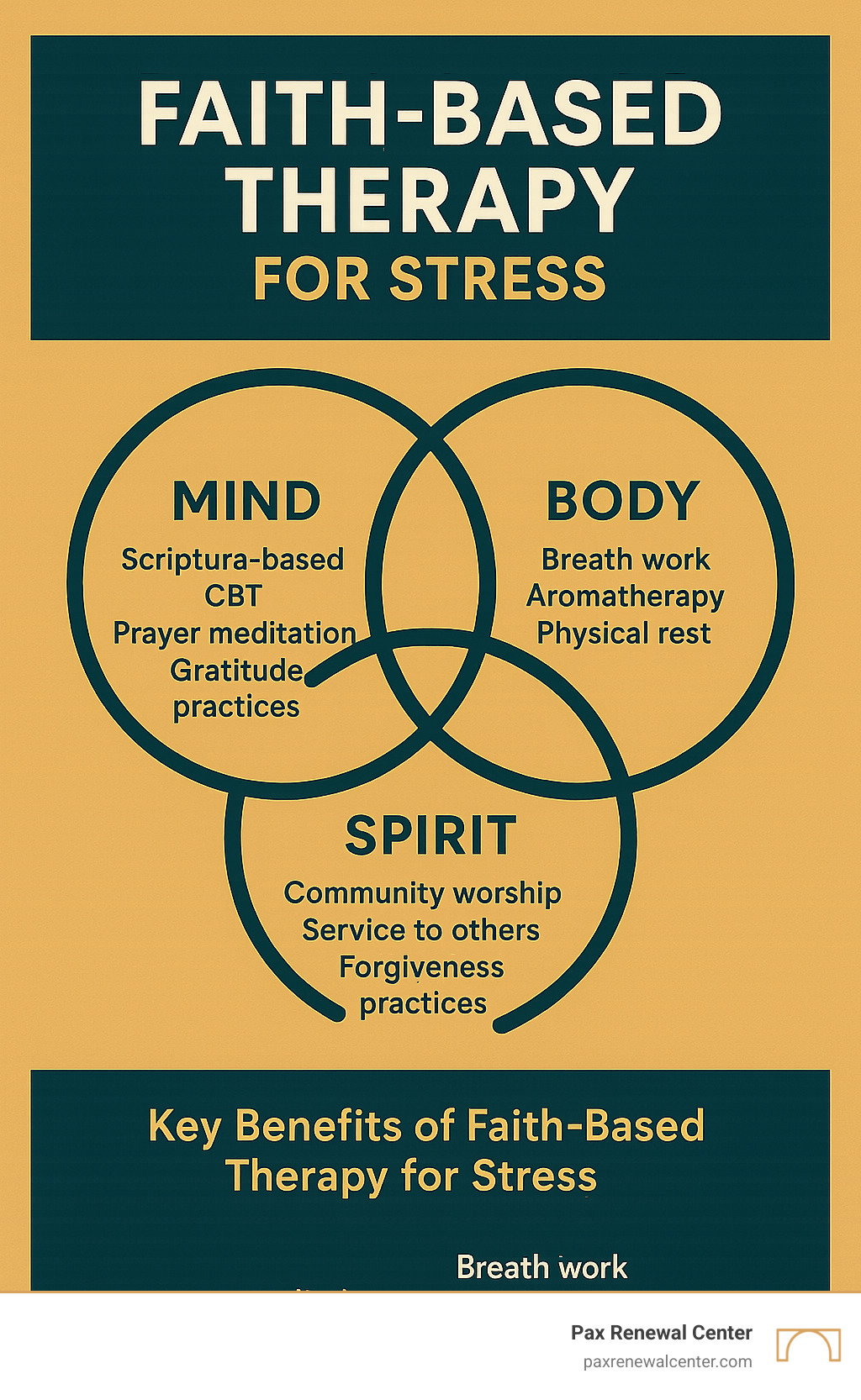
Faith-based therapy for stress combines proven clinical techniques with your spiritual beliefs to create a powerful path toward healing and peace. Unlike traditional therapy alone, this approach recognizes that true wellness involves your mind, body, and spirit working together.
Key Benefits of Faith-Based Therapy for Stress:
- Prayer and meditation as coping tools for anxiety
- Scripture-based cognitive techniques to replace negative thoughts
- Community support through faith connections
- Professional counseling that honors your beliefs
- Holistic healing addressing spiritual, emotional, and physical needs
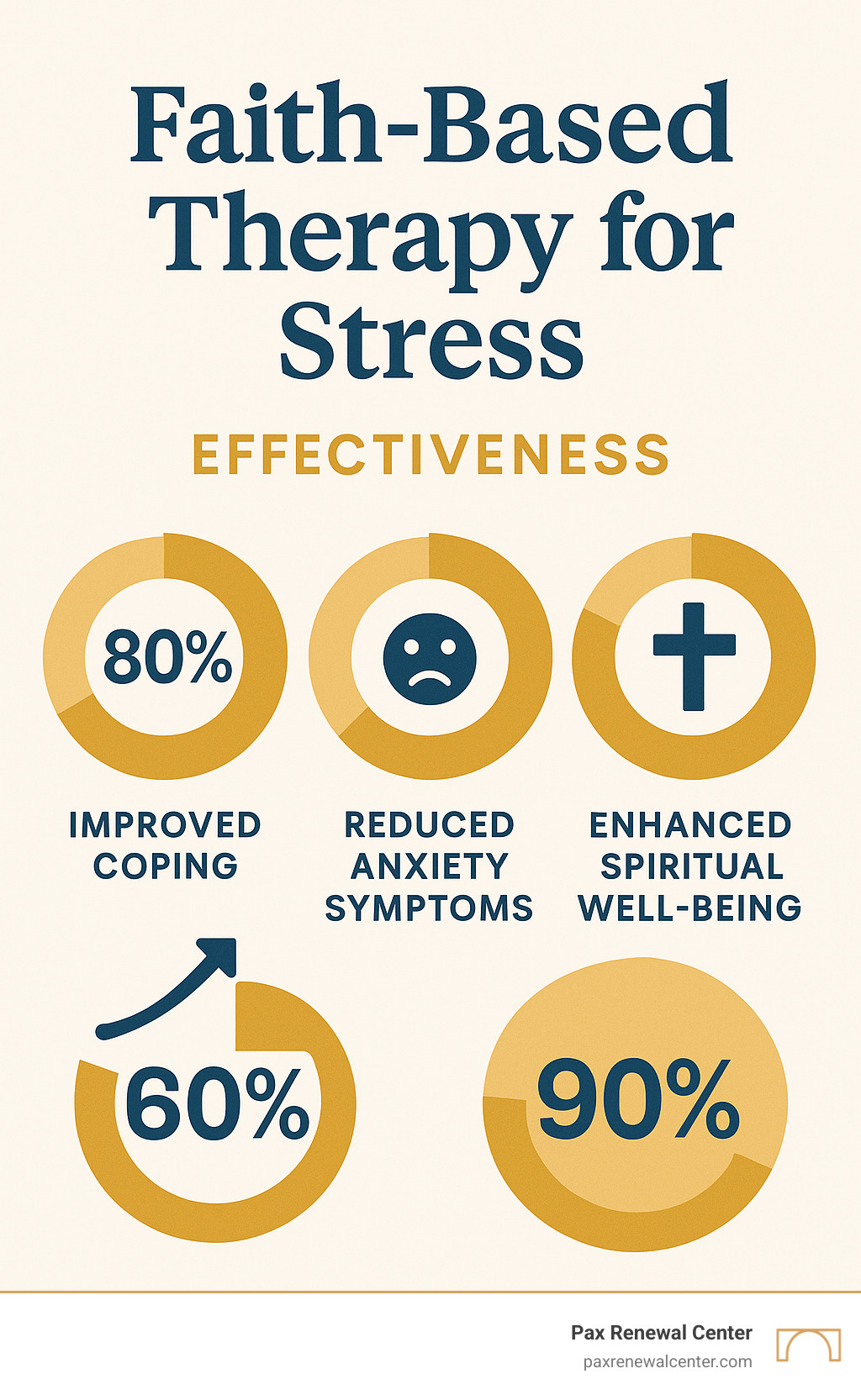
Research shows that one in three Americans report feeling “extreme stress,” and nearly half struggle with sleep due to anxiety. But studies involving over 126,000 people found that religious involvement increased life expectancy by 29%, while 80% of chronic patients who used religious coping daily said it helped moderate their symptoms.
Your faith isn’t separate from your healing – it can be the foundation of it. When spiritual practices like prayer, gratitude, and forgiveness are woven into evidence-based therapies like CBT and EMDR, clients often experience faster relief and deeper, lasting change.
The difference lies in the approach. Traditional therapy focuses on thoughts and behaviors. Faith-based therapy adds meaning, purpose, and hope rooted in your relationship with God. It’s therapy that speaks your language and honors what matters most to you.
What Is Faith-Based Therapy & How It Differs From Traditional Counseling
Faith-based therapy for stress is like traditional counseling’s wise older sibling – one who’s learned that healing happens best when your whole self is invited to the table. While regular therapy focuses on your thoughts and behaviors, faith-integrated therapy recognizes that you’re a complex being with spiritual needs that deeply impact your mental health.
When you walk into a traditional therapy session, you might find yourself carefully editing out references to prayer, church, or what God might be teaching you through your struggles. Therapy creates a space where your spiritual life isn’t just tolerated – it’s seen as a powerful resource for healing.
The sacred integration happens naturally when your therapist understands that Scripture isn’t just ancient text to you – it’s living wisdom that can transform anxious thoughts. Instead of generic positive affirmations, you might work with verses like Philippians 4:6: “Do not be anxious about anything, but in every situation, by prayer and petition, with thanksgiving, present your requests to God.”
| Traditional CBT | Faith-Integrated CBT |
|---|---|
| Identify negative thoughts | Identify thoughts that contradict God’s truth |
| Challenge with evidence | Challenge using Scripture and religious resources |
| Develop coping strategies | Develop spiritual coping through prayer and community |
| Focus on behavioral change | Focus on change through God’s grace |
| Rely on personal strength | Rely on God’s strength and personal effort |
Scientific Foundations Meet Spiritual Truths
You don’t have to choose between good science and deep faith. Empirical studies consistently show that spiritually-integrated therapy works. The scientific research on spiritually-modified CBT reveals that when people received religiously-integrated cognitive behavioral therapy, they showed faster initial improvement compared to traditional CBT alone.
Your brain actually changes during spiritual practices. Prayer and meditation increase feel-good chemicals like serotonin and dopamine while decreasing cortisol – that stress hormone that keeps you feeling on edge. It’s as if God designed our minds to respond positively to spiritual connection.
At Pax Renewal Center, when clients know their faith will be honored rather than dismissed, they open up faster and make deeper progress. We integrate these evidence-based findings with approaches like EMDR, the Gottman Method, and Emotionally Focused Therapy, always through the lens of Catholic and Christian values. For more information about how we address stress and anxiety specifically, visit our Stress & Anxiety services page.
Core Principles & Practices that Melt Stress
Faith-based therapy for stress operates on several core principles that work together to create lasting peace and resilience. These aren’t just nice ideas – they’re practical tools that can transform how you experience and respond to stress.
Prayer as Primary Coping: Prayer isn’t just talking to God; it’s a form of therapeutic communication that helps process emotions, gain perspective, and find strength beyond yourself. Research shows that prayer can be as effective as traditional talk therapy for stress relief.
Gratitude as a Stress Antidote: When you actively practice gratitude, you’re rewiring your brain to notice blessings rather than burdens. Keeping a gratitude journal can shift your entire perspective on stressful situations.
Forgiveness as Freedom: Carrying resentment is like drinking poison and expecting the other person to get sick. Forgiveness practices rooted in Scripture free you from the toxic burden of bitterness that fuels chronic stress.
Community Support: Faith communities provide “social connectedness” – one of the strongest predictors of mental health resilience. When you’re part of a caring faith community, you have built-in support during difficult times.
For more specific techniques and support, explore our Stress & Anxiety services where we integrate these principles into personalized treatment plans.

Scripture-Anchored CBT Techniques
One of the most powerful aspects of faith-based therapy is how it transforms traditional cognitive behavioral techniques by anchoring them in Scripture. Instead of just challenging negative thoughts with logic, you challenge them with God’s truth.
Thought Records with Scripture: When you notice a stress-triggering thought like “I can’t handle this,” you ask “What does God say about my ability to handle difficult situations?” Then you might turn to Philippians 4:13: “I can do all things through Christ who strengthens me.”
Biblical Affirmations: Rather than generic positive statements, you create affirmations based on Scripture. Instead of “I am strong,” you might say “God has not given me a spirit of fear, but of power, love, and sound mind” (2 Timothy 1:7).
Mind-Body Rituals for Calm
Breath Prayer: This ancient Christian practice combines deep breathing with short prayers. You might breathe in while praying “Jesus, Prince of Peace” and breathe out while praying “calm my anxious heart.”
Scripture Meditation: Unlike secular mindfulness, Scripture meditation involves focusing your mind on God’s word. You might meditate on Psalm 46:10 – “Be still and know that I am God.”
Community & Worship as a Stress Buffer
Participating in Bible studies or prayer groups provides regular opportunities to share burdens and receive support. Serving others shifts your focus from your own problems to helping meet others’ needs, triggering the release of endorphins and reducing stress hormones.
Integrating Spiritual Disciplines Inside the Therapy Room
When you step into a therapy** session, your spiritual life doesn’t get left in the waiting room. The sacred practices that have sustained believers for centuries become powerful tools for healing right within the therapeutic process.
Lectio Divina becomes therapeutic insight. This ancient practice of sacred reading takes on new depth in therapy. We might read a passage from Scripture together, not as a Bible study, but as a way to listen for how God might be speaking into your specific situation.
Lament prayers give voice to pain. Sometimes the most healing thing you can do is be completely honest with God about your hurt. The Psalms are full of raw, unfiltered prayers that don’t sugarcoat suffering. In our sessions, we might craft your own lament prayers – bringing your grief, disappointment, or trauma directly into God’s presence.
Spiritual journaling processes emotions deeply. Writing combined with prayer and Scripture reflection becomes incredibly powerful for working through difficult feelings. We use guided prompts that help you explore how your faith intersects with your struggles.

Using Worksheets & Digital Tools
Modern faith-based therapy combines ancient wisdom with contemporary tools to accelerate your healing.
Biblical affirmations worksheets help you identify negative thoughts and replace them with Scripture-based truths. When you catch yourself thinking “I’m not strong enough for this,” you learn to counter with God’s truth: “I can do all things through Christ who strengthens me.”
Prayer and anxiety trackers reveal patterns. You might find that your anxiety drops significantly on mornings when you pray, or that skipping church correlates with increased stress.
Scripture memorization cards focus on verses for stress and anxiety management. Research shows that memorizing Scripture promotes genuine calmness and resilience.
For deeper understanding of how meditation practices support mental health, the scientific research on meditation offers valuable insights.
Faith-Based Therapy for Stress in Action
“Michael” came to us as a military veteran struggling with PTSD and crushing anxiety. He’d tried traditional therapy with some success, but something felt incomplete. His faith had always anchored his life, but his traumatic experiences left him questioning everything.
We used EMDR to process his traumatic memories while simultaneously addressing his spiritual trauma. We explored how his experiences had shaken his relationship with God, and we used Scripture to show him that even biblical heroes like Job and David wrestled with difficult emotions.
Prayer became part of our EMDR sessions. We invited God’s presence into the healing process itself. Over time, Michael’s PTSD symptoms decreased significantly, and his relationship with God was not just restored but actually deepened through his suffering.
Who Can Benefit & What to Expect from Faith-Based Therapy for Stress
Faith-based therapy** opens its doors to anyone who wants their spiritual beliefs to be part of their healing journey. You don’t need to have perfect faith or be able to quote Scripture from memory. Some of our most meaningful work happens with people who are questioning, struggling, or even angry with God.
Many clients come to us feeling frustrated that traditional therapy treated their faith as irrelevant. Your faith isn’t a crutch or a weakness – it’s often your greatest source of strength and resilience. When therapists understand and respect your spiritual worldview, healing can happen more naturally and completely.
We work with people experiencing spiritual struggles alongside mental health challenges. Maybe you’re wondering where God is in your suffering, or you’re carrying guilt about having anxiety despite your faith. These aren’t signs of weak faith – they’re normal human experiences that deserve compassionate, skilled attention.
At Pax Renewal Center, we seamlessly blend spiritual approaches with proven clinical methods. You might receive EMDR for trauma processing while also exploring how your experiences have affected your relationship with God. Or we might use the Gottman Method for couples work while helping you understand marriage as a covenant blessed by God.
First Session Walk-Through
Walking into your first therapy session can feel both hopeful and nerve-wracking. We might begin with a brief, optional prayer, nothing lengthy or formal, just asking for God’s guidance and healing presence in our time together.
The intake process includes a spiritual assessment where we explore your faith background and current spiritual practices. This isn’t a theology test – we want to understand what spiritual resources you already have.
Goal-setting goes beyond symptom reduction to explore how your healing journey fits into God’s bigger purpose for your life. Treatment planning integrates both clinical and spiritual elements in ways that feel authentic to you.
Tailoring Modalities Across Life Stages
Children benefit from play therapy that incorporates Bible stories and age-appropriate prayer. Teenagers often struggle with identity questions that are both developmental and spiritual. We help teens explore their identity in Christ while navigating typical stressors.
Marriage and couples work using Emotionally Focused Therapy helps partners see their relationship as a covenant blessed by God. Adults facing life transitions can use their faith as an anchor during turbulent times. Grief and loss counseling helps you lament honestly while holding onto hope in God’s promises.
Finding the Right Faith-Aligned Therapist
Finding the right therapist is one of the most important decisions you’ll make in your healing journey. Not every therapist who mentions spirituality will truly understand how to weave your faith into the therapeutic process meaningfully.
The key is finding someone who has both solid clinical credentials and genuine respect for your spiritual life. Look for licensed mental health professionals who have specialized training in religious and spiritual issues beyond basic credentials.
Cultural and spiritual sensitivity makes all the difference. A therapist who truly understands Catholic traditions will know why the sacraments matter to you. Someone grounded in Protestant faith will appreciate your personal relationship with Jesus and understand how Scripture speaks into your daily struggles.
When interviewing potential therapists, ask important questions upfront. How do they integrate faith without being pushy? What specific training do they have in spiritual issues? A good faith-based therapist will welcome these questions and answer them thoughtfully.
Online therapy options have opened up incredible possibilities, especially if you live in a smaller community with limited resources. Many qualified professionals now offer virtual sessions.
For a deeper understanding of how this integration works in practice, explore our comprehensive guide on understanding a faith-based approach to counseling in the Catholic Christian tradition.
Checklist for Your Search
Start with the practical basics: verify their license and credentials, then dig deeper into their approach and experience. Psychology Today’s filters can be helpful when you filter specifically for “Religious” or “Spiritual” specialties.
Getting referrals from your faith community often yields the most trusted recommendations. Your pastor, priest, or other church leaders frequently know which local therapists truly understand and respect your faith tradition.
Insurance coverage is a practical reality, so verify your mental health benefits early. Many excellent therapists also offer sliding scale fees if cost is a concern.
The right fit matters more than convenience. It’s worth traveling a bit further for a therapist who truly understands both your clinical needs and your spiritual life.
Frequently Asked Questions about Faith-Based Therapy for Stress
Does faith-based therapy work if I’m not very religious?
Faith-based therapy often works best for people who are struggling with their faith, not those who have it all figured out. You don’t need to be a spiritual giant to benefit from this approach.
Many clients come to us feeling disconnected from God, angry about unanswered prayers, or questioning beliefs they once held dear. These spiritual struggles aren’t obstacles to therapy – they’re often the very reason people seek help.
What matters isn’t how religious you are right now, but whether you’re open to exploring how your spiritual life connects to your emotional well-being. Even if your faith feels shaky, therapy can help you work through these questions in a safe, non-judgmental space.
How are prayer and Scripture used without feeling pushy?
At Pax Renewal Center, we follow what I call the “invitation approach.” Every spiritual practice – whether it’s prayer, Scripture reading, or reflection on religious themes – is offered as an invitation, never a requirement. You’re always in the driver’s seat.
We typically start small and let you guide the process. Maybe you mention feeling anxious about a decision and wondering what God wants you to do. That opens the door for us to explore prayer or Scripture together, but only if you’re interested.
You never have to worry about being preached at or having someone else’s spiritual agenda imposed on you. Your spiritual journey is yours, and our job is simply to help you steer it in ways that promote healing.
Can worksheets and apps really lower my stress levels?
The worksheets we use aren’t busy work. They’re carefully crafted tools that help you identify patterns in your thinking, connect your spiritual practices to your emotional well-being, and track your progress over time. When you write down your anxious thoughts and then challenge them with Scripture verses, something powerful happens in your brain.
Apps and digital tools work because they meet you where you are. Having quick access to prayer reminders, Scripture verses for anxiety, or guided breathing exercises means you can practice stress management in real time.
These tools work best when they’re part of a bigger picture that includes professional therapy, community support, and spiritual practices. Studies show that people who use structured tools between therapy sessions make faster progress and maintain their gains longer.
Conclusion
When life feels overwhelming and stress threatens to consume your peace, therapy** offers something profound – a path to healing that honors both your mind and your spirit. This isn’t about choosing between professional help and your faith. It’s about finding how they work together to create change that goes deeper than managing symptoms.
At Pax Renewal Center in Lafayette, Louisiana, we’ve walked alongside hundreds of people who thought they had to leave their beliefs at the door to get real help. Instead, they found that their faith could become the very foundation of their healing journey.
The difference lies in being truly understood. When your therapist gets why prayer matters to you, when Scripture can be woven into cognitive techniques, when your faith community becomes part of your support system, healing happens more naturally.
Our licensed therapists combine proven methods like CBT, EMDR, EFT, and the Gottman Method with the wisdom of Catholic and Christian traditions. This means you receive excellent clinical care that speaks your language and honors what you hold sacred.
You don’t have to face this alone. God designed us for community and healing, sometimes through prayer and Scripture, sometimes through skilled professional helpers who understand your faith.
Your next step is simpler than you might think. Reach out to learn how faith-based therapy for stress might be exactly what you’ve been searching for. Schedule a consultation where you can share your story without judgment.
The stress and struggles you’re carrying don’t define you, and they don’t have to be faced in isolation. With faith as your anchor and professional support as your guide, the peace and resilience you long for are within reach.
Ready to begin? Explore our full range of services or contact Pax Renewal Center today. Your faith and your mental health were never meant to be separate – let us show you how they can work together for your healing and God’s glory.