

When Faith Meets the Mind: A Path to True Healing
Faith based CBT (Cognitive Behavioral Therapy) is a therapeutic approach that combines the proven techniques of standard CBT with Christian beliefs, scripture, and spiritual practices to treat mental health conditions like anxiety and depression.
Key Components of Faith-Based CBT:
- Cognitive Restructuring – Identifying negative thoughts and replacing them with biblical truths
- Behavioral Activation – Engaging in meaningful activities aligned with Christian values
- Spiritual Practices – Prayer, scripture meditation, forgiveness, and gratitude exercises
- Integration of Faith – Using religious beliefs and resources to challenge unhelpful thinking patterns
- Therapeutic Alliance – Working with a licensed therapist who respects and incorporates your faith
If you’ve ever felt torn between seeking professional mental health support and your Christian faith, you’re not alone. Many believers mistakenly think they must choose between psychology and spirituality. But what if the most powerful healing happens when both work together?
That’s the promise of faith-based CBT. Research shows it’s at least as effective as conventional therapy, and for religious clients, it often works even better. When your therapist understands that your relationship with God is central to your mental health, real change becomes possible.
What is Faith-Based CBT and How Does It Work?
At Pax Renewal Center in Lafayette, Louisiana, we’ve seen that people don’t have to choose between their faith and professional mental health care. Faith-based CBT brings these two powerful forces together, creating a path to healing that honors both the science of psychology and the wisdom of Christian spirituality. It’s about recognizing that your relationship with God is central to who you are, and that means it should be central to your healing too.

Understanding Faith-Based Cognitive Behavioral Therapy
Faith-based CBT, also known as Christian Cognitive Behavioral Therapy (CCBT), weaves your Christian beliefs, values, and practices into the proven framework of standard CBT. It’s psychology and theology working hand in hand.
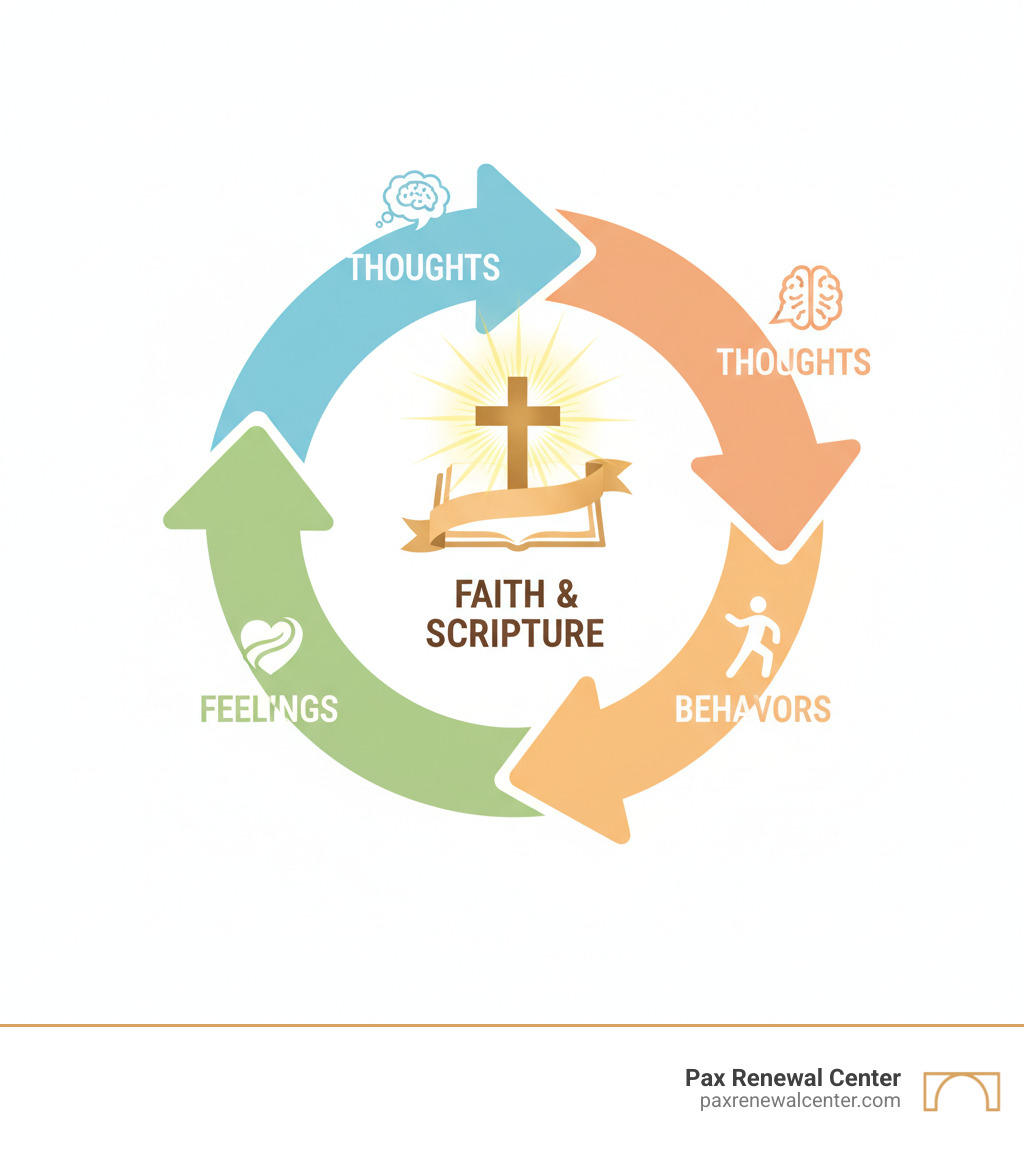
The foundation is the same: our thoughts, feelings, and behaviors are deeply connected. When you’re struggling with anxiety or depression, it often starts with unhelpful thought patterns, like believing you’re unworthy or that God has abandoned you. Faith-based CBT helps you identify these patterns and replace them with both psychological and biblical truth. We ask not only, “Is this thought helpful?” but also, “Does this align with what God says about you?” It’s a partnership where clinical expertise meets divine wisdom, addressing your whole person: mind, body, and spirit.
How Faith-Based CBT Differs from Standard Therapy
Standard CBT is highly effective, but it typically operates from a secular framework. Faith-based CBT takes a different approach by integrating your beliefs.
| Feature | Standard CBT | Faith-Based CBT |
|---|---|---|
| Worldview | Secular; focuses on universal psychological principles. | Christian; integrates biblical truths and spiritual understanding. |
| Techniques | Cognitive restructuring, behavioral activation, exposure, relaxation. | Same techniques, but infused with Christian content and spiritual practices. |
| Content | General rationales, evidence-based self-help strategies. | Biblical teachings, scripture, prayer, spiritual disciplines, theological reflections. |
| Therapist Role | Clinical expert, guide for thought/behavior change. | Clinical expert, spiritual guide, respects and integrates client’s faith journey. |
| Ultimate Goals | Symptom reduction, improved coping, functional well-being. | Symptom reduction, improved coping, functional well-being, spiritual growth, deeper relationship with God. |
| Support System | Focus on personal resources, social support. | Personal resources, social support, and the active presence of God and the faith community. |
At Pax Renewal Center, our licensed professionals, including LPC-S and LMFT-S therapists, are trained in clinical best practices like EMDR, Exposure Therapy, and CBT. We also understand the profound role of the Holy Spirit in healing and integrate Catholic and Christian values into care. For example, when addressing anxiety, we challenge worry patterns with cognitive restructuring while also exploring trust in God’s sovereignty. The clinical framework is solid, but it’s infused with spiritual truth.
The Science Behind Integrating Faith
You might wonder if there’s real evidence behind adding faith to therapy. The research is clear: religion-adapted psychotherapy, including faith-based CBT, is at least as effective as conventional psychotherapy for mental health conditions.
In fact, CBT is the most frequently studied religion-adapted approach, with robust proof of effectiveness. A systematic review of religion-adapted CBT shows how religious content can be successfully integrated into every part of therapy. What’s more, most clients want their therapists to address religious issues. When therapy aligns with your core values, you’re more likely to engage fully and experience lasting change.
Depression is the most frequently studied condition, with evidence showing significant benefits for people of faith. At Pax Renewal Center, we’ve witnessed that when clients can bring their faith into therapy, healing goes deeper. The science confirms what we’ve seen: integrating faith doesn’t dilute therapy; it improves it.
Core Techniques: How Your Faith Becomes Part of the Healing Process
In faith-based CBT, your beliefs become an active, living part of your healing journey. At Pax Renewal Center, we use proven CBT techniques like cognitive restructuring and behavioral activation, but we infuse them with the spiritual disciplines and biblical wisdom that sustain you. It’s an approach where your faith directly fuels your healing, scripture speaks into your struggles, and the change God promises becomes tangible.

Using Scripture to Reconstruct Your Mental Scaffolding
Your mind has an underlying framework of beliefs that supports your thoughts. When this is built on distorted or negative thoughts, it can lead to anxiety and depression. One of the most powerful aspects of faith-based CBT is using scripture to identify, challenge, and replace these unhelpful thought patterns.
We start by recognizing cognitive distortions, mental habits like all-or-nothing thinking or believing you’re worthless. These are lies that can feel overwhelmingly true. Here’s where faith changes everything. We don’t just challenge these lies with logic; we challenge them with God’s truth. If you’re struggling with worthlessness, we might turn to Psalm 139:14, which reminds you that you are “fearfully and wonderfully made.” If anxiety tells you you’re alone, we meditate on God’s promises of presence in Psalm 23.
This process of replacing lies with biblical truths is what Romans 12:2 calls “renewing your mind.” Our therapists at Pax Renewal Center guide you in finding relevant scriptures and integrating them into your daily thought life, creating new pathways of positive, God-directed thinking.
Applying Faith-Based CBT Through Spiritual Disciplines
Spiritual disciplines are powerful therapeutic tools in faith-based CBT. These ancient Christian practices provide practical methods to engage your faith for mental wellness.
- Prayer as a coping strategy: We teach surrendering prayer, where you entrust your anxieties to God. This practice affirms His wisdom and goodness, which can lower stress and increase resilience.
- Scripture meditation for anxiety: This involves contemplative prayer, savoring specific verses to bring peace. Meditating on a passage like Philippians 4:6-7 can anchor you in God’s peace.
- Gratitude journaling: Focusing on God’s blessings shifts your perspective from what’s wrong to what’s right, aligning with 1 Thessalonians 5:18.
- Forgiveness exercises: We guide you through biblical practices of repentance and forgiveness to release the heavy burden of unforgiveness, which can reduce depression and anxiety.
- Altruism and service: Engaging in selfless service, as encouraged in James 1:22, is a behavioral activation strategy that fosters purpose and community while combating isolation.
- Worship as a tool: Worship shifts your focus from self to God, fostering awe and connection that are vital for mental well-being.
At Pax Renewal Center, these spiritual disciplines are woven into your treatment plan, providing concrete steps to deepen your faith while applying proven psychological techniques.
Behavioral Activation: Putting Your Faith into Action
Behavioral activation is a core CBT component that combats depression and anxiety by increasing your engagement in meaningful activities. The principle is simple: action often precedes motivation. In faith-based CBT, we amplify this by aligning activities with your Christian values, changing it into a spiritual practice of “walking by faith.”
We work with you to schedule activities that bring pleasure or accomplishment, even when you lack motivation. For Christians, this often includes connecting with your church community, attending worship, or engaging in service. These are intentional steps toward living out your faith.
If social withdrawal is a factor, attending a church group can provide support and belonging. We help you overcome avoidance by setting faith-based goals, sometimes using exposure therapy principles where you rely on biblical courage. This approach recognizes you can “act your way into a new way of thinking.” As you engage in these values-aligned activities, you often find your mood improves and hope returns.
The Benefits and Applications of Faith-Based CBT
When you choose faith-based CBT, you’re opening the door to a deeper kind of healing for your mind, heart, and spirit. At Pax Renewal Center, we’ve seen clients experience changes that go far beyond what traditional therapy alone could offer.

Research backs this up. Evidence shows that faith-adapted therapies are effective for treating depression and anxiety, with many religious clients experiencing even better outcomes. When your therapist understands your faith, the therapeutic alliance becomes stronger, and you feel truly seen and supported. For those dealing with reduced depression, lowered anxiety, and increased hope, this integrated approach is about becoming more whole.
How Faith-Based CBT Helps with Anxiety and Depression
Anxiety and depression can shake your faith, raising deep spiritual questions. Faith-based CBT shines by helping you find purpose in suffering through a Christian lens. Instead of seeing pain as meaningless, you begin to see how God can work through it for your growth. This acknowledges your struggle while anchoring you in the truth that God is present. For clients with chronic illness, this is transformative, and research on religiously integrated CBT for depression shows its effectiveness.
Combating hopelessness with eternal hope is another benefit. Faith-based CBT counters the lies of depression with biblical truth—scriptures like Jeremiah 29:11 that replace despair with divinely grounded hope. When it comes to managing worry through trust in God, you learn to surrender control. This practice of trusting in a higher power when circumstances feel chaotic, a concept known as “compensatory control”, is both biblically sound and scientifically validated.
Creating a ‘Mental Map of Your Story’
One of our most meaningful techniques is helping you create a “mental map of your story.” This involves viewing your life journey through a redemptive lens, finding where God has been present all along. We guide you to identify feelings and contributing factors and bring them into prayer, asking for God’s perspective.
As patterns emerge, you might see how past experiences shape current behaviors. A crucial part of this is examining your thoughts about God’s personality. Your view of God, whether as loving or distant, profoundly impacts your well-being. This narrative approach helps you understand your past and, more importantly, reframe your story with God as the central author and redeemer. Your story becomes defined not by your struggles, but by God’s persistent love and redemptive work.
Potential Challenges and What to Look For
While faith-based CBT offers tremendous benefits, it’s important to approach it with discernment. One concern is spiritual bypassing, dismissing psychological issues by over-spiritualizing them with comments like “just have more faith.” Authentic faith-based CBT honors both the spiritual and psychological, recognizing that mental health conditions require clinical intervention alongside faith.
The importance of clinical training is also critical. Your therapist should be a licensed professional (LPC, LMFT) with specialized training in CBT. Faith alone doesn’t qualify someone to treat mental health conditions. Finding a qualified faith-based CBT therapist means looking for someone who respects Christian beliefs and integrates scripture authentically, without shaming or controlling.
At Pax Renewal Center in Lafayette, Louisiana, our therapists bring both clinical excellence and authentic faith integration. We are trained in evidence-based methods and are deeply committed to a spiritually grounded approach. When you work with us, you get both professional expertise and spiritual sensitivity.
Frequently Asked Questions about Faith-Based CBT
When people first learn about faith-based CBT, they naturally have questions. Let me address the most common ones we hear at Pax Renewal Center.
Is faith-based CBT only for Christians?
Our approach at Pax Renewal Center is specifically designed for Christian clients. While Religion-Adapted CBT (R-CBT) can be adapted for other faiths, our expertise is in Christian applications. Faith-based CBT works best with a shared worldview, allowing the therapist to authentically reference scripture and understand how your relationship with Christ impacts your mental health. This shared foundation creates a therapeutic space where you don’t have to explain your faith; it’s already understood and honored.
How effective is faith-based CBT compared to regular CBT?
This is a key question. Research shows faith-based CBT is at least as effective as conventional CBT, and for many religious clients, it’s more effective. A study on religiously integrated CBT for major depression found significant benefits. Why? Because faith-based CBT leverages your spiritual strengths as resources for healing. Your relationship with God, prayer, and scripture becomes an active, potent element that can accelerate your healing journey. The integration of faith provides motivation and meaning, addressing your whole person.
What’s the difference between a faith-based therapist and a biblical counselor?
This distinction is important. A faith-based therapist at Pax Renewal Center is a licensed mental health professional (LPC-S, LMFT-S) with graduate-level training in psychology and counseling. We integrate evidence-based clinical methods like CBT and EMDR with spiritual guidance rooted in Christian values. We see faith as a powerful resource within a clinically sound framework. You can learn more about our Christian Counseling on our site.
A biblical counselor, on the other hand, typically relies solely on scripture. They may not hold a state license or have training in evidence-based psychological techniques. Some biblical counseling approaches even reject psychological models like CBT, viewing them as insufficient for true change, which they believe comes only from the Holy Spirit. At Pax Renewal Center, we believe psychology and theology are complementary. Our faith-based CBT approach combines clinical expertise with spiritual integration, which is crucial for treating clinical depression, anxiety, or trauma effectively.
Find Healing at the Intersection of Faith and Science
You’ve carried this burden long enough. Maybe you’ve been told to “just pray more,” or perhaps you’ve felt uneasy about leaving your faith at the door of a therapist’s office. The truth is, you shouldn’t have to choose. Your Christian faith is a source of strength, and professional therapy, particularly faith-based CBT, is a powerful, evidence-based tool God can use for healing. They aren’t competing paths; they’re complementary gifts.
At Pax Renewal Center in Lafayette, Louisiana, we’ve built our practice on this integrated approach for over 35 years. We’ve witnessed profound healing when clinical excellence meets spiritual wisdom, from clients finding hope through Virtual Christian Therapy to teens finding freedom with our Christian Counseling for Teens Guide.
Our therapists are licensed professionals, LPC-S, LMFT-S, trained in best practices like EMDR, Exposure Therapy, and CBT. We are also believers who see our role as partners in God’s work of restoration, offering professional expertise and spiritual guidance rooted in Catholic and Christian values.
You don’t have to struggle alone or compromise your faith to get help. Whether you’re dealing with depression, anxiety, trauma, or relationship challenges, there’s a path forward that honors your whole self, mind, body, and spirit.
Take the first step towards integrated healing today. We offer individual therapy, specialized trauma-informed care, and compassionate support for individuals, couples, and families throughout Lafayette, LA and beyond through our virtual programs.
Learn more about our approach to Faith-Based Cognitive Behavioral Therapy and find how we can support you on your journey toward emotional healing, relational restoration, and spiritual renewal. Your faith is a source of strength. Professional therapy is a powerful tool. Together, they can change your life.