

Why Grief Training for Therapists Is More Critical Than Ever
Grief training for therapists equips clinicians with specialized skills to support clients through all forms of loss, from death and divorce to reproductive trauma and disenfranchised grief. Here’s what you need to know:
Core Components of Grief Training:
- Theoretical frameworks – Dual Process Model, Attachment Theory, Continuing Bonds, Task-Based Model
- Clinical interventions – CBT, EMDR, Narrative Therapy, Companioning approaches
- Specialized loss types – Prolonged Grief Disorder, traumatic bereavement, perinatal loss, and ambiguous loss
- Certification options – CAGCS, GCTC, GC-C from AAGC (typically 7-13 CE hours)
- Practical tools – Assessment instruments, creative interventions, trauma-informed protocols
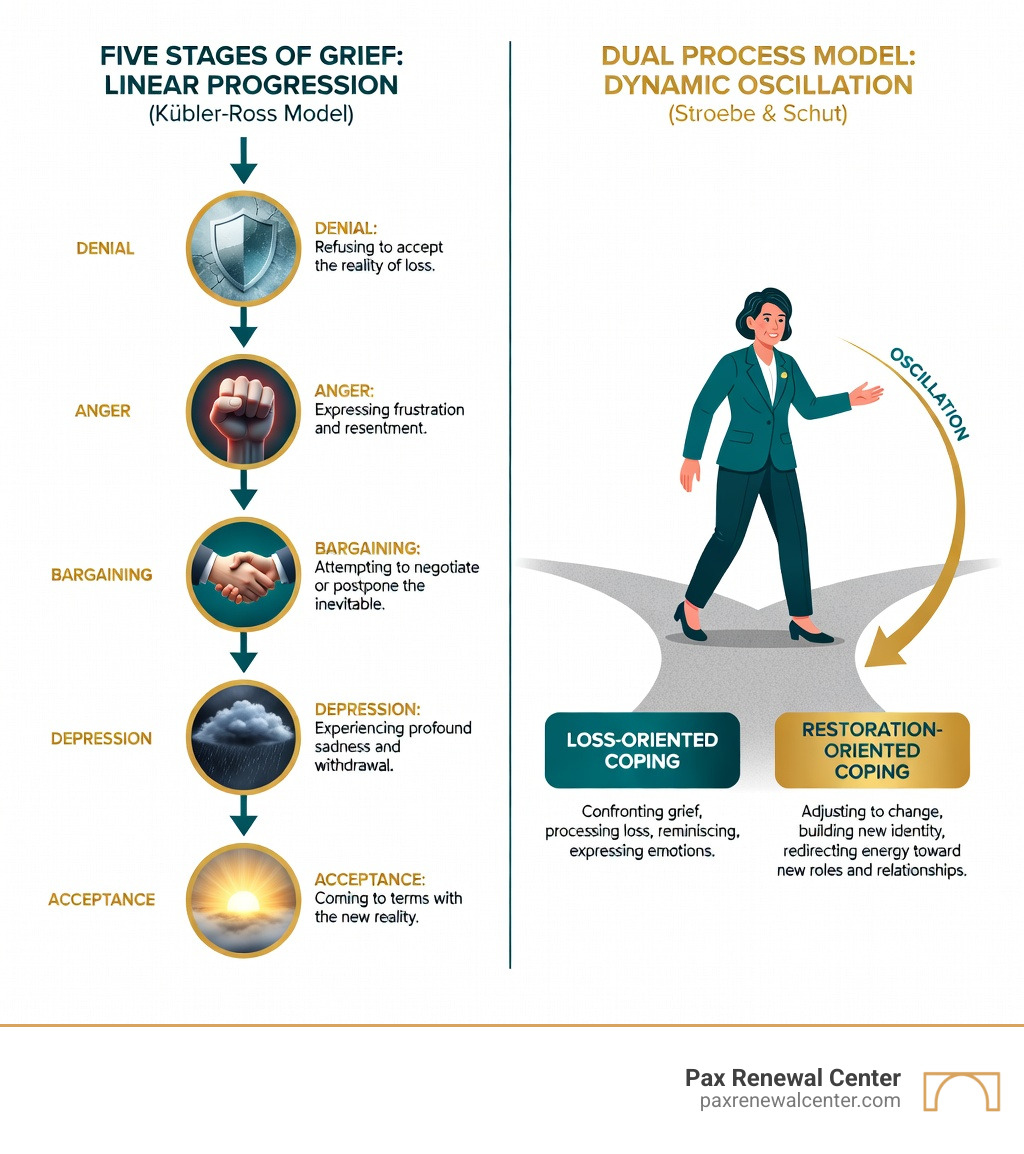
The landscape of grief therapy has transformed dramatically in recent years. The inclusion of Prolonged Grief Disorder in the DSM-5-TR has lifted the clinical importance of specialized training. Traditional models like the Five Stages of Grief are no longer sufficient for effective client care.
Modern grief work demands more than empathy. It requires evidence-based interventions that address the intersection of trauma and loss, cultural sensitivity across diverse populations, and practical tools for everything from childhood bereavement to reproductive grief.
The reality is stark: grief and trauma often intermingle in the counseling process. Without proper training, clinicians risk re-traumatization while missing opportunities for meaningful healing. Clients experiencing complicated grief need therapists who can differentiate between normal grief reactions and persistent complex bereavement—and who know exactly how to intervene.
Whether you’re supporting a client through spousal loss, helping parents steer perinatal grief, or addressing the collective trauma of pandemic-related deaths, specialized training gives you the clinical confidence and practical frameworks to guide your clients toward resolution and growth.
I’m Dan Jurek, M.A., LPC-S, LMFT-S, founder and clinical director of Pax Renewal Center in Lafayette, Louisiana, with over 35 years of clinical experience supporting individuals and families through loss, trauma, and life transitions. Throughout my career, I’ve seen how essential grief training for therapists is to providing compassionate, evidence-based care that honors both the clinical and spiritual dimensions of healing.
Understanding the Spectrum of Loss and the DSM-5-TR
In our work at Pax Renewal Center, we recognize that grief is not a monolithic experience. For many years, clinicians relied on the “normal grief” trajectory, expecting clients to move through a predictable period of mourning. However, the psychological community has shifted toward a more nuanced understanding of how loss impacts the human psyche.
The release of the DSM-5-TR formally introduced Prolonged Grief Disorder (PGD) as a diagnosable condition. This is a game-changer for grief training for therapists. PGD is characterized by intense longing for the deceased or a preoccupation with thoughts of the deceased, accompanied by emotional pain that is so severe it interferes with daily functioning for at least a year after the loss (or six months for children).
Understanding the difference between normal bereavement and traumatic or cumulative grief is essential. Traumatic bereavement occurs when the death is sudden, violent, or unexpected, often leaving the client’s nervous system in a state of hyperarousal. Cumulative grief, on the other hand, is the “grief upon grief” experienced when multiple losses occur in a short window, a phenomenon many in Lafayette and across Louisiana experienced during the height of the global pandemic.
For those looking for More info about grief counseling in Lafayette, it is important to note that specialized training helps clinicians identify when a client is “stuck” in a way that requires more than just a listening ear.
The Impact of Prolonged Grief Disorder
Research from the Center for Prolonged Grief highlights that PGD is distinct from depression or PTSD, though they can co-occur. Neuroimaging studies suggest that individuals with prolonged grief show different brain activity patterns—specifically in the reward centers—when thinking about their loved one, compared to those with integrated grief.
To accurately assess this, grief training for therapists often includes instruction on clinical assessment tools such as:
- Inventory of Complicated Grief (ICG): A scale used to identify the presence of maladaptive symptoms.
- Hogan Grief Reaction Checklist: Useful for tracking the multidimensional nature of the grief response.
- Beck Depression Inventory (BDI): To differentiate between primary grief and clinical depression.
Recognizing Disenfranchised and Living Losses
One of the most compassionate turns in modern therapy is the recognition of disenfranchised grief. This is grief that is not openly acknowledged, socially validated, or publicly mourned. Examples include:
- Pet Loss: For many, a pet is a primary attachment figure, yet society often expects a quick recovery.
- Reproductive Grief: Miscarriage, infertility, and stillbirth are often “silent” losses that carry immense weight.
- Living Losses: The grief associated with divorce, a child leaving home, or a loved one’s diagnosis of dementia (ambiguous loss).
Specialized training teaches us to validate these “non-death” losses, helping clients steer cultural mourning rituals that may be missing or inadequate for their specific situation.
Essential Models and Interventions in Grief Training for Therapists

When we move beyond the “Five Stages,” we enter a world of evidence-based models that offer a much more realistic roadmap for healing. In our practice at Pax Renewal Center, we integrate several of these frameworks to provide a holistic approach.
- The Dual Process Model: This suggests that healthy grieving involves “oscillating” between loss-oriented activities (crying, looking at photos) and restoration-oriented activities (learning new skills, engaging in hobbies).
- The ATTEND Model: Developed by Dr. Joanne Cacciatore, this emphasizes Attunement, Trust, Therapeutic Touch (where appropriate), Empathy, Need, and Degree.
- Companioning Model: Popularized by Alan Wolfelt, this focuses on “being with” the mourner rather than “treating” them.
- Task-Based Model: J. William Worden’s four tasks (Accepting the reality, Processing the pain, Adjusting to the world, and Finding an enduring connection).
Integrating EMDR and Somatic Strategies
Because grief often lives in the body, grief training for therapists is increasingly incorporating somatic and trauma-informed care. At Pax Renewal Center, we are strong proponents of EMDR and trauma-informed therapy in Lafayette, Louisiana.
Grief can be a physiological trauma. Integrating EMDR (Eye Movement Desensitization and Reprocessing) allows us to help clients process the “frozen” memories of a traumatic loss using the Adaptive Information Processing (AIP) model. This prevents re-traumatization and helps stabilize the nervous system, allowing the client to move from a state of “survival” to a state of “integration.”
Meaning Reconstruction and the Sixth Stage
David Kessler, a leading expert who co-authored works with Elisabeth Kübler-Ross, introduced the Sixth Stage of Grief: Meaning. This isn’t about finding a “reason” for the death, but rather finding meaning in the life of the person who died and in the survivor’s life moving forward.
Training in meaning reconstruction often includes:
- The Rainbow of Grief Tool: A neuroscience-informed activity that helps clients use memories for post-loss growth.
- Life Imprint Activity: Helping clients identify the positive traits and values they have “inherited” from the deceased.
- Narrative Therapy: Helping clients rewrite their story in a way that incorporates the loss without being consumed by it.
Navigating Certification Paths and Continuing Education
For the clinician, choosing the right path for grief training for therapists can feel overwhelming. There are several reputable organizations that offer Professional certification standards to validate your expertise.
| Certification | Provider | CE Hours | Focus Areas |
|---|---|---|---|
| CAGCS (Advanced Specialist) | PESI / Evergreen | 12-20 | CBT, EMDR, Somatic, Art Therapy |
| GCTC (Training Certificate) | Various Providers | 7 | DSM-V-TR, Assessment, Basic Models |
| GC-C (Certified Counselor) | AAGC | 100 | Comprehensive Death & Dying Education |
| CGP (Grief Informed) | PESI | 6 | Lifespan-specific, Evidence-based tools |
How to Select the Right Grief Training for Therapists
When selecting a program, we recommend looking for those that satisfy the requirements of major professional boards like the NBCC (National Board for Certified Counselors), ASWB (Association of Social Work Boards), and the APA (American Psychological Association).
If you are a busy professional in Lafayette, self-paced online courses from platforms like PESI or the Hospice Foundation offer flexibility. However, live webinars can provide the “consultation” hours often required for higher-level certifications like EMDRIA-approved EMDR training.
The Benefits of Specialized Grief Training for Therapists
Obtaining a specialty certification isn’t just about adding letters after your name. It provides:
- Clinical Confidence: Knowing you have a “toolbox” of interventions for the most difficult sessions.
- Marketability: Distinguishing your practice in a crowded field.
- Client Trust: Clients often feel safer knowing their therapist has invested in Continuing education requirements specifically for their type of pain.
Most certifications, like those from the American Academy of Grief Counseling (AAGC), are valid for four years and require approximately 50 CE hours for recertification, ensuring you stay current with the latest research in the field.
Specialized Clinical Skills for Traumatic and Diverse Loss
Grief looks different at age five than it does at age fifty. Grief training for therapists must include a developmental perspective. Children often “puddle jump” through grief—feeling intense sadness one moment and wanting to play the next. Adolescents may express grief through risk-taking or withdrawal.
In our local community, we often see a need for More info about local grief support regarding specific, painful losses like perinatal death or the loss of a spouse.
Addressing Reproductive and Perinatal Grief
Reproductive loss—including miscarriage, stillbirth, and birth trauma—requires an incredibly sensitive, attachment-informed approach. Training in this area focuses on:
- Validation: Recognizing the baby as a person and the client as a parent.
- Ritual Co-creation: Helping families find ways to honor the life, such as naming ceremonies or memory boxes.
- Reducing Isolation: Addressing the unique shame and “biological failure” feelings that often accompany these losses.
Cultural Sensitivity and Global Pandemic Impacts
We cannot ignore the sociocultural influences on grief. Different cultures have different “rules” for mourning, and a therapist must be culturally humble. The global pandemic also introduced collective grief and disrupted rituals. Many families were unable to hold traditional funerals, leading to “frozen grief.” Training today helps us address these micro and macro-level grieving processes, often utilizing virtual bereavement support to bridge the gap.
Frequently Asked Questions about Grief Training for Therapists
What is the difference between grief counseling and grief treatment?
Grief counseling generally refers to supporting a client through a “normal” grief reaction, helping them steer the standard tasks of mourning. Grief treatment (or grief therapy) is more clinical and intensive, usually reserved for complicated, traumatic, or prolonged grief that requires specialized interventions like EMDR or CBT-G (Grief-focused Cognitive Behavioral Therapy).
How many CE hours are required for a grief certification?
It varies. A “Grief Informed” designation can often be earned in 6–7 hours. However, a full “Certified Grief Counselor” (GC-C) credential through the AAGC requires 100 hours of grief-specific education.
Are there free resources to supplement formal grief training?
Yes! Many experts offer excellent free content. David Kessler’s blog and “Grief.com” are gold mines for clinicians. Dr. Kate Truitt offers resources on the neuroscience of trauma. Additionally, organizations like the Hospice Foundation often offer free introductory webinars, and some providers offer “workplace care kits” and meditation files for therapists to use with clients.
Conclusion
At Pax Renewal Center in Lafayette, Louisiana, we believe that the journey through grief is sacred. By pursuing advanced grief training for therapists, you are not just checking a box for licensure; you are honoring the profound trust your clients place in you during their darkest hours.
Our team integrates clinical excellence with faith-based values to help our community heal. If you are a clinician looking to refer a client or a seeker looking for a place to process your own loss, we invite you to Explore our professional counseling services. Together, we can move beyond bereavement toward a place of restoration and hope.