
Why Divorce Doesn’t Have to Mean Total Loss
Therapy for divorcing couples offers a path through one of life’s most painful transitions. Here’s what it can do:
- Reduce conflict during the separation process
- Protect your children from unnecessary emotional harm
- Help you make clear decisions about your relationship’s future
- Create a cooperative co-parenting plan that works for everyone
- Process grief and anger in a healthy way
- Divide assets and responsibilities more peacefully
Divorce affects roughly half of all first marriages in the United States. If you’re reading this, you know the statistics are one thing—living through them is another. The emotional weight of a marriage ending can feel crushing. You might be dealing with anger, sadness, confusion, or even relief mixed with guilt.
But here’s what many people don’t realize: divorce doesn’t have to destroy your family. With the right support, it’s possible to separate in a way that minimizes harm, especially to your children.
This guide will walk you through how therapy specifically designed for divorcing couples works differently from traditional marriage counseling. You’ll learn about practical tools for managing conflict, making tough decisions, and building a foundation for healthy co-parenting. We’ll also cover discernment counseling—a specialized approach for couples who aren’t sure whether divorce is the right path.
I’m Dan Jurek, M.A., LPC-S, LMFT-S, founder and clinical director of Pax Renewal Center in Lafayette, Louisiana, and one of the few therapists in Louisiana certified in Discernment Counseling for Couples. Over 35 years of working with couples in crisis, I’ve helped many steer the difficult journey of deciding whether to divorce and, when that’s the path forward, how to make therapy for divorcing couples a tool for healing rather than more hurt.
What Is Divorce Counseling and How Is It Different?
Divorce counseling is a specialized therapy designed to help couples steer the emotional, psychological, and practical aspects of ending a marriage. Unlike traditional couples counseling, which aims to repair the marital bond, the primary focus of divorce counseling is on achieving an amicable and constructive separation.
Divorce can be a traumatic event, causing pain, anger, and uncertainty. With the support of an experienced counselor, it’s possible to steer the process, understand feelings, communicate more effectively, and adjust to new lives.
Our team at Pax Renewal Center in Lafayette, Louisiana, provides a supportive, faith-aligned environment to process these challenges. We help couples manage the psychological and practical aspects of separation, including communication, asset division, and child custody. This guidance can lead to mutually acceptable agreements, potentially making the divorce more affordable by avoiding drawn-out legal battles. Research shows that divorce has significant long-term implications for children, making a supportive separation crucial for their well-being. You can explore scientific research on the long-term implications of divorce on children to understand this impact further.
The Concept of a ‘Good Divorce’
The idea of a “good divorce” might sound contradictory, but it’s rooted in minimizing harm and fostering cooperation, especially when children are involved. It emphasizes a cooperative post-divorce relationship that prioritizes the children’s well-being by reducing conflict and maintaining essential family ties.
Research highlights that the quality of the co-parenting relationship is crucial for a child’s development. Even when a marriage ends, the family system continues in a restructured form. A “good divorce” strives to preserve these family ties, ensuring children feel loved and supported by both parents.
Key Differences from Marriage Counseling
The distinction between divorce and marriage counseling is fundamental to their goals.
Marriage Counseling:
- Goal: To repair, strengthen, and reconcile the marital relationship.
- Focus: Identifying and resolving marital issues, improving communication, and rebuilding intimacy.
- Techniques: Exploring relationship dynamics and historical patterns to foster forgiveness and renewed commitment.
Divorce Counseling:
- Goal: To facilitate a constructive, respectful, and amicable separation.
- Focus: Managing the practical and emotional aspects of ending the marriage, such as asset division, child custody, and processing grief.
- Techniques: Emphasizing respectful detachment, effective co-parenting communication, setting boundaries, and supporting individual healing.
While both involve therapy, their objectives diverge. Divorce counseling helps couples manage the transition and establish a functional post-marital relationship, particularly for their children’s sake.
Navigating the Emotional and Psychological Impacts of Divorce

Divorce is rarely just a legal process; it’s a profound emotional and psychological upheaval. For many, it’s akin to a death of a relationship, triggering a complex grieving process. We understand that this period can be incredibly challenging, marked by a range of intense emotions and significant psychological stress.
Individuals often experience increased short-term symptoms of depression and anxiety. The stress can manifest physically, leading to changes in eating and sleeping habits, and even digestive issues. Beyond the immediate impact on the individuals, divorce can also weaken parent-child and extended family relationships, exposing children to parental conflict and leading to a loss of emotional and financial resources. Our goal at Pax Renewal Center is to help you steer these impacts, providing a compassionate space for healing and growth.
Grieving the End of a Marriage
The end of a marriage involves grieving not only the loss of the relationship as it was but also the loss of a shared future, dreams, and identity. This process can be non-linear and unpredictable, often characterized by “hidden griefs” or “little reminders” that society might overlook but are deeply felt by those experiencing them.
The grieving process associated with divorce often mirrors the stages of grief experienced after a death, including denial, anger, bargaining, depression, and acceptance. It’s crucial to allow space for these emotions to be processed. We encourage clients to use tools like the Grieving After a Divorce worksheet to understand their sense of loss and work through it constructively. Recognizing that grief can reopen old wounds or a history of trauma is also vital for comprehensive healing.
The Impact on Children’s Wellbeing
The impact of divorce on children is a primary concern for many parents. We know that at least 1,000,000 children are affected by divorce every year in the United States. Divorce can negatively impact children in numerous ways, including weakened parent-child relationships, exposure to parental conflict, and loss of emotional support and financial resources.
However, research consistently shows that the quality of the co-parenting relationship, rather than whether parents stay married, is crucial for a child’s continued cognitive, emotional, and physical development. This means that minimizing negative impacts on children largely depends on how parents manage their post-divorce relationship. Therapy for divorcing couples helps parents create a child-centered approach, fostering open communication, establishing consistent routines, and shielding children from parental disputes. Our faith-based approach at Pax Renewal Center also emphasizes the importance of family and provides support for parents to steer these challenges with grace and wisdom.
The Core Process: How Therapy for Divorcing Couples Works

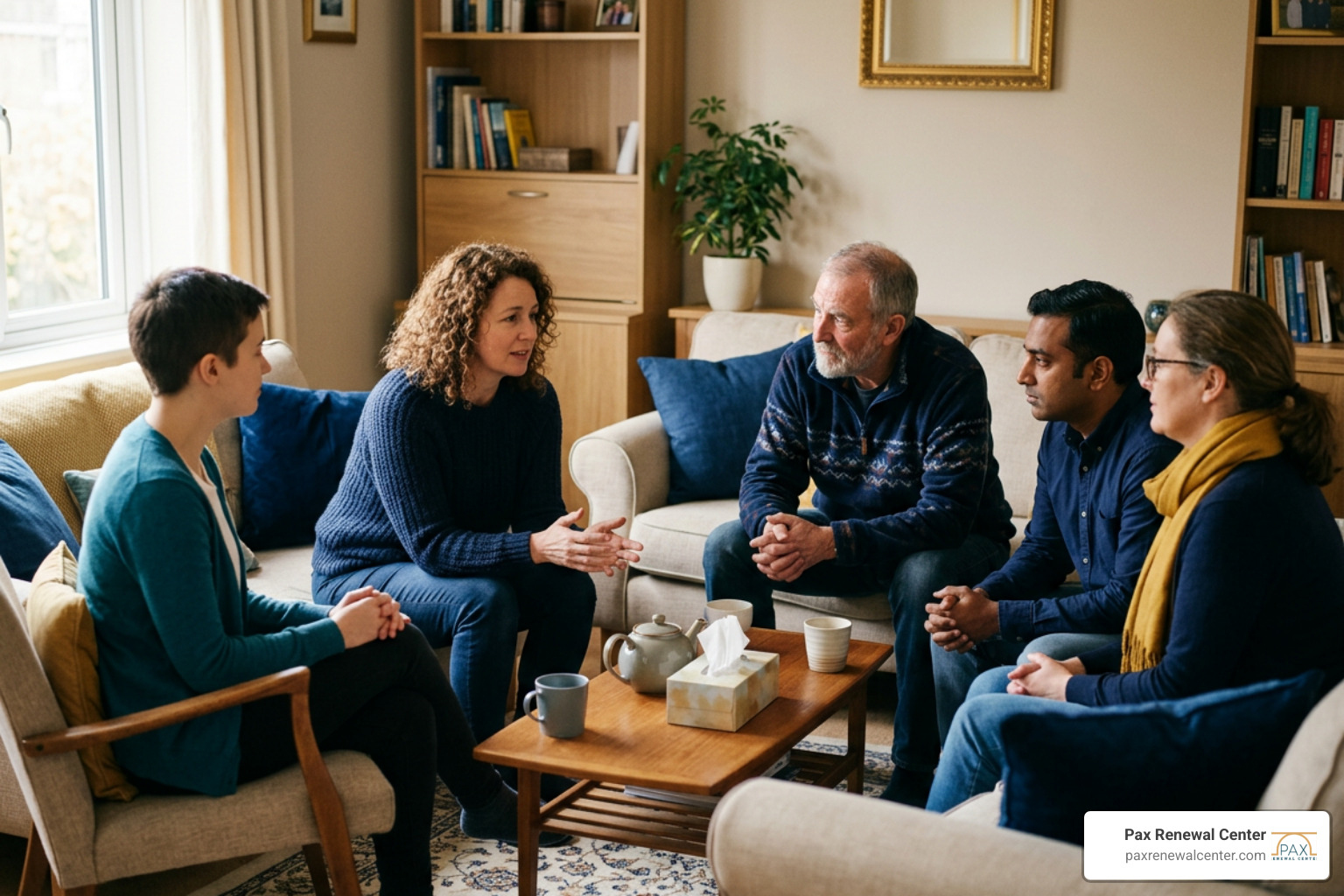
In therapy for divorcing couples, our counselors act as neutral third parties to facilitate a healthier separation. We guide conversations and manage emotions, moving beyond turmoil to focus on practical solutions and healing. The goal is to foster structured, productive dialogue instead of reactive, blame-filled interactions. This involves setting clear boundaries and new relational rules to support the transition, creating a foundation for respectful interactions, especially for co-parenting.
Key Challenges Addressed in Sessions
Divorcing couples face complex challenges, from personal emotional struggles to practical disputes. Common concerns we address include:
- Communication Breakdown: The inability to communicate effectively due to years of unresolved conflict, resentment, or emotional shutdown.
- Conflict over Assets and Finances: Disagreements about how to divide property, savings, debts, and future financial responsibilities.
- Child Custody Disagreements: Disputes over parenting schedules, decision-making authority, and the overall well-being of the children.
- Lingering Resentment and Anger: Unprocessed emotions from the marriage, including feelings of betrayal, hurt, and injustice, which can fuel ongoing conflict.
- Betrayal and Trust Issues: Especially prevalent in cases of infidelity, these deep wounds require careful processing to move towards acceptance and a functional co-parenting relationship.
Our role is to help you steer these challenges, providing strategies for managing emotions and facilitating fair solutions.
Effective Techniques for Conflict Management
Managing conflict during a divorce is paramount to minimizing stress. In therapy for divorcing couples, we employ several techniques to help clients steer disagreements more constructively:
- Active Listening: Encouraging each person to hear and understand their partner’s perspective without interruption.
- ‘I’ Statements: Teaching individuals to express their feelings and needs in a non-accusatory way, focusing on “I feel…” rather than “You always…”.
- The Win-Win Waltz Technique: This valuable worksheet helps clients move from opposing positions to find mutually agreeable solutions.
- De-escalation Strategies: Providing tools like taking breaks during heated discussions and practicing deep breathing.
We also establish clear communication ground rules to ensure productive discussions:
- Respectful Tone: No yelling, name-calling, or personal attacks.
- Focus on the Present: Avoid replaying past hurts.
- One Person Speaks at a Time: Allow for uninterrupted expression.
- Agree to Disagree: Acknowledge that a compromise or agreement to move forward is necessary.
Rebuilding Identity and Self-Worth Post-Divorce
Divorce often triggers an identity crisis, as the end of a marriage can feel like losing a significant part of one’s self.
In therapy for divorcing couples, we help individuals separate their identity from the dissolved marriage and start a journey of self-findy. This involves:
- Exploring Personal Values: Reconnecting with core beliefs and passions that may have been overshadowed.
- Setting New Life Goals: Envisioning a future independent of the former spouse.
- Self-Care Strategies: Developing routines that promote well-being. The Self-Care During a Divorce worksheet can be a helpful starting point.
- Addressing Feelings of Failure: Re-framing the end of the marriage not as a personal failure, but as a life transition that offers opportunities for growth.
- Rebuilding Trust in Oneself: Learning to trust one’s own intuition and decisions again.
This challenging transition can be an invitation into further healing, leading to greater clarity about relational needs and desires moving forward.
Discernment Counseling: Clarity for Couples on the Brink
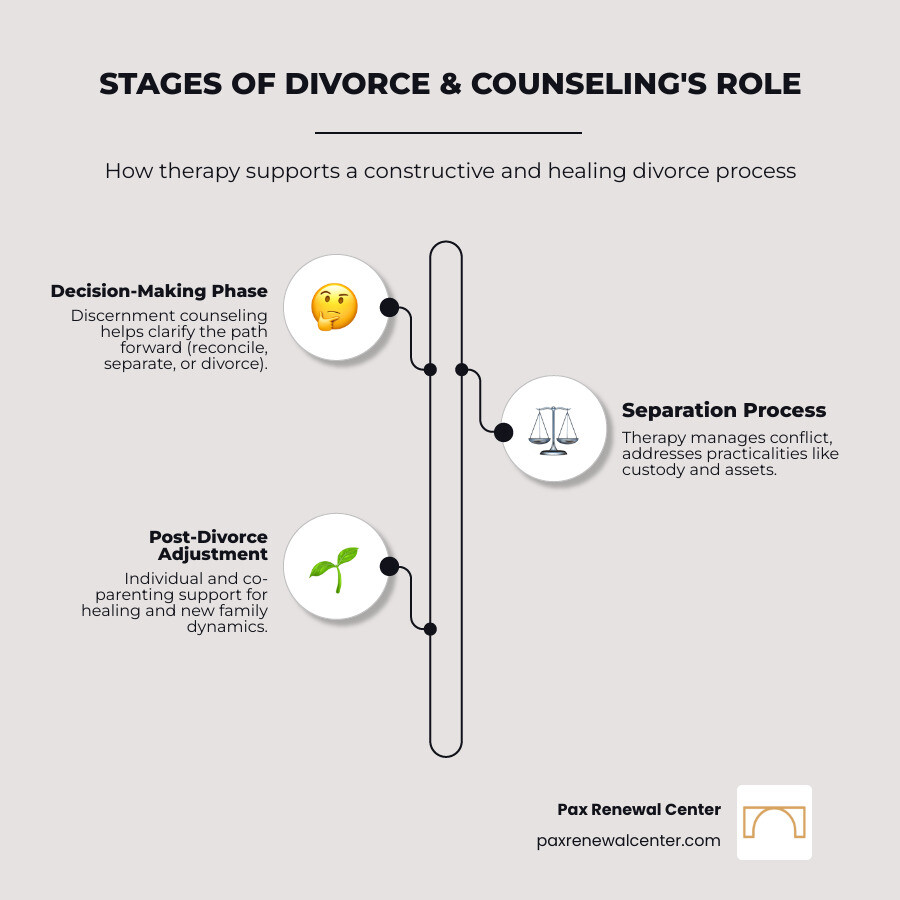
Many couples arrive at our doors at Pax Renewal Center unsure whether divorce is the right path. For these “mixed-agenda” couples—where one partner is leaning towards divorce, the other towards saving the marriage, or both are ambivalent—Discernment Counseling offers a unique and invaluable service.
Discernment counseling is a short-term, decision-focused therapeutic approach, typically lasting 1-5 sessions, designed to help couples gain clarity and confidence about the future of their marriage. It is explicitly not about solving marital problems, but about determining whether those problems can be solved. We are proud to offer More info about Discernment Counseling services at our Lafayette, LA center.
As a Certified Discernment Counselor, I’ve seen how this process provides a safe, structured space for couples to explore their options without the pressure of immediately committing to reconciliation or divorce. This approach helps couples make a thoughtful and informed decision, reducing the likelihood of future regret or ongoing ambivalence. Research on Discernment Counseling for mixed-agenda couples has shown its effectiveness in helping couples achieve greater clarity and confidence in their decision-making.
The Three Paths of Discernment Counseling
In Discernment Counseling, couples explore three possible paths for their relationship:
- Path One: Maintain the Status Quo: The couple decides to continue as they have been, making no immediate changes to their relationship or their decision-making process. This path is chosen when one or both partners are not ready to commit to either divorce or intensive reconciliation efforts.
- Path Two: Move Towards Separation/Divorce: The couple decides to proceed with divorce. Discernment counseling helps them do so in a way that is as respectful and cooperative as possible, laying the groundwork for a “good divorce.”
- Path Three: Commit to a Six-Month Reconciliation Effort: The couple agrees to a structured, time-limited period of intensive couples therapy, fully committing to working on the marriage. This path is entered with a clear understanding of the work involved and a commitment from both partners.
The goal is for both individuals to make a confident decision about their path forward, understanding their own contributions to the marital problems and what a future, whether together or apart, might look like.
How It Improves Co-Parenting
Even if a couple decides to divorce, Discernment Counseling can significantly improve their future co-parenting relationship. By fostering clarity and honesty during the decision-making process, it helps reduce the potential for post-divorce conflict. Participants in studies on discernment counseling reported that it helped them achieve clarity and honesty, leading to greater coparental cooperation post-divorce.
This process lays crucial groundwork for a respectful parenting partnership by:
- Reducing Ambivalence: Both parents move forward with a clearer understanding of why the marriage ended, which can reduce blame and resentment.
- Improving Communication: The structured dialogue learned in counseling can carry over into co-parenting discussions.
- Focusing on Children: The process encourages parents to consider the children’s best interests from the outset, leading to more child-focused decisions.
This collaborative foundation is invaluable for minimizing the negative impacts of divorce on children, promoting a stable and supportive environment even across two households.
Creating a Cooperative Co-Parenting Plan
For couples with children, navigating divorce is not just about ending a marriage; it’s about restructuring a family. Creating a cooperative co-parenting plan is paramount to minimizing disruption for children and ensuring their continued well-being. Our role in therapy for divorcing couples is to guide parents in establishing child-focused decision-making, setting clear communication protocols, and developing a practical parenting schedule.
This involves helping parents develop a “business-like” relationship with each other, where the focus shifts from marital issues to effective collaboration on behalf of the children. We assist in setting clear boundaries, utilizing tools like shared calendars for scheduling, and agreeing on major decisions concerning the children’s education, health, and upbringing. For comprehensive support, we also offer Counselling for Co-Parenting services in Lafayette, LA.
Here’s a comparison of how individual and couples counseling can address co-parenting issues:
| Aspect | Individual Counseling for Co-Parenting | Couples Counseling for Co-Parenting |
|---|---|---|
| Focus | Personal emotional regulation, coping strategies, individual contributions to co-parenting challenges. | Direct communication between co-parents, conflict resolution, joint decision-making, drafting agreements. |
| Benefits | Reduces personal stress, improves self-awareness, develops healthier reactions to ex-spouse’s behavior. | Establishes unified front for children, creates consistent rules, reduces direct conflict, builds cooperation. |
| When to Choose | When one parent struggles with emotional reactivity, resentment, or needs support in their parenting role. | When both parents are willing to work together, even with high conflict, to create a shared plan. |
What to Expect in Therapy for Divorcing Couples Focused on Co-Parenting
When you engage in therapy for divorcing couples with a specific focus on co-parenting, you can expect a structured and goal-oriented process. We help parents:
- Develop a Business-like Relationship: This means learning to interact with your former spouse primarily as partners in raising your children, minimizing personal emotional mess.
- Set Clear Boundaries: Establishing guidelines for communication, interaction, and decision-making that protect both parents and children from unnecessary conflict.
- Use Shared Tools: Implementing practical strategies like shared online calendars or communication apps to manage schedules and information effectively.
- Agree on Major Decisions: Facilitating discussions and agreements on crucial topics such as schooling, healthcare, extracurricular activities, and religious upbringing.
- Receive Ongoing Support: Providing a safe space to process challenges, refine strategies, and access resources that support healthy co-parenting.
Our aim is to create a functional and stable co-parenting dynamic that places your children’s needs at the forefront, even amidst the changes of divorce.
Individual vs. Couples: Which Therapy for Divorcing Couples Is Right?
Deciding between individual counseling and couples counseling during and after a divorce depends on your specific needs and circumstances. Both offer distinct benefits:
Benefits of Individual Counseling:
- Emotional Processing: Provides a safe space to grieve, process anger, sadness, and other complex emotions without the presence of the former spouse.
- Identity and Self-Worth: Helps individuals rebuild their sense of self, explore new life goals, and address feelings of failure or inadequacy.
- Coping Mechanisms: Equips individuals with personal strategies to manage stress, anxiety, and depression that often accompany divorce.
- Rebuilding Trust: Focuses on restoring self-trust and preparing for future healthy relationships.
- Personal Growth: Allows for deep introspection and personal development, changing the divorce into an opportunity for healing and expansion.
Benefits of Couples Counseling (for divorcing couples):
- Structured Communication: Facilitates direct, respectful communication between former spouses, especially for co-parenting discussions.
- Conflict Resolution: Addresses specific areas of disagreement, such as asset division or custody arrangements, with a neutral third party.
- Co-Parenting Plan Development: Collaboratively creates a comprehensive plan that outlines responsibilities, schedules, and decision-making for children.
- Minimizing Harm: Works to reduce animosity and create a more amicable separation process, benefiting both adults and children.
When to Choose One Over the Other:
- Individual counseling is often recommended when one partner is unwilling to attend joint sessions, when there’s a need for deep personal emotional processing, or in situations where one partner feels unsafe or overwhelmed by direct interaction with the other.
- Couples counseling (for divorcing couples) is ideal when both partners are committed to an amicable separation and co-parenting, even if conflict is high. It’s particularly effective for creating practical agreements and communication protocols.
In high-conflict situations, a combination of individual and couples counseling may be the most effective approach, allowing for individual healing while still providing a forum for necessary joint discussions. Our therapists at Pax Renewal Center in Lafayette, LA, can help you determine the best path for your unique situation.
Frequently Asked Questions about Divorce Counseling
Navigating a divorce brings many questions, and we’re here to provide clarity. Here are some common questions we encounter regarding therapy for divorcing couples.
How much does divorce counseling cost?
The cost of divorce counseling can vary widely based on several factors, including the therapist’s experience, the duration and frequency of sessions, and the specific services provided. While we don’t discuss specific pricing here, it’s worth noting that investing in divorce counseling can often be more affordable than drawn-out legal battles. Divorce counseling can help couples reach mutually acceptable agreements early on, potentially avoiding significant legal fees. We also offer affordable options like group therapy and our online community through the Skool platform, providing expert-led support at a reduced cost.
How do we find the right divorce counselor?
Finding the right divorce counselor is crucial for a successful outcome. We recommend looking for a therapist with:
- Specialized Training: Look for counselors who are specifically trained in divorce mediation, family systems therapy, or discernment counseling. Our therapists at Pax Renewal Center, for example, integrate clinical best practices like EFT, Gottman Method, EMDR, and CBT, and are often trained in discernment counseling.
- Experience with High-Conflict Couples: An experienced therapist can effectively mediate difficult conversations and guide couples through intense emotions.
- Alignment with Values: If faith is important to you, consider a faith-based approach. At Pax Renewal Center, our compassionate care is rooted in Catholic and Christian values, providing spiritual guidance alongside clinical expertise.
- Importance of Fit: The right counselor is someone with whom both individuals feel comfortable, respected, and understood. We encourage initial consultations to assess this personal fit.
Can counseling help us decide whether to divorce?
Yes, absolutely. This is precisely where discernment counseling plays a crucial role. For couples who are “on the brink” and unsure about their future, discernment counseling helps clarify their options. It provides a structured, short-term process to explore:
- Personal Contributions: Each individual’s role in the marital problems, fostering a deeper understanding of the dynamics.
- Exploring All Options: A thorough examination of the three paths: maintaining the status quo, committing to intensive reconciliation, or moving towards divorce.
- Making a Decision with Confidence: The goal is not to pressure a specific outcome but to ensure that whatever decision is made, it is done with clarity, confidence, and a sense of informed choice, rather than out of confusion or regret.
This process helps individuals and couples move from ambivalence to a clear path forward.
Conclusion: Building a Hopeful Future After Divorce
Divorce is undeniably one of life’s most challenging transitions, affecting approximately half of all first marriages in the U.S. and impacting millions of children annually. However, engaging in therapy for divorcing couples offers a powerful pathway to transform this difficult ending into an opportunity for healing, personal growth, and a hopeful future.
Throughout this guide, we’ve explored how divorce counseling differs from traditional marriage counseling, focusing on constructive separation rather than reconciliation. We’ve seen how it can help individuals and families steer profound emotional and psychological impacts, from processing grief and rebuilding identity to minimizing harm to children through cooperative co-parenting. Specialized approaches like discernment counseling offer clarity for couples on the brink, guiding them toward confident decisions about their marriage’s future.
The benefits are clear: reduced conflict, healthier communication, a foundation for respectful post-divorce interactions, and the opportunity for both adults and children to adjust and thrive. We firmly believe that divorce can be a transition, not just an end, opening doors to further healing and clarity about future relational needs. It is indeed possible to achieve a “good divorce” – one characterized by mutual respect, effective co-parenting, and a commitment to the well-being of all involved.
At Pax Renewal Center in Lafayette, Louisiana, our compassionate, professional, and faith-aligned approach is dedicated to supporting individuals, couples, and families through these complex journeys. We are here to help you find healing, personal growth, and spiritual renewal, guiding you towards building healthy relationships in the future.
If you are navigating the complexities of divorce or seeking clarity for your relationship’s future, please don’t hesitate to reach out. Find faith-based support for your journey with our couples counseling services at Pax Renewal Center, where we integrate clinical best practices with spiritual guidance to help you move forward with hope and confidence.