

Why Ongoing Training Makes Better Mental Health Counselors
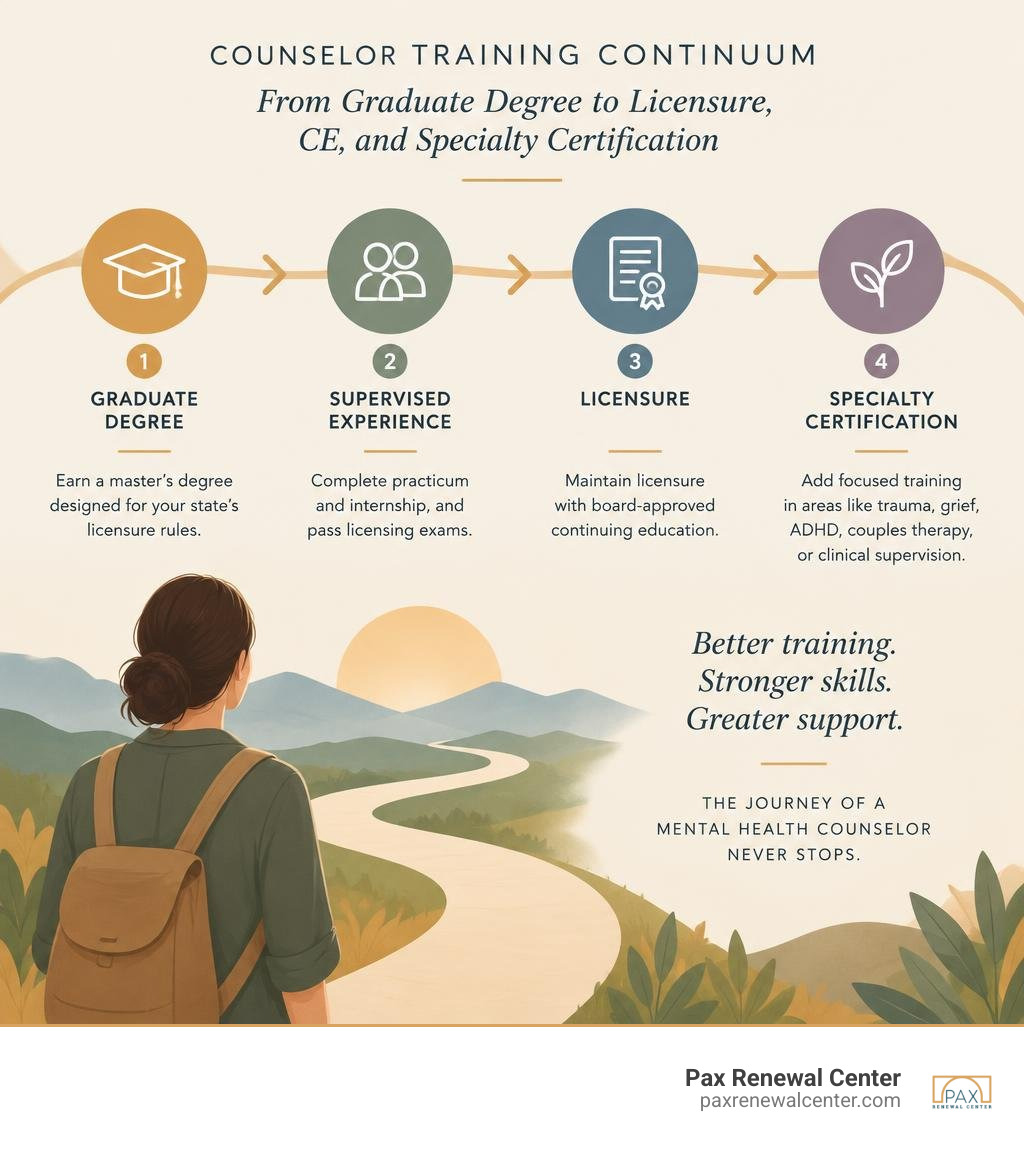
Training for mental health counselors starts with a qualifying graduate degree, supervised practicum and internship work, and state licensure. It continues throughout a counselor’s career through board-approved continuing education, clinical supervision, and focused training in the needs of the people they serve.
A practical path looks like this:
- Earn a master’s degree designed to meet your state’s counseling licensure rules.
- Complete supervised clinical experience and pass required licensing exams.
- Maintain licensure with approved continuing education in areas such as ethics, telehealth, and suicide prevention.
- Add specialized training in trauma, grief, ADHD, couples therapy, or clinical supervision when it fits your practice goals.
This is not just a professional requirement. It is how counselors keep their skills current, use evidence-based care responsibly, and offer safer support to clients facing anxiety, loss, trauma, relationship strain, and major life changes. Demand reinforces the need: employment for mental health counselors is projected to grow 17% from 2022 to 2032.
I am Dan Jurek, M.A., LPC-S, LMFT-S, a counselor and clinical director with more than 35 years of experience in individual, marriage, and family therapy. My perspective on training for mental health counselors comes from long-term clinical practice, supervision, and integrating approaches such as CBT, EFT, and the Gottman Method with ethical, faith-sensitive care.
Training for mental health counselors terms at a glance:
Foundational Training for Mental Health Counselors: Degrees, Practicum, and Licensure

The journey to becoming a licensed clinician demands academic rigor, hands-on field experience, and deep personal reflection. At its core, the foundational pathway prepares practitioners to translate psychological theories into empathetic, effective care.
Aspiring counselors must first choose between master’s-level counseling degrees and doctoral pathways (such as a Ph.D. or Psy.D. in Counselor Education, Clinical Psychology, or Marriage and Family Therapy). For most practitioners focused primarily on direct clinical practice, a Master of Arts (M.A.), Master of Science (M.S.), or Master of Education (M.Ed.) in Clinical Mental Health Counseling serves as the primary stepping stone.
Quality graduate programs align their curricula with standards established by credentialing bodies like the Council for Accreditation of Counseling and Related Educational Programs (CACREP). These curricula typically range between 60 and 62 semester credit hours, covering essential pillars:
- Human growth and development across the lifespan
- Social and cultural diversity in counseling
- Counseling theories and helping relationships
- Group counseling dynamics and facilitation
- Career development and lifestyle assessment
- Assessment, diagnostic testing, and clinical appraisal
- Research methods, evidence-based evaluation, and program assessment
- Professional counseling orientation and ethical practice
A defining element of graduate education is the clinical experience requirement. High-caliber programs mandate at least 700 clock hours of supervised clinical work, typically broken down into a 100-hour practicum (with at least 40 hours of direct client contact) followed by a 600-hour clinical internship (with at least 240 hours of direct contact). For example, the Master of Arts in Clinical Mental Health Counseling at Adler University requires 62 credits and over 700 supervised clinical hours, blending core clinical competencies with a commitment to community advocacy. Understanding the step-by-step therapist training process ensures candidates navigate these rigorous requirements smoothly.
| Training Model | Typical Duration | Credit / Contact Hours | Primary Focus | Best Suited For |
|---|---|---|---|---|
| Master’s in Clinical Mental Health Counseling (M.A. / M.S. / M.Ed.) | 2 to 3.5 Years | 60–62 Credits; 700+ Supervised Hours | Direct client counseling, diagnosis, treatment planning, and state licensure preparation. | Clinicians seeking outpatient, private practice, or agency counseling roles. |
| Doctoral Programs (Ph.D. / Psy.D. in CES or Clinical Psychology) | 4 to 6 Years | 90–120+ Post-Baccalaureate Credits | Advanced clinical intervention, clinical supervision, academia, advanced research, and psychological testing. | Future counselor educators, clinical researchers, and clinical directors. |
| Post-Graduate Residencies & Multidisciplinary Fellowships | 1 to 2 Years | 1,500–2,000 Hours / Year (Full-Time) | Specialized clinical immersion (e.g., integrated health, trauma, veteran care) under board-approved supervision. | Provisionally licensed clinicians seeking advanced clinical mastery and structured support. |
Master’s Programs vs. Post-Graduate Fellowships
While graduate degree programs build foundational diagnostic and therapeutic knowledge, post-graduate residencies and hospital-based fellowships provide immersive, real-world experience. Large multidisciplinary systems—such as the Kaiser Permanente Mental Health Training Program, which trains over 300 clinicians annually across medical centers—bridge the gap between textbook theory and complex, integrated healthcare delivery.
For working adults and career changers, flexible academic options have grown substantially. Modern distance programs, such as the Clinical Mental Health Counseling online MA at TCNJ, provide structured coursework while arranging local field placements. Other notable distance options include the online MS in Clinical Mental Health Counseling at Methodist University, the online MA in Mental Health Counseling at American International College, the online MS in Clinical Mental Health Counseling at St. Catherine University, and the online Master’s in Mental Health Counseling at Lehigh University. Demystifying accredited online training for counselors helps prospective clinicians verify that their chosen distance program satisfies both regional educational accreditation and national counseling standards.
Navigating State Licensure and Clinical Supervision Requirements
Graduating with a master’s degree marks the beginning of post-degree provisional practice. New graduates must register with their state licensing board to earn provisional or associate status (such as a Provisionally Licensed Professional Counselor or PLPC in Louisiana).
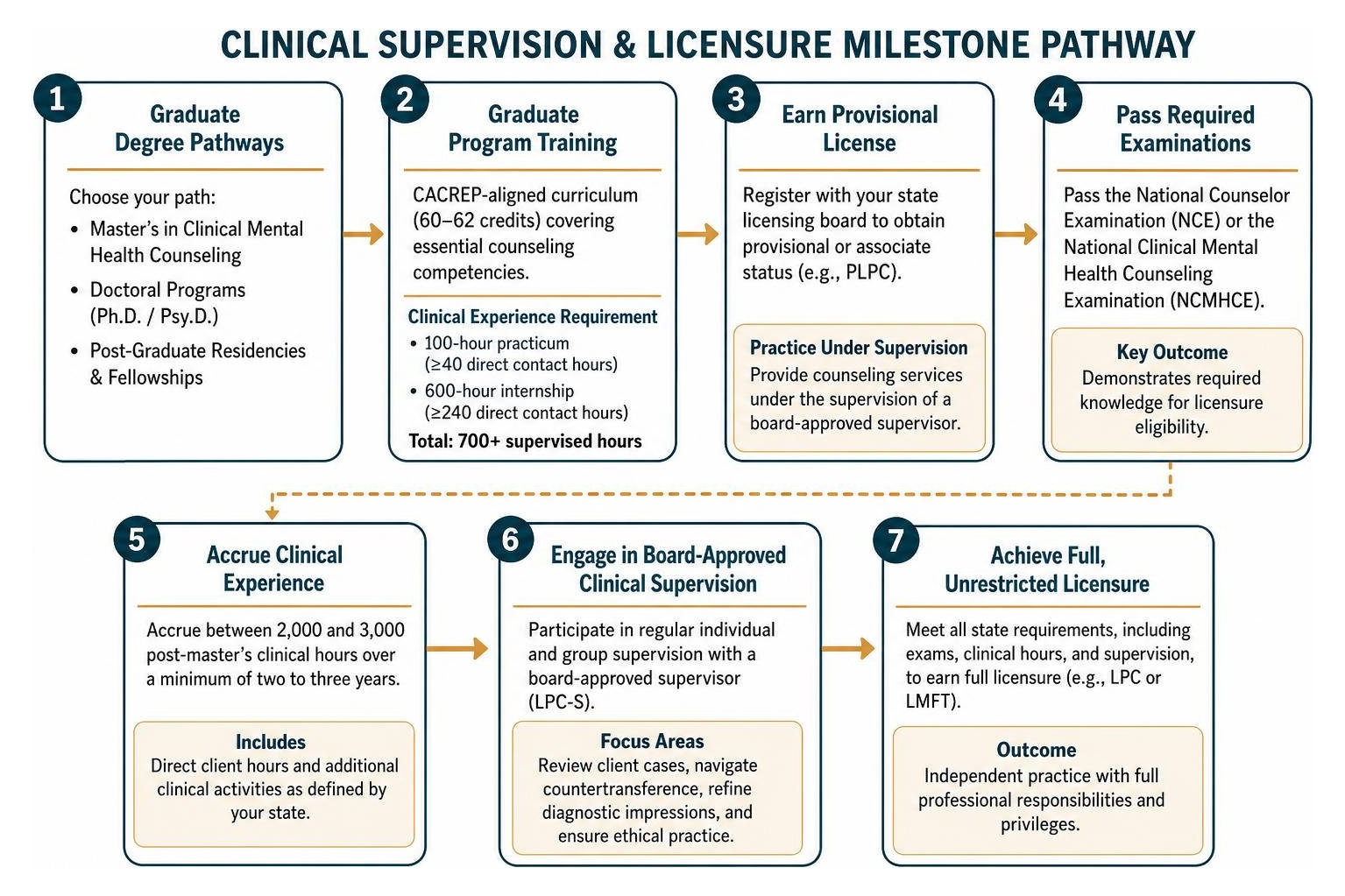
Achieving full, unrestricted licensure (such as an LPC or LMFT) requires meeting specific state benchmarks:
- Pass Required Examinations: Candidates must pass the National Counselor Examination (NCE) or the National Clinical Mental Health Counseling Examination (NCMHCE).
- Accrue Direct and Indirect Clinical Hours: Most jurisdictions require between 2,000 and 3,000 post-master’s clinical hours over a minimum of two to three years.
- Engage in Board-Approved Clinical Supervision: Clinicians must log regular individual and group supervision hours with a board-approved supervisor (LPC-S) to review client cases, navigate countertransference, refine diagnostic impressions, and ensure ethical practice.
Clinicians practicing in Louisiana begin by submitting their credentials through the Louisiana LPC Board application process. Securing the right mentor is vital; working with an experienced LPC supervisor in Louisiana provides the clinical insight and systemic guidance needed to move from provisional status to independent clinical practice.
Continuing Education and Licensure Maintenance: Earning Board-Approved CEUs

Completing graduate school and earning a license is not the finish line—it is the baseline. As mental health research, diagnostic standards, and neurobiology evolve, practicing counselors must participate in ongoing professional development to maintain their licenses and protect client welfare.
State licensing boards require practitioners to earn Continuing Education Units (CEUs) or clock hours approved by national bodies like the National Board for Certified Counselors (NBCC) or state-specific associations. Reviewing a practical guide to approved CEU trainings for counselors ensures that course hours meet audit criteria. In our home state, clinicians must follow Louisiana counseling continuing education guidelines, which require 40 clock hours of approved continuing education every two-year renewal cycle.
Ethics, Telehealth, and State-Mandated CE Hours
Continuing education is not simply about collecting general credits; licensing boards mandate focused training in high-liability and rapidly changing practice areas:
- Professional Ethics and Jurisprudence: Most boards require 3 to 6 hours in legal updates, confidentiality laws (including HIPAA), documentation, and boundary management aligned with the American Counseling Association (ACA) Code of Ethics.
- Telehealth and Digital Practice: The expansion of remote therapy requires specific training in secure platforms, crisis management across digital channels, and state licensing laws. Therapists in our region must complete approved Louisiana telehealth training courses to meet mandatory distance therapy regulations.
- Suicide Assessment and Crisis Intervention: Many states require periodic coursework in lethal means counseling, risk assessment protocols, and evidence-based crisis intervention.
- Cultural Responsiveness and Social Drivers of Health: Modern standards emphasize ongoing training in systemic inequities, multicultural competencies, and treating diverse client populations effectively.
Free and Low-Cost Professional Development Resources
Professional growth does not have to strain your budget. Clinicians can sharpen their skills through accessible tools and educational initiatives:
- Downloadable Assessment Tools: Open-access symptom tracking inventories (such as the PHQ-9 for depression, GAD-7 for anxiety, and PCL-5 for PTSD) help clinicians measure objective client progress.
- State Association Webinars and Lunch-and-Learns: Regional mental health counselor chapters frequently host free or low-cost webinars covering emerging topics such as sandtray interventions, functional recovery in major depressive disorder, and ethical AI utilization.
- Peer Consultation and Study Groups: Meeting regularly with trusted colleagues allows clinicians to discuss challenging cases, maintain trauma stewardship practices, and prevent secondary traumatic stress.
Advanced Clinical Certifications: Trauma, Grief, Couples, and ADHD
While generalist training equips counselors for a broad range of presenting concerns, advanced certifications allow clinicians to deepen their expertise in specific clinical populations and complex diagnoses. Earning specialized credentials elevates clinical precision, sharpens treatment planning, and improves client outcomes.
Nationally recognized credentials, such as the Certified Clinical Mental Health Counselor (CCMHC) administered by the NBCC, validate advanced clinical knowledge, extensive supervised experience, and high ethical standards. Similarly, acquiring specialized credentials in trauma recovery, ADHD coaching, grief counseling, or relationship therapy helps clinicians deliver targeted care for difficult symptoms.
Advanced Modality Training for Mental Health Counselors: Trauma, Grief, and Relationships
Clients facing severe distress need clinicians who are skilled in specialized, evidence-based therapeutic modalities. Broadening your clinical toolkit through post-licensure certification yields significant therapeutic breakthroughs:
- Eye Movement Desensitization and Reprocessing (EMDR): Clinicians seeking to resolve deep trauma and PTSD can invest in EMDRIA-approved training. Equipping your practice with advanced trauma training for counselors helps clients process traumatic memories without becoming overwhelmed.
- Comprehensive Trauma Competencies: Gaining a broader framework to become a trauma counselor ensures you can treat complex PTSD, childhood neglect, and medical trauma using somatic and nervous-system regulation strategies.
- Advanced Grief and Bereavement Therapy: Moving beyond basic bereavement into advanced grief therapy gives therapists practical tools to help clients navigate traumatic loss, complicated grief, and existential transitions.
- Couples and Relationship Interventions: Relationship distress requires specialized systemic assessment. Completing online Gottman Method training or Emotionally Focused Therapy (EFT) certifications equips therapists with structured, research-backed roadmaps to defuse conflict, repair attachment injuries, and restore intimacy.
Integrating Evidence-Based Modalities with Holistic and Faith-Based Approaches
At Pax Renewal Center in Lafayette, Louisiana, our clinical philosophy centers on treating the whole person—mind, body, heart, and spirit. We believe that top-tier clinical training and deeply held faith complement one another.
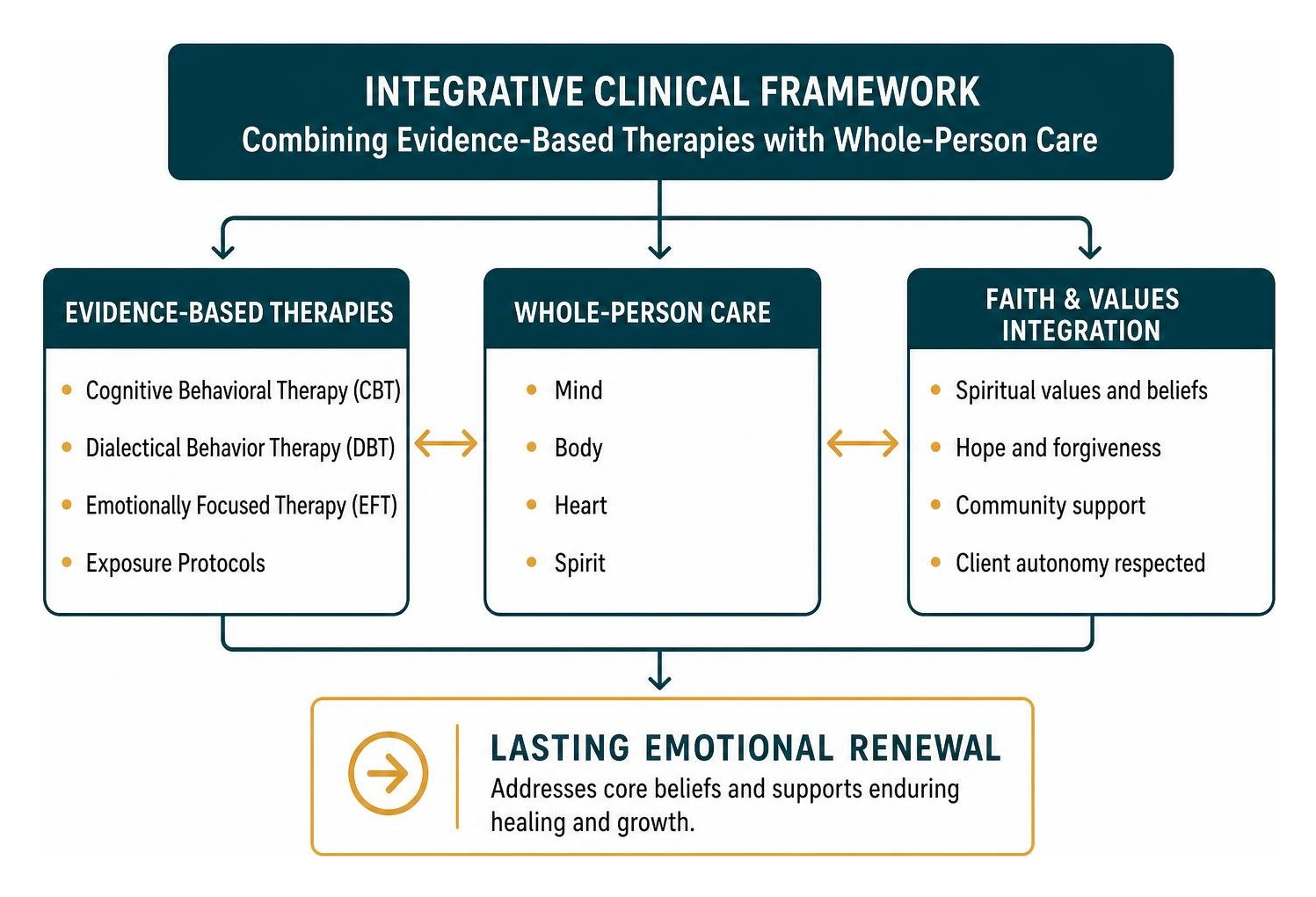
When therapists combine evidence-based methods—such as Cognitive Behavioral Therapy (CBT), Dialectical Behavior Therapy (DBT), Emotionally Focused Therapy (EFT), and exposure protocols—with a client’s spiritual values, therapy addresses foundational core beliefs. Faith-integrated counseling respects client autonomy while drawing upon hope, forgiveness, and community support systems to facilitate lasting emotional renewal.
Selecting the Right Training Program for Your Career Pathway
With hundreds of workshops, online CEU platforms, and certification bodies available, counselors must carefully assess where to invest their time and educational resources. Making strategic choices ensures that your training translates directly into improved client outcomes.
Evaluating Quality in Specialized Training
Before enrolling in advanced training, evaluate programs against key quality criteria:
- Board Approvals and Accreditations: Confirm that the provider is recognized by the NBCC, ACA, APA, or your state licensing board to ensure your hours count toward renewal.
- Instructor Credentials and Active Clinical Experience: Look for instructors who are active clinicians, clinical supervisors, or established researchers in their subject area.
- Format and Practical Application: Decide whether a self-paced on-demand course fits your lifestyle or if a live, interactive workshop is needed for real-time skill practice.
- Inclusion of Clinical Consultation: Advanced modalities (such as EMDR or Gottman Level 2/3) require case consultation hours to help you apply techniques with active clients safely.
Aligning Clinical Training with Practice Goals and Client Demographics
Your training pathway should reflect the community you serve and your long-term career vision:
- Private Practice Clinicians: Focus on specialized niche areas (such as couples intensives, affair recovery, OCD exposure therapy, or neurodivergence/ADHD) that address specific community needs.
- Community Mental Health and Agency Practitioners: Emphasize crisis de-escalation, trauma stewardship, substance use disorders, and evidence-based depression interventions.
- Integrated Behavioral Health Specialists: Pursue training in chronic illness management, pain psychology, and interdisciplinary collaboration within medical settings.
As your skills grow, your professional marketability increases. Starting salaries for clinical mental health counselors typically range between $60,000 and $78,000, while experienced, fully licensed counselors in specialized private or group practices frequently earn $100,000 to $130,000 or more.
Frequently Asked Questions About Counselor Training
How many hours of continuing education do mental health counselors need for renewal?
Continuing education requirements vary by state licensing board. In Louisiana, Licensed Professional Counselors (LPCs) must complete 40 approved contact hours every two-year renewal period. These hours must include mandatory minimums in professional ethics (typically 3 to 6 hours), approved telehealth training, and state-mandated suicide prevention coursework. Always check your specific board rules to confirm valid sponsors and credit limits for online learning.
What is the difference between a certificate of completion and a clinical certification?
A certificate of completion verifies that a counselor attended and completed a specific course, webinar, or workshop (e.g., attending a 6-hour seminar on CBT). A clinical certification (such as becoming an EMDR Certified Therapist, Certified Clinical Trauma Professional, or CCMHC) requires a comprehensive process: completing advanced educational modules, logging documented direct clinical practice hours with that modality, receiving direct case consultation from an approved consultant, and passing a competency exam.
Can counselors complete accredited graduate training or CEUs online?
Yes. Many universities provide high-caliber, CACREP-aligned online master’s programs in mental health counseling that blend live virtual seminars (synchronous learning) with independent modules (asynchronous study) and local hands-on clinical practicums. Furthermore, licensed counselors can earn most—and often all—of their required continuing education hours through board-approved webinars, digital seminars, and interactive online workshops.
Conclusion
Excellence in mental health counseling is a continuous pursuit. From foundational graduate studies and intensive supervised internships to advanced certifications in trauma, couples therapy, and grief, dedicated training equips clinicians to guide clients through life’s most complex challenges. Ongoing professional development ensures that every client who walks through your door receives safe, evidence-based, and compassionate care.
At Pax Renewal Center, our team of licensed therapists in Lafayette, Louisiana, combines clinical modalities—including EMDR, EFT, CBT, and the Gottman Method—with compassionate, faith-integrated guidance. Whether you are an individual navigating anxiety and trauma, a couple seeking marital restoration, or a family searching for guidance, explore our compassionate counseling services at Pax Renewal Center to begin your journey toward emotional healing and relational renewal.