Finding Hope: Your Guide to a Spousal Grief Support Group
Joining a spousal grief support group can help you find your footing when you feel completely lost after losing your partner.
Losing a spouse is unlike any other loss. It changes your daily routines, your social life, and even your identity. If you need immediate help, here is how you can access specialized grief platforms right now:
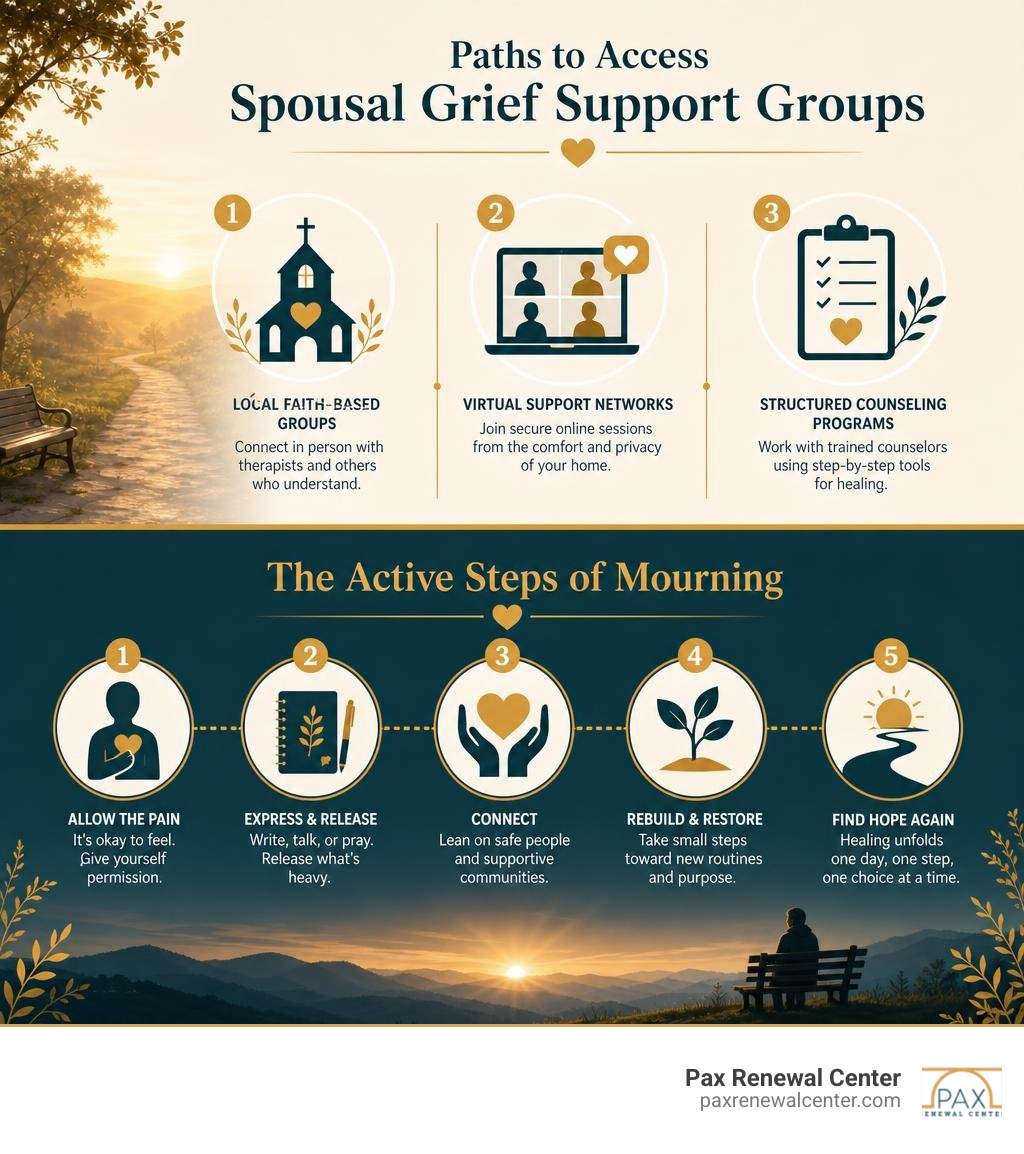
- Local Faith-Based Groups: Connect with trusted, licensed therapists in Lafayette, Louisiana, for in-person, faith-integrated healing.
- Virtual Support Networks: Join secure, online video sessions if you prefer to share your journey from the comfort of home.
- Structured Counseling Programs: Look for counselor-led groups that offer active, step-by-step tools to process deep pain rather than just open discussion.
The weight of this loss can feel too heavy to carry on your own. But you do not have to walk this dark path in isolation.
I am Dan Jurek, M.A., LPC-S, LMFT-S, founder of Pax Renewal Center, and I have spent over 35 years helping grieving spouses navigate their pain through professional counseling and faith-integrated spousal grief support group settings. My goal is to help you process this deep trauma, rebuild your daily life, and find a safe, compassionate community where you can truly heal.
Key terms for spousal grief support group:
What is a Spousal Grief Support Group and How Does It Help?
When you experience the death of a husband, wife, or partner, your world does not simply change—it completely shatters. A spousal grief support group is a highly specialized gathering of individuals who are all navigating this exact, life-altering experience. Unlike a general bereavement circle, which might include people grieving the loss of a parent, a friend, or a coworker, a spousal loss group focuses entirely on the unique, multi-layered trauma of losing a life partner.
At Pax Renewal Center, we understand that this journey requires more than just passive time; it demands active, compassionate processing. A dedicated group provides a safe, non-judgmental container where you can express your deepest fears, anger, and sorrow without feeling like a burden to your well-meaning friends or family.
For many, a support group serves as a vital bridge out of isolation. It is a space where your pain is normalized, your emotional setbacks are expected, and your small victories are celebrated. By walking alongside peers who truly understand the physical and emotional exhaustion of widowhood, you learn that you are not losing your mind—you are simply navigating a profound, natural human process. For deeper insights on how these groups facilitate recovery, you can explore our guide on How to Navigate Life After Loss with a Spouse Grief Support Group.
How Spousal Loss Differs from General Grief
Losing a spouse is a unique form of bereavement because it triggers what clinicians call “secondary losses.” When a partner dies, you do not just lose their physical presence. You also lose:
- Your daily confidant and best friend.
- Your co-parent, financial partner, or household coordinator.
- Your shared dreams, retirement plans, and social identity as a couple.
This loss forces an immediate, overwhelming identity shift. You are suddenly thrown into a world where you must transition from “we” to “I.” This process, known as “undoing the psycho-social ties” that bind you to your partner, is incredibly taxing.
Everyday routines—like making a single cup of coffee, sitting in an empty living room, or managing household bills that your spouse once handled—become painful reminders of your loss. In a general grief group, the focus may be on adjusting to the absence of a loved one you saw occasionally. In a spousal loss group, the focus is on rebuilding a life that has been completely emptied of its primary daily anchor.
The Unique Benefits of Partner Loss Groups
Sharing your story with peers who have lived through the exact same type of loss brings a unique level of comfort. In a dedicated partner loss group, you do not have to explain the crushing weight of coming home to an empty house or the anxiety of facing major life transitions alone. The mutual understanding within the room acts as an immediate emotional balm.

One of the most effective frameworks we utilize in our clinical approach is J. William Worden’s “Tasks of Mourning.” This model views healing as an active, non-linear process rather than a set of passive stages you must wait out. In a partner loss group, you are guided through these four essential tasks:
- Accepting the Reality of the Loss: Moving past the initial shock and emotional fog to acknowledge that your partner is physically gone.
- Processing the Pain of Grief: Allowing yourself to feel the full spectrum of emotions—anger, sadness, guilt, and fear—rather than suppressing them.
- Adjusting to a World Without Your Partner: Developing new skills, taking on new roles, and learning how to navigate daily responsibilities independently.
- Finding an Enduring Connection While Moving Forward: Honoring your partner’s memory and continuing your bond with them while actively building a meaningful, fulfilling life for yourself.
By working through these tasks in a structured peer environment, you can actively combat the intense isolation that often leads to complicated grief or depression. To learn more about local resources and clinical approaches in our area, read our comprehensive Grief Counseling Lafayette LA Guide.
Age-Specific Support for Younger and Older Spouses
Grief is highly personal, and the practical challenges you face often depend on your stage of life. This is why specialized support groups frequently segment participants by age or life stage to foster deeper, more relevant connections.
- Young Widows and Widowers (Under 50): Younger grieving spouses face distinct, high-pressure challenges. They are often balancing demanding careers, raising young children or teenagers as single parents, and navigating the social isolation of being the only widowed person in their peer group. Their discussions often center around co-parenting through grief, managing financial survival, and the daunting prospect of eventually rebuilding a new life chapter.
- Seniors and Older Adults (55+): For older adults, the loss of a spouse often comes after decades of shared history. The challenges here are deeply rooted in adjusting to altered, long-term daily routines, managing physical loneliness, and redefining identity after a lifetime of partnership. Group support for this demographic focuses heavily on combatting senior isolation, finding new daily purposes, and sharing practical resources for independent living.
Formats and What to Expect in a Support Group
If you are considering joining a spousal grief support group, it is helpful to understand the different formats available so you can choose the one that aligns best with your comfort level and schedule.
- In-Person Groups: These groups meet face-to-face in local counseling centers, churches, or community spaces. The physical presence of others, the shared silence, and the face-to-face connection can be incredibly healing for those struggling with severe home isolation.
- Virtual Support Groups: Conducted via secure video conferencing, virtual groups allow you to access professional support without the stress of travel. This format is ideal for those with limited mobility, busy parenting schedules, or high social anxiety.
- Hybrid Models: Some programs offer a combination of virtual sessions and occasional in-person gatherings, providing both flexibility and the opportunity for physical community connection.
If you are looking for professional, therapist-led options tailored to your needs, you can search for qualified Grief Therapists Near Me to find a local program that fits your life.
What Happens During a Typical Spousal Grief Support Group Meeting?
Walking into your first meeting can feel intimidating, but knowing what to expect can help ease your anxiety. A typical session lasts between 60 to 90 minutes and follows a structured flow to ensure everyone feels safe and supported:
- Welcome and Grounding: The facilitator opens the meeting, reviews group guidelines to ensure confidentiality, and leads a brief breathing or mindfulness exercise to help participants settle in.
- Psychoeducation or Theme Introduction: The facilitator introduces a specific topic, such as managing holiday grief, dealing with emotional fog, or J. William Worden’s Tasks of Mourning.
- Active Group Discussion: Members are invited to share their experiences related to the weekly theme. There is never any pressure to speak; simply listening to others is highly respected and therapeutic.
- Creative Expression or Workbook Exercises: Many groups incorporate structured activities, such as drawing a “Grief Map” to identify where stress lives in the body, or completing an “Identity Inventory” to reflect on personal growth.
- Closing and Resources: The session ends with a supportive wrap-up, a reminder of self-care practices for the week, and the distribution of helpful resources or readings.
To help you decide which type of group is right for you, here is a comparison of peer-led and therapist-led support groups:
| Feature | Peer-Led Support Groups | Therapist-Led Support Groups |
|---|---|---|
| Facilitator | Fellow grievers / volunteers | Licensed Professional Counselors (LPCs) |
| Primary Focus | Shared storytelling and mutual peer comfort | Clinical processing, psychoeducation, and coping skills |
| Structure | Casual, open-ended, and flexible | Structured curriculums (e.g., J. William Worden’s Tasks) |
| Safety Assessment | Rely on group dynamics and basic guidelines | Pre-screening interviews and clinical crisis intervention |
| Best For | Long-term companionship and casual sharing | Processing trauma, complicated grief, and deep anxiety |
How to Find a Spousal Grief Support Group Near You or Online
Finding a trusted group requires looking in the right places. If you live in the Lafayette, Louisiana area, there are several excellent community and clinical avenues to explore:
- Faith-Based Directories: The local faith community offers deep comfort for those who want to integrate spiritual values into their healing. You can find local, church-based support networks through Lafayette, Louisiana GriefShare Groups – Grief Recovery Support.
- Diocesan Resources: For Catholic-specific bereavement ministries and parish-based support groups in our local area, consult the Grief Resources | Roman Catholic Diocese of Lafayette, Louisiana.
- Regional Support Networks: If you are willing to look at broader regional programs across South Louisiana, you can connect with the Healing Hearts Grief Support Group | Baton Rouge or explore regional lists via the Bereavement groups, grief support available directory.
- National Directories: If you are searching for a highly structured, video-driven program near you, use the global search tool at GriefShare: Find a Group to locate an active weekly group.
How to Know If You Are Ready to Join
It is completely normal to wonder if you are “ready” to join a support group. Some people seek out a group within weeks of their loss because the isolation feels unbearable. Others prefer to wait several months until the initial shock has subsided and they feel capable of listening to others’ pain without feeling completely overwhelmed.

Signs that you may be ready to join a group include:
- You feel lonely and isolated, even when surrounded by friends or family.
- You are looking for practical, real-world coping strategies to help manage your daily routines.
- You want to speak openly about your spouse without feeling like you are bringing down the mood of those around you.
- You are ready to actively process your grief rather than trying to distract yourself or avoid your feelings.
If you find that your grief is deeply intertwined with spiritual questions or a crisis of faith, integrating clinical therapy with spiritual direction can offer profound relief. To learn more about this approach, read our guide on Finding Comfort in Faith-Based Grief Therapy and Spiritual Guidance.
Overcoming Roadblocks to Healthy Grieving
As you navigate this journey, you may encounter emotional roadblocks that stall your healing. These roadblocks often include:
- Surviving Spouse Guilt: Feeling guilty for being the one who survived, or feeling guilty during moments when you find yourself laughing or enjoying life again.
- Emotional Avoidance: Keeping yourself excessively busy with work, chores, or social obligations to avoid sitting with the painful reality of your loss.
- Severe Mental Fog and Exhaustion: Feeling physically and cognitively depleted, making it difficult to make decisions or engage in deep conversations.
When these roadblocks turn into complicated grief, traumatic shock, or persistent depression, peer support alone may not be enough. In these cases, professional, trauma-informed therapy is essential to help you process the underlying emotional wounds. If your loss was sudden, traumatic, or highly complicated, we invite you to read Finding Hope and Healing a Guide to Trauma Treatment to understand how specialized clinical care can help you safely release this pain.
Frequently Asked Questions about Spousal Grief Support
How much do spousal grief support groups cost?
The cost of a spousal grief support group varies widely depending on the format and the facilitating organization. Many non-profit organizations, local churches, and community hospice programs offer weekly support groups completely free of charge to remove financial barriers to care.
For professional, therapist-led groups, there is typically a nominal fee per session to cover the cost of clinical facilitation, and some practices offer sliding-scale options based on financial need. Some structured programs may also require a small, one-time fee to cover the cost of participant workbooks or guides.
How long do these support programs typically last?
Support groups are structured in several different ways to meet different needs:
- Short-Term Structured Cycles: Many educational or clinical groups run on an 8-to-13-week cycle. These closed groups focus on a specific curriculum, helping you move systematically through the tasks of mourning with the same core group of people.
- Long-Term Programs: Some community programs meet weekly for a full year or longer, recognizing that the intense waves of spousal grief do not adhere to a short-term calendar.
- Open-Group Formats: These groups meet ongoingly (often monthly or bi-monthly) and allow members to drop in or out as needed, offering flexible, long-term support with no commitment.
Can I combine a support group with individual therapy?
Absolutely. In fact, combining a peer-led or therapist-led support group with individual therapy is often considered the gold standard for healthy grief recovery.
While a support group provides invaluable peer companionship, normalization, and shared coping strategies, individual therapy offers a private space to address personal trauma, family conflicts, or clinical depression. In individual sessions, a licensed therapist can utilize evidence-based modalities like Eye Movement Desensitization and Reprocessing (EMDR), Cognitive Behavioral Therapy (CBT), or Emotionally Focused Therapy (EFT) to help you process the specific, painful details of your loss at your own pace.
Conclusion
Losing your spouse is one of the most profound, exhausting journeys you will ever walk. But as you navigate this dark valley, please remember that you do not have to carry this heavy load alone. Joining a spousal grief support group can provide the compassionate community, professional guidance, and shared understanding you need to begin rebuilding your life.
At Pax Renewal Center in Lafayette, Louisiana, our team—led by Dan Jurek—is deeply committed to helping you experience emotional healing and spiritual renewal. We specialize in integrating clinical best practices like EMDR, CBT, and Gottman Method therapy with compassionate, faith-based counseling rooted in Christian and Catholic values. Whether you are looking for local, in-person counseling or affordable online support communities, we are here to walk beside you every step of the way.
When you are ready to take the next step toward hope and healing, we invite you to Explore Pax Renewal Center Services and let us help you carry your heavy load.