

Find Approved CEU Trainings That Fit Your Counseling License
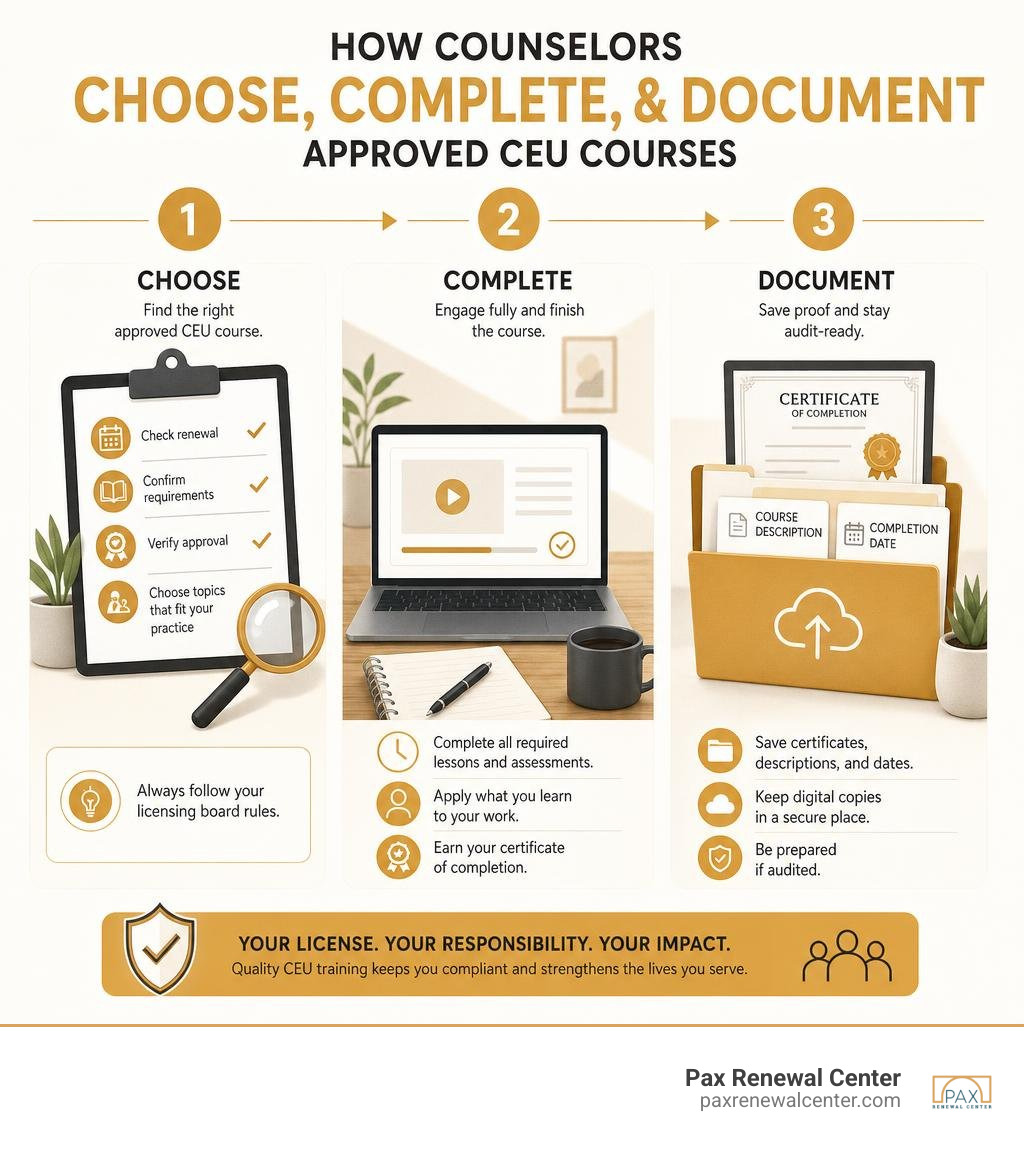
To choose approved CEU trainings for counselors, start with your state licensing board’s renewal rules. Then select courses from providers recognized by your board or an accepted national approver, confirm the course format counts, and save every completion certificate.
A simple checklist:
- Check your renewal deadline and total required hours.
- Identify required subjects, such as ethics, suicide assessment, law, or health equity.
- Verify the provider and course approval before enrolling.
- Choose clinical topics that strengthen your work with clients, such as trauma, CBT, DBT, grief, multicultural competence, or telehealth.
- Keep digital copies of certificates, course descriptions, and completion dates in case of an audit.
Requirements differ by license and state. For example, Washington certified counselors complete 36 hours every two years, including required ethics training, while suicide assessment and health equity training follow separate multi-year schedules. Your own board rules always control, especially when limits apply to self-study or on-demand courses.
I am Dan Jurek, M.A., LPC-S, LMFT-S, a counselor and clinical director with more than 35 years of experience in faith-integrated counseling, trauma, individual, and couples work. This guide to CEU trainings for counselors is designed to help clinicians meet renewal requirements while building skills that better serve real people and families.
Ceu trainings for counselors vocab to learn:
Understanding State Board Requirements and Accreditation Standards
Navigating continuing education can feel like sorting through a maze of state mandates, board rules, and credentialing terminology. We know how easy it is to become overwhelmed when trying to make sense of what truly counts toward your license renewal. Understanding the underlying regulations helps you turn a routine administrative requirement into a meaningful opportunity for professional growth.
When evaluating continuing education opportunities, it helps to review accredited online training for counsellors terms demystified to clarify how national approvals intersect with regional rules. For local practitioners, reviewing CE Courses for Louisiana Counselors – Impact CE ensures you remain fully compliant with regional board policies.
Mandatory Focus Areas: Ethics, Suicide Prevention, and Health Equity
State licensing boards structure continuing education to ensure clinicians remain legally sound, clinically competent, and culturally attuned. Most jurisdictions require specific allocations across key regulatory categories:
- Professional Ethics and Law: A recurring core requirement across licensing bodies to ensure practitioners remain well-versed in confidentiality, HIPAA regulations, boundaries, and legal precedents.
- Suicide Risk Assessment, Treatment, and Management: Highly targeted clinical training focused on identifying warning signs, safety planning, and managing acute crises.
- Health Equity and Implicit Bias: Specialized coursework examining cultural barriers, systemic disparities, and self-reflection to provide sensitive care to diverse client populations.

Navigating Approvals from NBCC, ASWB, and State Licensing Boards
Before enrolling in any continuing education program, verify the organization’s accreditation credentials. Major credentialing bodies include:
- National Board for Certified Counselors (NBCC): Approves providers through the Approved Continuing Education Provider (ACEP) framework, recognized widely across counseling boards.
- Association of Social Work Boards (ASWB): Oversees continuing education standards often accepted cross-professionally for interdisciplinary mental health workshops.
- State Licensing Boards: Some state boards maintain direct registries or utilize tracking systems like CE Broker.
Always confirm that self-study or distance-learning modules include a post-course test of comprehension to ensure formal board acceptance.
Core Topics Covered in CEU Trainings for Counselors

Continuing education provides an exceptional platform to expand your clinical repertoire, integrate updated diagnostic standards, and master evidence-based interventions that directly benefit the individuals, couples, and families you serve.
Top Clinical Modalities in CEU Trainings for Counselors
Modern continuing education courses offer deep clinical insight into transformative therapeutic frameworks:
- Eye Movement Desensitization and Reprocessing (EMDR): Clinicians seeking to support healing from deep emotional wounds often explore the ultimate guide to becoming a trauma counselor to understand how trauma-informed protocols restore nervous system regulation.
- Dialectical Behavior Therapy (DBT): Focuses on distress tolerance, emotion regulation, mindfulness, and radical acceptance, making it ideal for treating high-risk behaviors and chronic suicidality.
- Cognitive Behavioral Therapy (CBT) & Acceptance and Commitment Therapy (ACT): Groundbreaking cognitive approaches that help clients identify unhelpful thought patterns and take value-driven actions.
- Internal Family Systems (IFS): A compassionate, parts-based framework designed to resolve inner conflicts and foster emotional integration.
Specialized Tracks: Grief, ADHD, and Clinical Supervision
Clinicians often seek targeted tracks to address specific client needs:
- Complex Grief and Loss: Navigating profound loss requires advanced clinical techniques. Clinicians can study beyond bereavement advanced grief therapy for clinicians to guide clients through complicated bereavement.
- Neurodevelopmental Disorders: Specialized courses prepare therapists to earn credentials such as the ADHD Clinical Services Provider (ADHD-CCSP) designation, blending behavioral strategies with executive functioning support.
- Clinical Supervision: Serving as a supervisor requires mastery of legal boundaries, developmental models, and evaluative feedback. Those mentoring future clinicians can discover pathways outlined in supervision success in the bayou state best LPC supervisors in Louisiana.
Multicultural Competence, Transference, and International Frameworks
Deepening cultural humility is vital for therapeutic rapport. Specialized courses explore how countertransference, cultural assumptions, and implicit biases influence the clinical alliance.
Counselors working with school-aged populations and adolescents can also draw valuable insights from international frameworks, such as the Erasmus Course for School Counsellors: Young People in Distress, which highlights structured support plans and narrative strategies for youth experiencing internalizing distress and school avoidance. Additional international programs, such as the Guidance and Counselling Administration in Schools Course (Ghana) – CEEL Training, Guidance and Counselling Administration in Schools Course (USA) – CEEL Training, and Counselling Training for Teachers – CEEL Training, offer insight into how counseling administration and empathy-building are taught across diverse academic environments. Broader interdisciplinary certificates, including the Advanced Certificate in Romani Studies at CEU and executive leadership curricula like The EMBA for The open world ® , emphasize how cultural diversity, human rights, and purpose-driven decision-making intersect with supportive human services.
Evaluating Course Formats and Subscription Models
Choosing how to earn your continuing education hours depends on your clinical schedule, learning preferences, and professional goals. Practitioners can choose from various delivery models to fulfill their licensure needs:
| Format Type | Learning Style | Primary Advantage | Best Suited For |
|---|---|---|---|
| Unlimited Annual Subscription | Self-paced, on-demand text or video | Maximum flexibility and access to broad catalogs | Independent learners seeking steady, year-round hours |
| Individual Course Purchases | Asynchronous or scheduled single modules | Highly targeted learning on niche topics | Clinicians needing specific hours to close renewal gaps |
| Live Interactive Webinars | Synchronous virtual sessions with real-time Q&A | Fulfills live/interactive board hour requirements | Clinicians who thrive on real-time peer discussion |
| Multi-Day Clinical Certifications | Cohort-based intensives with supervision | Deep clinical mastery and specialized credentials | Counselors building dedicated niche practices (e.g., EMDR) |
To optimize your ongoing education, review strategies in 5 ways to find professional training for therapists like a pro.
Cost Comparison: Subscriptions vs. Individual CEU Trainings for Counselors
When choosing between annual subscription models and single-course purchases, consider your total hourly requirements. Unlimited subscription plans allow you to explore diverse clinical topics throughout your renewal cycle without paying per course. Conversely, individual course purchases make sense if your licensing board limits asynchronous home-study credits or if you only need a specific ethics or supervision course to complete your cycle.
Live Interactive Webinars vs. Asynchronous Self-Study Courses
It is essential to understand how your state board categorizes delivery formats:
- Synchronous (Live Webinars / In-Person): Feature real-time instructor engagement, live chat, and immediate Q&A. Many boards consider live webinars equivalent to in-person classroom hours.
- Asynchronous (Digital Seminars / Text-Based Reading): Offer self-paced convenience, allowing you to read clinical materials or watch recorded modules around client sessions. These typically require passing a comprehension post-test before a certificate is generated.
Always verify whether your board caps the number of asynchronous or home-study hours you may claim during a single renewal cycle.
Best Practices for Tracking and Documenting Continuing Education Hours
Maintaining organized documentation ensures you can submit your renewal materials without stress or fear of an audit.

Recordkeeping and Board Audit Preparation
Establish a reliable system to safeguard your continuing education records:
- Maintain Digital and Physical Backups: Save digital PDF copies of completion certificates in a dedicated folder organized by renewal cycle.
- Log Essential Details: Keep a running tracking sheet with the course title, approved provider name, ACEP or approval number, date completed, and specific category (Ethics, Suicide Prevention, Clinical Modality, Supervision).
- Archive Course Syllabi: Retain course descriptions, learning objectives, and presenter credentials in case a board auditor requests verification of clinical relevance.
- Track Alternative Learning Credits: If your board permits credit for writing peer-reviewed articles, presenting workshops, or serving on professional committees, document all agendas, published dates, and attendance records.
- Retain Records for the Full Audit Window: Most licensing boards require clinicians to retain documentation for several years beyond the active renewal period.
Finding Accredited Free and Low-Cost Training Resources
Maintaining your license does not have to strain your professional budget. Many reputable avenues provide accredited or low-cost continuing education:
- Professional Association Memberships: Joining national or state professional counseling associations often includes a set number of complimentary webinars or discounted CE credits annually.
- Introductory Modality Webinars: Major training organizations frequently offer free introductory workshops covering emerging evidence-based treatments, screening tools, and documentation strategies.
- Public Health Portals: Government and non-profit health organizations often sponsor accredited, no-cost training modules on suicide prevention, veteran mental health, and substance use disorders.
Frequently Asked Questions About Counselor Continuing Education
How do I know if a CEU provider is approved by my state licensing board?
Check the provider’s accreditation statement before purchasing a course. Look for recognized national bodies, such as the National Board for Certified Counselors (NBCC ACEP status) or the ASWB, and cross-reference the provider with your state licensing board’s list of accepted sponsors.
What is the difference between standard CEUs and advanced clinical certifications?
Standard CEUs provide didactic hours to refresh knowledge and satisfy license renewal minimums. Advanced clinical certifications (such as EMDR certification, complex trauma credentials, or ADHD clinical specialist designations) require comprehensive didactic instruction paired with mandatory group consultation hours, case presentations, and formal evaluations of clinical competency.
How many hours of ethics or suicide prevention training do counselors need?
Mandates vary by licensing jurisdiction. While general professional ethics requirements typically recur every two-year cycle, specialized topics such as suicide risk assessment or health equity often operate on multi-year reporting rotations established by regional statutes. Always review your board’s current administrative code for exact hourly quotas.
Conclusion
Continuing education should be more than an administrative hurdle—it is an ongoing commitment to ethical excellence, clinical mastery, and compassionate client care. By intentionally selecting accredited courses that deepen your therapeutic skills, you enrich your practice and help individuals, couples, and families find lasting healing and restoration.
At Pax Renewal Center, we are dedicated to fostering relational renewal and emotional wellness through faith-aligned, evidence-based care. Whether you are seeking specialized guidance for your family or exploring our comprehensive counseling services, our experienced team is here to walk alongside you on the journey toward healing.