

Why Catholic Mental Health Matters Now More Than Ever
Catholic mental health resources and ministries are growing across the United States as the Church responds to an urgent mental health crisis. Here’s what you need to know:
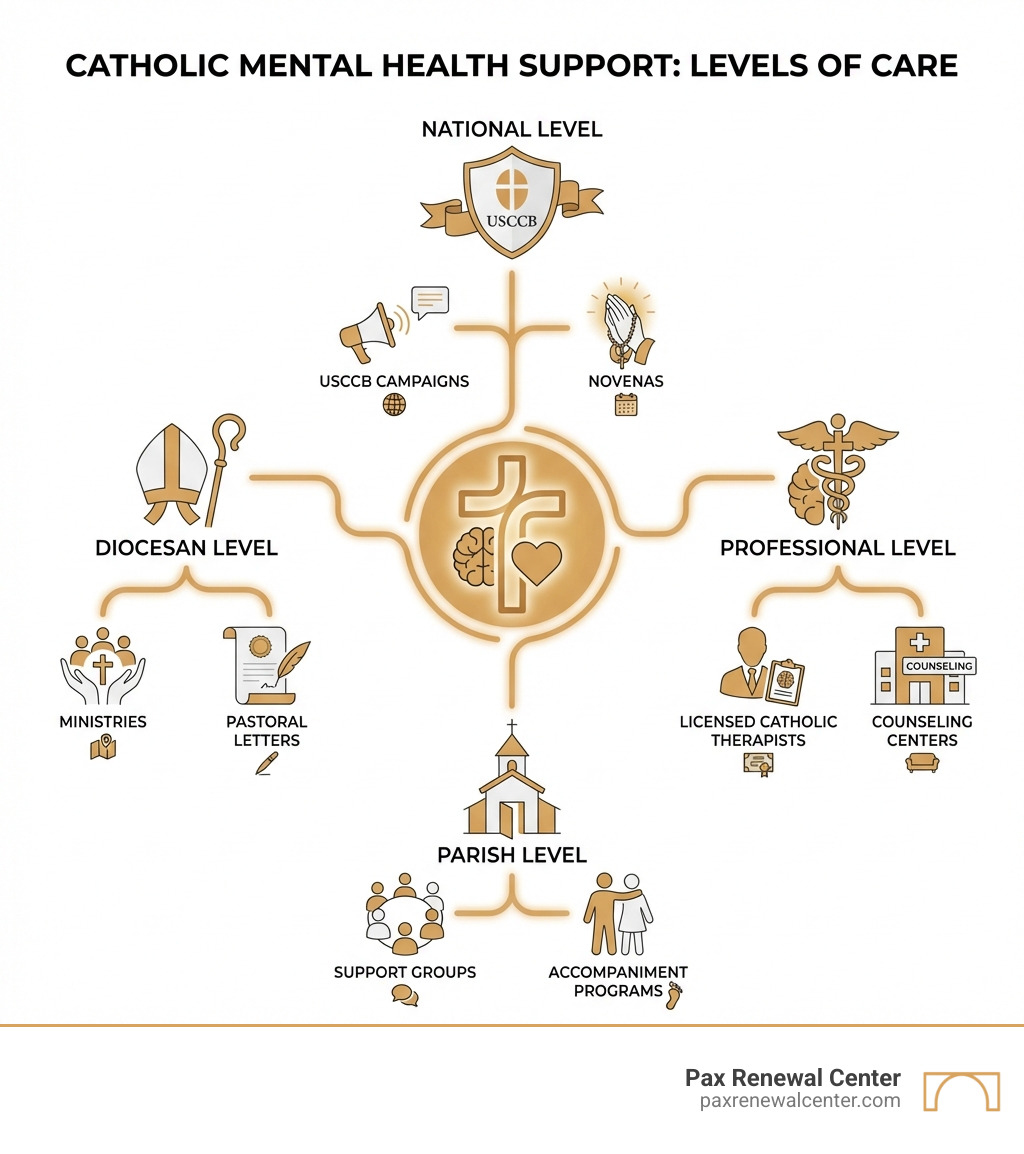
Where to Find Catholic Mental Health Support:
- National Resources – The USCCB’s National Catholic Mental Health Campaign offers prayer, education, and advocacy
- Diocesan Ministries – 12% of US dioceses have dedicated mental health ministries providing local support
- Parish-Level Programs – Many parishes offer support groups, the Sanctuary Course and peer accompaniment
- Professional Counseling – Licensed Catholic therapists integrate clinical excellence with faith-based values
Key Facts:
- One in five adults experiences mental illness each year
- The Church teaches that mental illness is not a moral failure or character defect
- Faith-based support works best alongside professional treatment, not as a replacement
The numbers tell a sobering story. In 2021, nearly 23% of American adults, 57.8 million people, experienced mental illness. Among young people, the crisis is even more acute, with 42% of high school students reporting persistent feelings of sadness or hopelessness. The Catholic Church has responded by launching national initiatives, with bishops across the country issuing pastoral letters and the USCCB establishing an annual Novena for Mental Health from October 10-18.
But finding the right support can feel overwhelming. While 65% of US dioceses offer only minimal mental health information on their websites, a growing number are establishing meaningful ministries. Some dioceses provide comprehensive resource lists, others have built dedicated mental health ministries, and many are training parish communities to become “sanctuaries” for those struggling.
The Church’s response reflects a deep theological truth: every person is made in God’s image and possesses inherent dignity, regardless of mental health challenges. As the California bishops wrote in their pastoral letter “Hope and Healing,” mental illness “strikes deep within the human soul,” but never diminishes a person’s worth. This perspective shapes a uniquely Catholic approach—one that honors both the biological reality of mental illness and the spiritual dimension of human healing.
I’m Dan Jurek, M.A., LPC-S, LMFT-S, founder and clinical director of Pax Renewal Center in Lafayette, Louisiana, where I’ve spent over 35 years integrating Catholic mental health principles with evidence-based therapies like EMDR, EFT, and the Gottman Method. My work bridges the gap between professional clinical care and faith-based healing, helping individuals and couples find renewal through both psychological insight and spiritual growth.
This guide will help you understand the Catholic perspective on mental wellness, steer the growing landscape of diocesan and parish ministries, and find professional services that honor both clinical excellence and Catholic values.
Understanding the Catholic Perspective on Mental Wellness
At the heart of the Catholic approach to mental health lies a profound understanding of the human person. We believe that every individual, regardless of their struggles, is created in the image and likeness of God (Genesis 1:27) and possesses inherent dignity. This foundational truth shapes how we conceptualize mental health and illness, guiding our response with compassion and a commitment to holistic care.
Historically, the relationship between faith and mental well-being within American Catholicism has seen various influences and debates. While early Christians sometimes misunderstood psychological distress as diabolical possession or moral failure, the Church’s understanding has evolved significantly. Pope Saint John Paul II affirmed that the mentally ill are also made in God’s image, emphasizing their inherent worth. More recently, Pope Benedict XVI highlighted mental disturbance as a “real social-health care emergency” affecting one-fifth of humanity.
This evolution has fostered a vital dialogue between psychology and Catholicism, moving beyond past tensions to seek integration. The Church now clearly distinguishes between sin and illness, recognizing that mental illness is neither a moral failing nor a sign of insufficient faith. Instead, it is an affliction that can profoundly impact a person’s life, affecting their thoughts, emotions, behaviors, and even their relationship with God. Our goal is to approach these challenges with both scientific understanding and spiritual wisdom, ensuring that individuals receive care that respects their whole person, body, mind, and spirit.
The Human Person: A Union of Body and Soul
Catholic teaching, rooted in a hylomorphic anthropology, understands the human person as a unified being—a composite of body and soul. This perspective, articulated by thinkers like Thomas Aquinas, suggests that the soul is the form of the body, meaning they are intrinsically linked. Therefore, what affects one often affects the other.
For instance, Aquinas believed that certain forms of “madness” could result from “some impediment in a bodily organ.” This ancient insight resonates with modern understandings of mental illness often having a biological basis, such as neurochemical imbalances or structural differences in the brain. This integrated view rejects a strict dualism that would separate mental and physical ailments, acknowledging that mental illness can be as real and debilitating as any physical disease.
In our practice at Pax Renewal Center, we accept this understanding. We recognize that while mental health challenges have biological and psychological components, they also impact the spiritual life. Our approach to counseling in the Catholic Christian tradition seeks to heal the whole person, integrating clinical best practices with spiritual guidance. This means addressing not only symptoms and behaviors but also exploring how faith, meaning, and purpose can contribute to profound healing and renewal. We believe that understanding this unity helps individuals to engage in a more comprehensive and effective healing journey, as explored in our guide on Understanding a Faith-Based Approach to Counseling in the Catholic Christian Tradition.
The Role of Community and Social Teaching
Within a Catholic framework, individual mental health struggles are never viewed in isolation but are deeply intertwined with the broader community and family. Catholic Social Teaching emphasizes the “common good” and the “universal destination of goods,” asserting that access to basic healthcare, including mental healthcare, is a fundamental right and a responsibility for all. This means that individuals struggling with mental illness, particularly those marginalized, should be a focus of particular concern.
The family, often called the “domestic church,” plays a crucial role. When one member of a family experiences mental illness, it often becomes a “family illness,” affecting everyone within the household. Statistics show that one in four families will experience mental illness and its accompanying effects. This communal impact necessitates a community-wide response, encouraging parishes and dioceses to support not only the individual but their entire family unit.
This focus aligns with our work at Pax Renewal Center, where we recognize the profound impact of family dynamics on individual well-being. We offer Christian Parenting Support and family counseling, understanding that a supportive family environment is vital for healing and growth. By fostering strong, faith-filled communities and families, we can create environments where individuals feel seen, supported, and loved, helping to mitigate the isolation often associated with mental health challenges.
The Current Landscape of Catholic Mental Health Support

The Catholic Church in the United States is actively responding to the growing mental health crisis, yet the landscape of support remains varied. Our research indicates that while mental health is an increasing area of concern, the level of engagement and resources offered by US Catholic dioceses differs significantly.
Of the 196 US dioceses, 65% have minimal information dedicated to mental health on their websites. However, a growing number are stepping up: 17% primarily provide resources, 12% have their own dedicated mental health ministry, and 2% focus on spiritual healing ministries. It’s important to note a small percentage (1%) still places mental health information alongside discussions of demonic activity, highlighting the ongoing need for informed and integrated approaches. This varied response indicates both challenges and opportunities for Catholic mental health ministries in the current landscape, pushing us towards more standardized and comprehensive support across the Church.
National and Diocesan Initiatives
A significant step forward is the USCCB’s National Catholic Mental Health Campaign, launched in 2023. This year-round initiative encourages awareness, seeks to eliminate stigma, and promotes creative ways to accompany those who struggle. A key component is the Nationwide Novena for Mental Health, observed annually from October 10 to 18, beginning on World Mental Health Day. We are encouraged to participate in this novena, and we can even sign up for daily emails during the mental health novena to join Catholics across the country in prayer.
The campaign also promotes Mental Health Sunday, encouraging every Catholic parish to engage with the national campaign on the weekend following World Mental Health Day. These national efforts aim to translate into concrete action at the diocesan and parish levels, fostering a culture of compassion and support.
Many bishops have also issued pastoral letters, offering guidance and encouragement. For example, Bishop James D. Conley of Lincoln, Nebraska, released “A Future with Hope,” reflecting on his own mental health journey and advocating for integrated spiritual, psychological, and bodily healing. The California bishops’ “Hope and Healing” pastoral letter also provides a comprehensive framework, emphasizing that mental illness is neither a moral failure nor a character defect. These pastoral responses provide a theological foundation and practical direction for dioceses to develop their own initiatives. While specific diocesan programs vary across Louisiana, these national and regional initiatives provide a blueprint and encouragement for local Catholic communities to improve their mental health support.
Parish-Level Ministries: Creating a Sanctuary
Parishes are increasingly recognized as vital spaces for mental health support. The question, “How can a church become a sanctuary—a place where individuals living with mental health challenges feel safe, supported, and a sense of belonging?” is at the forefront of many community efforts. The Sanctuary Course for Catholics is an excellent resource, designed to equip communities of faith to answer this very question. This eight-session study guide, developed in consultation with mental health professionals, theologians, and individuals with lived experience, explores key topics and offers practical ways to provide companionship, support recovery, and promote well-being. It is even available in multiple languages, including Spanish.
Parish-based ministries often focus on accompaniment rather than direct clinical treatment, creating environments where individuals can share their experiences without judgment. These ministries can include support groups, educational workshops, and peer-to-peer initiatives. Resources like the Association of Catholic Mental Health Ministers offer invaluable guidance and support for developing local ministries. Their “Introduction to Catholic Mental Health Ministry” program provides actionable steps for parishes looking to build a mental health ministry custom to their specific context. By integrating mental health support into existing ministries, parishes can become true sanctuaries, offering a first line of compassionate care and connection.
Finding Professional Catholic Mental Health Services
While parish ministries offer invaluable community and spiritual support, professional mental health services are often a necessary component of a comprehensive healing journey. For individuals in Lafayette, Louisiana, and beyond, finding licensed therapists who integrate clinical best practices with a Catholic-Christian worldview is essential.
At Pax Renewal Center, we are dedicated to providing such care. Our team of highly qualified, faith-based therapists integrates evidence-based modalities like EFT, Gottman Method, EMDR, CBT, and exposure therapy with spiritual guidance rooted in Catholic and Christian values. This allows us to offer professional, compassionate care that respects the whole person, body, mind, and spirit, in areas such as individual therapy for depression, anxiety, trauma, addiction, OCD, grief, or life transitions, as well as marriage and couples counseling.
For more local resources, our Lafayette, LA Christian Counseling Guide can provide further direction for those seeking faith-based support. We also offer Virtual Christian Therapy to ensure accessibility for those who cannot attend in-person sessions, and our Faith-Based Therapy Guide offers a comprehensive overview of our approach.
Navigating Spiritual and Clinical Pathways to Healing
The Catholic approach to mental health acknowledges that healing can occur through both spiritual and clinical pathways, which are not mutually exclusive but often complementary. Spiritual healing, rooted in the belief that all healing ultimately comes from God, encompasses practices such as prayer, the sacraments, and Christian spiritual renewal. The Church actively encourages prayer for mental health, with the Pope’s Worldwide Prayer Network mobilizing Catholics globally to pray for these intentions. We believe that engagement in the sacraments, particularly the Eucharist, can be a profound source of grace, comfort, and hope for those suffering. Our Christian Spiritual Renewal programs are designed to foster this deeper connection.
However, spiritual support is understood to intersect with clinical treatment, not replace it. While faith can offer profound meaning, purpose, and resilience, it does not immunize a person against mental illness. The Church recognizes that mental illnesses are often complex conditions with biological, psychological, and social components that require professional intervention. We encourage a “both-and” approach, where individuals seek appropriate medical and psychological care while simultaneously drawing strength from their faith. Discerning between spiritual issues and mental illness is crucial, avoiding the pitfall of spiritual reductionism that might attribute all distress solely to spiritual causes. Instead, we see spiritual practices as a powerful complement to clinical treatment, enhancing overall well-being and providing a holistic path to healing, as explored in our Faith-Based Therapy for Stress resources.
Addressing Stigma in the Church
One of the most significant barriers to seeking help for mental health challenges is stigma. Within the Church, there has sometimes been a misconception that mental illness is a moral failure, a sign of weak faith, or even a punishment for sin. This perspective is contrary to Catholic teaching, which unequivocally states that mental illness is not a moral failure or character defect. As the bishops of California affirmed in “Hope and Healing,” mental illness is not a sign of insufficient faith or weakness of will.”
We are called to actively address this stigma, promoting awareness and acceptance within our communities. This involves fostering open conversations, educating parishioners, and ensuring that our language around mental health is compassionate and affirming. Personal stories of hope, like that of Bishop John P. Dolan of Phoenix, who openly shared his experience with depression, are powerful tools in breaking down shame and isolation. By creating a “culture of encounter”, one where we get to know people, befriend them, listen generously, and walk with them, we can help individuals feel seen and supported, rather than judged. This compassionate approach is essential for individuals to feel comfortable seeking the help they need, whether it’s through parish ministries or professional counseling services.
Support for Specific Challenges
Recognizing the diverse mental health needs within our community, we offer specialized support that integrates faith and clinical expertise. For individuals navigating everyday pressures, our Faith-Based Therapy for Stress provides tools and strategies rooted in Christian principles. For couples, we understand that marital challenges can significantly impact mental well-being, and our Catholic Marriage Help resources offer guidance for relational restoration.
The mental health crisis disproportionately affects young people, making adolescent support particularly vital. We provide Christian Counseling for Teens Guide and Faith-Based Therapy Programs for Teens, addressing issues like anxiety, depression, and trauma within a supportive, faith-aligned context. For those struggling with specific conditions, our approach includes methods like Faith-Based Cognitive Behavioral Therapy and Faith-Based EMDR Complete Guide for trauma, ensuring that clinical excellence is always paired with spiritual sensitivity. We also offer specialized support for grief and loss, addiction, and recovery, recognizing that these struggles often have both psychological and spiritual dimensions that benefit from integrated care.
Frequently Asked Questions about Catholic Mental Health
What is the difference between spiritual direction and therapy?
While both spiritual direction and therapy can contribute to personal growth and well-being, they serve distinct purposes. Spiritual direction focuses on a person’s relationship with God, helping them discern God’s will in their life, grow in prayer, and deepen their spiritual journey. A spiritual director guides the individual in their spiritual walk, helping them to recognize and respond to God’s presence.
Therapy, on the other hand, addresses psychological and emotional issues, aiming to heal wounds, resolve conflicts, and develop healthier coping mechanisms. A licensed therapist uses clinical techniques to help individuals manage symptoms of mental illness, process trauma, or steer through difficult life transitions.
At Pax Renewal Center, we understand that these two approaches can be complementary. Therapy can create the inner space and emotional stability necessary for deeper spiritual growth, while a strong spiritual foundation can support psychological healing. We encourage individuals to seek both as appropriate, recognizing that each contributes uniquely to holistic well-being.
Can a Catholic take medication for mental illness?
Absolutely, yes. The Catholic Church fully supports medical and scientific advancements that uphold human dignity and alleviate suffering. Taking medication for a mental illness is no different from taking medication for a physical illness like diabetes or heart disease. Mental illnesses often have biological components, and medication can be a necessary and effective part of treatment, helping to restore balance and alleviate debilitating symptoms.
The National Catholic Partnership on Disability’s Pastoral Response to Persons with Mental Illness affirms the importance of appropriate medical care. We believe that all healing comes from God, directly or indirectly, including through the gifts of medical science and dedicated healthcare professionals. It is important to consult with a qualified medical professional to determine the best course of treatment, which may include medication, therapy, or a combination of both.
How can my parish start a mental health ministry?
Starting a Catholic mental health ministry in your parish is a powerful way to foster a more compassionate and supportive community. We recommend beginning with education to build mental health literacy among parish leaders and members. Resources like “Introduction to Catholic Mental Health Ministry” from the Association of Catholic Mental Health Ministers provide excellent guidelines.
Key actionable steps include:
- Gain Pastoral Support: Ensure your pastor is on board and understands the vision for the ministry.
- Educate Your Community: Use programs like The Sanctuary Course for Catholics to raise awareness and reduce stigma.
- Start Small: Begin with a prayer ministry, a book club on mental health topics, or a small support group for caregivers.
- Identify and Train Leaders: Equip volunteers with basic mental health literacy and the skills for compassionate accompaniment.
- Provide Resources: Compile a list of local and national mental health resources, including professional counselors and emergency contacts.
- Integrate into Existing Ministries: Look for ways to weave mental health awareness into catechism classes, youth groups, and adult formation.
The goal is to create an environment where everyone feels comfortable discussing mental health, knowing they will be met with understanding, prayer, and practical support.
Conclusion: A Church of Hope and Healing
The Catholic Church, both nationally and locally in Lafayette, Louisiana, is increasingly responding to the urgent mental health crisis of our time. This response is rooted in our profound belief in the inherent dignity of every human person, created in the image and likeness of God. We accept a holistic approach that integrates faith, community support, and professional care, recognizing that true healing encompasses the body, mind, and spirit.
We want you to know that you are not alone in your struggles. Help is available, whether through the growing number of parish ministries, national initiatives like the USCCB’s National Catholic Mental Health Campaign, or specialized counseling services. The journey towards mental wellness can be challenging, but it is a journey you do not have to walk by yourself.
For those seeking professional care that integrates clinical excellence with a Catholic-Christian worldview, centers like Pax Renewal Center in Lafayette, Louisiana, offer a path to healing and renewal. Our dedicated team of faith-based therapists is committed to providing compassionate, evidence-based therapy that respects your faith and helps you find emotional healing, relational restoration, and spiritual growth.