
When Parenting Becomes a Pressure Point: Understanding Parenting Stress and Marriage Tension
Parenting stress and marriage tension often go hand in hand, and the numbers are striking. Here’s what research tells us at a glance:
| Key Fact | Statistic |
|---|---|
| Couples who see relationship quality drop within 3 years of a baby | ~66% |
| Couples who separate within 5 years of first child | Over 40% |
| Parents who find parenting stressful “all or most of the time” | 29% |
| Biological parents who experience on-again/off-again relationships by child’s 5th birthday | ~16% |
You pour everything into your children. Then one day, you realize you and your partner are barely speaking, not because you stopped caring, but because exhaustion quietly took over. The deep conversations you used to have over dinner are now quick check-ins squeezed between feedings and bedtime routines. That’s not a personal failure. That’s what chronic parenting stress does to a relationship when it goes unaddressed.
The transition to parenthood is one of the most profound shifts a couple can experience. It brings real joy, but it also brings sleep deprivation, identity changes, financial pressure, and a slow erosion of the emotional connection that holds a marriage together. Research consistently shows that conflict and tension in a couple’s relationship spills over into the parent-child relationship, creating a cycle that amplifies stress for everyone in the home.
The good news: this cycle can be broken.
Glossary for Parenting Stress and Marriage Tension:
Understanding the Impact of Parenting Stress and Marriage Tension
When we talk about relationship quality, we aren’t just talking about how much you love each other. We are talking about the day-to-day functional health of your partnership. According to Scientific research on the effect of parenting stress on marital quality, the strain of raising children acts as a primary driver of marital dissatisfaction.
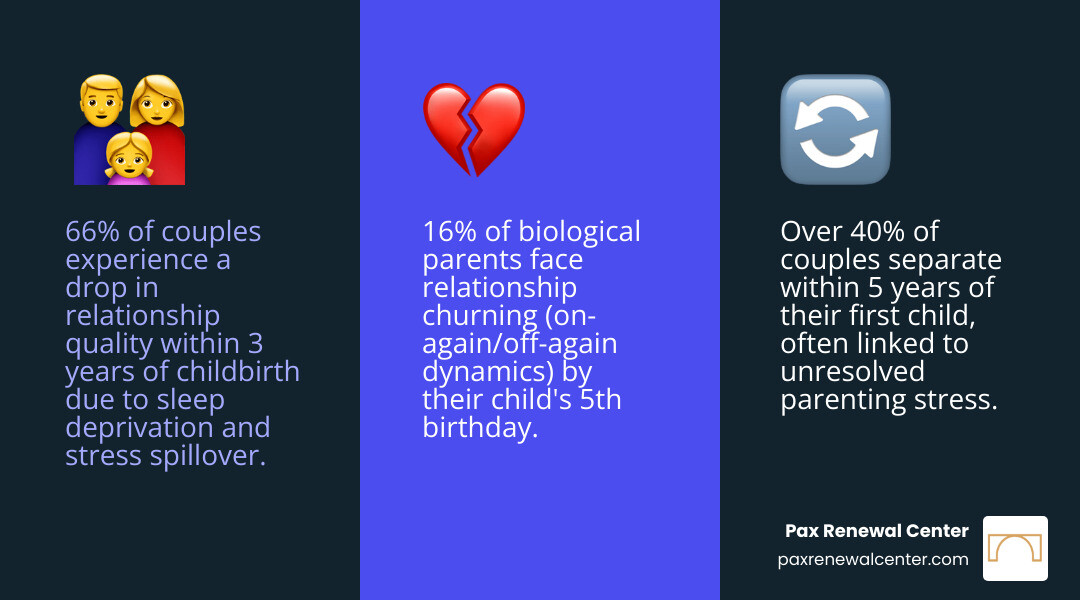
It is a sobering reality that over 40% of couples will go their separate ways within five years after the birth of their first child. This often happens because the “team” breaks down. Instead of facing the world together, the partners begin to view one another as another task on an already overflowing to-do list. If you feel like your relationship is on the brink, our Parenting Counseling Complete Guide offers a roadmap for navigating these early childhood transitions.

What is Relationship Churning?
One of the most damaging patterns we see in our Lafayette practice is what researchers call “relationship churning.” This refers to on-again/off-again dynamics where couples break up and reconcile repeatedly. By the time a child turns five, roughly 16% of biological parents have experienced this instability.
Research on relationship churning and parenting stress highlights that this cycle is significantly more stressful than being stably together or even stably separated. Churning is often tied to higher levels of material hardship, depression, and socioeconomic stressors. For parents in May 2026, the economic pressures of modern life only exacerbate this “churn,” making it harder for mothers and fathers to maintain the emotional regulation needed for healthy parenting.
Signs Parenting Stress and Marriage Tension are Peaking
How do you know if your stress levels have moved from “normal” to “toxic”? We often see three specific red flags:
- Funneling Focus: You stop investing in the marriage and funnel all your energy into areas where you feel “competent,” like your job or bonding solely with the baby. This leaves your spouse feeling like a roommate or a stranger.
- Score-Keeping: You start tracking who changed more diapers, who got less sleep, or who does more chores. This turns your partner into a competitor rather than a teammate.
- Blaming: As Brene Brown suggests, blame is often a discharge of pain and discomfort. When you’re exhausted, it’s easier to blame your spouse for the “lasagna burning” than to admit you are both drowning.
Understanding these 5 ways outside stress impacts marriage can help you identify when the “parenting score-keeping” is actually an unvoiced plea for help.

Why Marital Satisfaction Declines After Childbirth
It isn’t a mystery why marriages struggle after a baby arrives. Approximately two-thirds of couples see their relationship quality plummet within three years of a child’s birth. The primary culprits are sleep deprivation and the massive “mental load” shift.
A Maternal depression and marital satisfaction study found that for many mothers, depression fully mediates the relationship between parenting stress and marital quality. When a mother feels unsupported or isolated in her nursery, her dissatisfaction often leads the marital decline. This is why stress and anxiety management is a cornerstone of our work at Pax Renewal Center; we have to address the individual’s mental health to save the marriage.
The Role of Fathers in Conflict Resolution
Interestingly, fathers play a unique role in buffering the family from stress. Research indicates that when fathers use “constructive conflict resolution,” meaning they listen, compromise, and avoid hitting or criticizing, it significantly protects the child’s socioemotional development.
Research on child-related stress and couple communication shows that if a father remains warm and involved despite marital tension, the negative “spillover” to the children is reduced. At Pax, we teach fathers how to stay engaged even when they feel excluded from the mother-child bond, which is a common trigger for paternal withdrawal.
How Spillover Affects the Family System
“Spillover” is the process where the tension between a husband and wife leaks into their interactions with their children. If you are angry with your spouse, you are more likely to be irritable with your toddler. This creates a “negative emotional contagion” in the home.
Factors like a child’s difficult temperament or financial hardship can amplify this effect. However, tools like “cognitive reappraisal,” learning to reframe a situation in a more positive or neutral light, can weaken this spillover. If the conflict has become too high to manage alone, seeking Coparenting Counseling Near Me or specialized help for co-parenting stress can provide the circuit breaker your family needs.
Practical Strategies to Cope with Parental Burnout Together
When you’re in the thick of it, you don’t need a five-year plan; you need to survive the next five minutes. We encourage couples to focus on the immediate problem. If the baby is screaming and the stove is smoking, stop the argument about whose turn it is to cook. Take a breath, pray together, and solve the immediate crisis.
We also recommend:
- Daily Check-ins: Spend 15 minutes talking without phones. Ask, “What was the hardest part of your day?” and “How can I help you tomorrow?”
- Lowering Expectations: Perfectionism is the enemy of peace. It is okay if the house is messy.
- Faith Integration: Utilizing Faith-Based Therapy for Stress or Christian Parenting Support helps remind us that we aren’t carrying the burden alone.
| Strategy Type | Adaptive (Healthy) | Maladaptive (Unhealthy) |
|---|---|---|
| Conflict | Compromise and active listening | Blame, yelling, or “the silent treatment” |
| Stress Relief | Short walks, prayer, 20-second hugs | Substance use, withdrawal, or overworking |
| Communication | Expressing needs clearly | Keeping score and harboring resentment |
Prioritizing Self-Care to Reduce Parenting Stress and Marriage Tension
Self-neglect is the hidden root of parenting burnout. When you stop exercising, stop seeing friends, and stop pursuing hobbies, you have nothing left to give your spouse or your children. We often see parents who are “stupefied” when asked when they last took a break.
We recommend the “10-second kiss” and “20-second hug.” These small acts of physical touch release oxytocin and dopamine, which naturally lower stress levels. For couples needing a deeper reset, our Creating Connection Marriage Retreat provides a space to reconnect away from the demands of home.
Rebuilding Intimacy and Connection
Romance doesn’t have to die after children; it just has to be scheduled. Date nights are not a luxury; they are a necessity for marriage survival. Whether it’s a “kidnap date” or just a walk around the neighborhood, you must protect your time as a couple.
If you find yourself on the brink of divorce, specialized marriage counseling support can help you rediscover the fun and friendship that first brought you together. Even managing seasonal stress during holidays can be a chance to practice these connection rituals.
Frequently Asked Questions about Parenting Stress
How common is relationship churning among new parents in 2026?
By the time a child reaches their 5th birthday, approximately 16% of biological parents experience relationship churning, which is characterized by an on-again/off-again dynamic that significantly increases parenting stress. This is particularly common in non-marital relationships but can affect any couple facing high material hardship.
Why do most marriages see a decline in quality after a baby?
Roughly two-thirds of couples experience a plummet in relationship quality within three years of childbirth due to sleep deprivation, shifting identities, and the “spillover” of child-related stress into marital communication. The loss of “couple time” and the increase in task-oriented talk often leaves partners feeling disconnected.
How can we stop blaming each other for parenting stress and marriage tension?
Couples can reduce tension by focusing on immediate problems rather than long-term grievances, practicing cognitive reappraisal to reframe stressors, and seeking professional support to move from “keeping score” to a team-oriented approach. Learning to ask for what you need directly, rather than waiting for your partner to fail and then blaming them, is key.
Conclusion
Parenting is the most rewarding job you will ever have, but it is also the most demanding. At Pax Renewal Center in Lafayette, LA, we understand the unique challenges of parenting stress and marriage tension. Our team of faith-based therapists is here to help you move from survival mode to a place of thriving.
Whether you are seeking help for maternal depression, struggling with co-parenting conflict, or simply wanting to rebuild the romance in your marriage, we offer a compassionate, professional environment for your journey. You don’t have to choose between being a great parent and having a great marriage.
For relational restoration and professional counseling services, reach out to us today. Let’s work together to bring peace back to your home.