

Hope Exists Even When Your Marriage Feels Hopeless
When your marriage is on the brink of divorce, it can feel like you’re standing at the edge of a cliff. The pain is real, the distance feels impossible, and hope seems like a luxury you can’t afford.
If you’re facing the brink of divorce, here’s what you need to know:
- Recovery is possible: Research shows that up to 70% of people who divorce eventually regret it.
- You’re not alone: Most couples wait six years after distress begins before seeking help.
- Small changes matter: Your individual actions can significantly impact the relationship.
- Professional help works: Over half of discernment counseling cases transition to couples therapy.
- Time is critical: The sooner you act, the better your chances of recovery.
This guide shares real accounts from couples who stood exactly where you are now—questioning if their marriage could survive. Some felt emotionally bankrupt or were living like roommates. Many had already filed for divorce. Yet, they found their way back through intentional steps and professional guidance.
Research from the Gottman Institute shows that couples often wait six years to get help, allowing negative patterns to take root. But even at this late stage, marriages can be restored when one or both partners commit to the recovery process.
As Dan Jurek, M.A., LPC-S, LMFT-S, I’ve spent over 35 years helping couples steer the brink of divorce using faith-based counseling and evidence-based approaches like Discernment Counseling and Emotionally Focused Therapy. I’ve witnessed countless marriages transform, and I’m here to guide you with professional expertise and compassionate understanding.
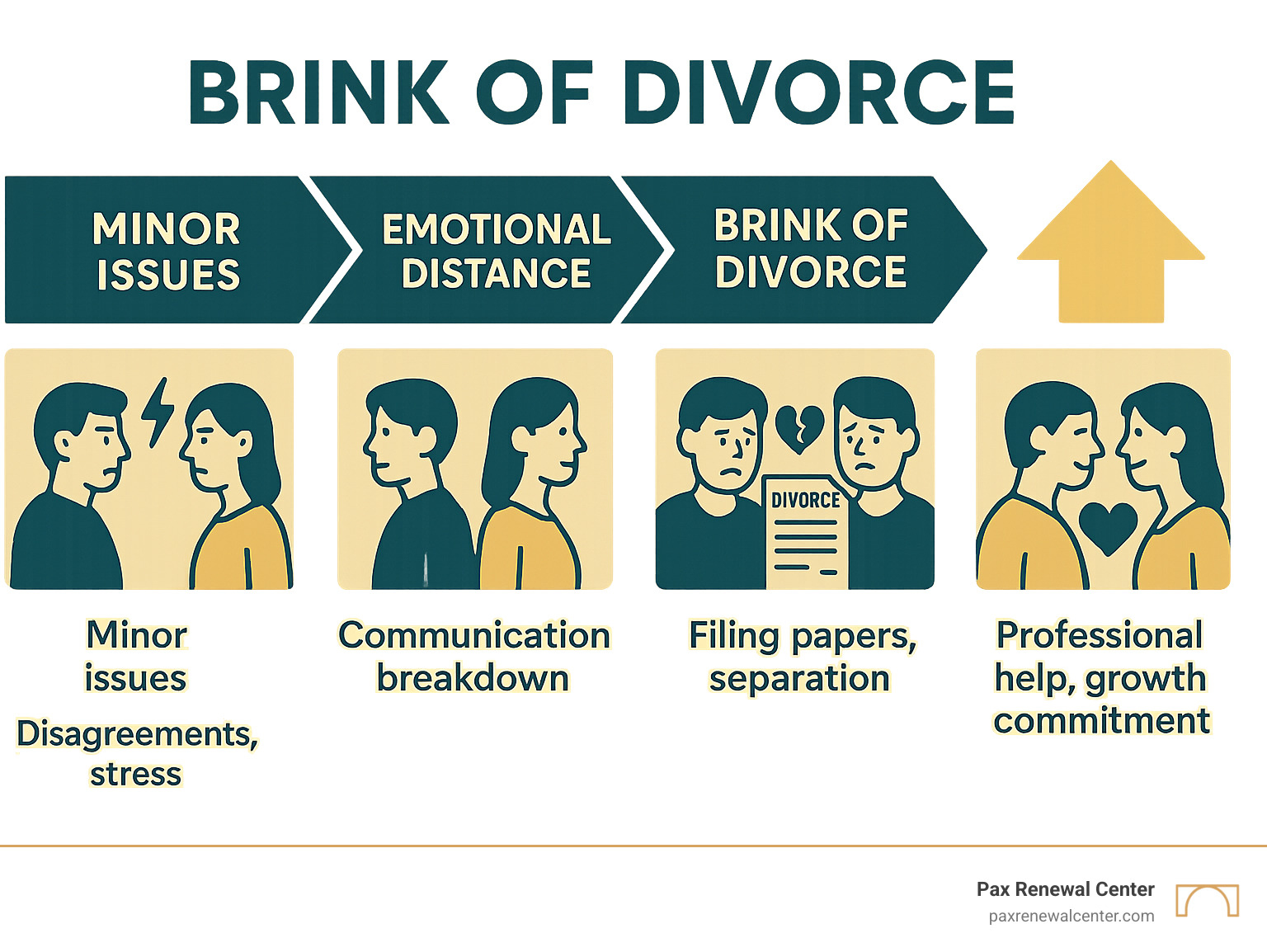
Recognizing the Warning Signs: Are You on the Brink of Divorce?

Warning signs can sneak up slowly, leading your marriage toward the brink of divorce before you realize it. This is often a gradual Marital Drift, a slow disconnection caused by countless small hurts.
Communication breakdown is a primary sign. Conversations may feel surface-level or quickly turn into arguments, leaving you feeling unheard.
The Gottman Institute identified four communication patterns that predict divorce, known as the Four Horsemen:
- Criticism: Attacking your partner’s character instead of addressing a specific behavior.
- Contempt: Treating your spouse with disgust or superiority through mocking, sarcasm, or eye-rolling.
- Defensiveness: Refusing to take responsibility and blaming your partner instead.
- Stonewalling: Completely shutting down and refusing to engage in conversation.
Other common signs include:
- Living like roommates: The emotional and physical intimacy has faded, leaving two people sharing a space but not a life.
- Constant fighting: The same issues arise repeatedly without resolution, creating a toxic cycle.
- Unresolved resentment: You may have stopped fighting altogether because it feels pointless, a sign that resentment is building.
- Infidelity: An emotional or physical affair can be a breaking point, though for some it’s a wake-up call to address deeper issues.
- Financial stress: Disagreements over money often reflect deeper conflicts about values and priorities.
External factors can also cause strain, as detailed in 5 Ways Outside Stress Can Impact Your Marriage and How to Manage It.
Recognizing these signs doesn’t mean your marriage is doomed. It means you’re aware enough to act. The sooner you address these issues, the better your chances of turning things around.
Hitting the Brakes: Immediate Steps to Stop the Downward Spiral
When your marriage is on the brink of divorce, your instincts may scream at you to do something. Unfortunately, our natural responses during a crisis often make things worse.
Desperate behaviors, though born from fear, can push your spouse further away. Pleading, begging, and constant hovering feel overwhelming to your partner. Starting unnecessary fights or giving the silent treatment only reinforces the distance between you. These are known as ‘push behaviors.’
Avoiding ‘Push Behaviors’ That Worsen the Crisis
Certain reactions, while understandable, accelerate the crisis. Pleading and begging can feel manipulative, while starting unnecessary fights reinforces the idea that you can’t get along. The silent treatment or withdrawing emotionally signals that you’ve given up, and blaming your spouse for all the problems prevents any shared ownership.
Here’s a simple list of behaviors to avoid when your marriage is in crisis:
- Constantly checking their phone, email, or tracking their movements
- Making dramatic threats about what you’ll do if they leave
- Bringing up past mistakes repeatedly during arguments
- Demanding immediate answers about the future of your relationship
- Using guilt or manipulation to get them to stay
Taking Control of Your 50% of the Relationship
Even if your spouse seems checked out, you control your 50% of the relationship, which is more influential than you think. The most powerful thing you can do is pause before reacting. When your spouse says something hurtful, take a breath before you respond. This simple act can prevent the escalation that drives couples apart.
Self-reflection is about honestly asking, “How have my actions contributed to where we are now?” It’s not about taking all the blame, but about focusing on what you can control: your words, reactions, and behavior.
Before making any major decisions, use the ‘sleep on it’ test. Ask yourself: “Will I be at peace with this action tomorrow morning?” This can save you from impulsive choices made in emotional moments.
Maintaining Healthy Boundaries in Relationships is crucial. You can be committed without being desperate. When you stop chasing and start changing, the dynamic shifts. This doesn’t guarantee immediate reconciliation, but it creates the space for healing.
The Path to Reconciliation When Your Marriage is on the Brink of Divorce
Once you’ve stopped the immediate slide towards divorce, the work of reconciliation begins. This path involves personal growth and a renewed commitment to intentional connection.
Rebuilding Yourself to Rebuild Your Marriage
Saving a marriage often starts with individual self-improvement. When you become the best version of yourself, you bring more to the relationship.

We use the “PIES of attraction” framework to guide this growth:
- Physical health: Care for your body through exercise, nutrition, and rest.
- Intellectual growth: Engage your mind by learning or pursuing new interests.
- Emotional regulation: Learn to manage your feelings and respond constructively.
- Spiritual renewal: Connect with your faith for strength and purpose. At Pax Renewal Center, we integrate faith-based principles, understanding that spiritual health is vital for healing.
Refinding personal hobbies and passions can reignite your spark. If you’re struggling, Individual Counseling can provide support, and learning to manage personal Stress and Anxiety is key.
Learning to Talk Again: Communication in a Crisis
Relearning how to talk—and listen—is paramount.
- Active listening: Hear what your partner is saying without interrupting or judging.
- ‘I’ statements: Express your feelings without blame (e.g., “I feel hurt when…”).
- Validating feelings: Acknowledge your partner’s perspective, even if you disagree.
- Scheduled check-ins: Dedicate time to discuss concerns, appreciation, and plans.
- Avoiding the Four Horsemen: Consciously eliminate criticism, contempt, defensiveness, and stonewalling.
Effective communication is one of the 3 Secrets to Achieving Emotional Satisfaction in Marriage.
Restoring Trust and Intimacy After Betrayal
When a marriage is on the brink of divorce, rebuilding trust and intimacy is a courageous, intentional process.
- Forgiveness: This is about releasing bitterness to allow yourself to move forward.
- Rebuilding trust: Trust is earned through consistent, transparent, and accountable behavior.
- Creating new positive memories: Intentionally engage in joyful shared experiences.
- Rekindling romance: Plan date nights and find creative ways to connect.
- Creating Connection Marriage Retreat: An immersive retreat can provide a breakthrough for reconnection.
This journey is challenging, but the rewards of a renewed relationship are immeasurable.
When You Need a Guide: The Role of Professional Counseling
While self-help is valuable, navigating a marriage on the brink of divorce often requires a professional guide. Therapists act as neutral third parties with tools to help you improve communication and make informed decisions.
Couples Therapy and Discernment Counseling at Pax Renewal Center
At Pax Renewal Center, we offer specialized counseling for couples in crisis.

- Couples Counseling: For couples committed to improving their relationship. The goal is to strengthen the bond and create a healthier dynamic using methods like the Gottman Method and Emotionally Focused Therapy (EFT).
- Discernment Counseling: For “mixed-agenda” couples, where one spouse is “leaning out” (considering divorce) and the other is “leaning in.” This short-term process (1-5 sessions) helps couples gain clarity about their future path without the pressure of immediate reconciliation.
Here’s a quick comparison:
| Feature | Couples Therapy | Discernment Counseling |
|---|---|---|
| Goals | Improve relationship, resolve conflict | Gain clarity on the future of the marriage |
| Duration | Ongoing, based on needs | Short-term (1-5 sessions) |
| Ideal Candidates | Both partners committed to improving the marriage | “Mixed-agenda” couples where one is considering divorce |
| Focus | Relationship dynamics, skill-building | Individual reflection, decision-making |
| Outcome | A stronger, healthier relationship | A clear decision on a path forward with less regret |
We offer both Couples Counseling and Discernment Counseling, integrating clinical best practices with our faith-based approach.
What to Expect from Your First Sessions
Knowing what to expect can ease the process of starting therapy.
- Find the right therapist: It’s essential to find a good fit. Our team consists of qualified, faith-based therapists who integrate clinical best practices with spiritual guidance.
- Set goals: Your therapist will work with you to understand your situation and establish goals for therapy.
- Build a therapeutic alliance: A strong, trusting relationship with your therapist is crucial for success.
- A faith-based approach: We respect your spiritual journey, incorporating Christian values into the healing process to address emotional, relational, and spiritual well-being.
For more details, read What You Can Expect From Psychotherapy: The First Sessions.
Navigating the Crossroads: Making the Final Decision
After trying to reconnect, you may still feel uncertain about the path forward. This isn’t a failure; it’s a complex part of the journey for couples on the brink of divorce. Making this decision requires honest reflection and courage.
Weighing the Realities of Divorce
While sometimes the healthiest choice, it’s important to understand the full scope of divorce. Many people focus on immediate relief but overlook the long-term changes.
- Financial Impact: Supporting two households typically reduces the standard of living for both partners. Legal fees, separate living expenses, and child or spousal support create significant financial restructuring.
- Emotional Toll: Divorce is a profound grief process. Even when it’s the right choice, it can bring out intense emotions and conflict.
- Impact on Children: Children are resilient but must steer changes in living arrangements and divided loyalties. Protecting them from parental conflict is a crucial responsibility.
Research shows that up to 70% of people who divorce eventually experience some regret, highlighting the complexity of the decision.
When Is It Time to Let Go?
At Pax Renewal Center, we fight for marriage restoration but recognize that some situations are harmful. We will never encourage someone to remain in a dangerous environment.
Divorce may be the healthiest path forward in cases of:
- Abuse: If physical, emotional, or psychological abuse is present, safety comes first. Separation and individual counseling are the immediate focus.
- Active Addiction: When a partner refuses to acknowledge their addiction or seek recovery, the marriage becomes unsustainable.
- Unwillingness to Engage: A marriage cannot heal if one partner consistently refuses to take accountability, participate in counseling, or make necessary changes.
- Unresolvable Issues: Sometimes, despite best efforts, fundamental incompatibilities prove too great to overcome.
Navigating these waters requires wisdom and support. Finding Hope and Empowerment Through Professional Counseling can provide the clarity you need. For additional support, resources like The National Alliance on Mental Illness helpline are available.
Whatever you decide, it’s possible to move forward with integrity and hope.
Frequently Asked Questions about Saving a Marriage on the Brink of Divorce
When your marriage is hanging by a thread, you’re filled with questions. Here are the most common ones we hear at Pax Renewal Center.
Can a marriage be saved if one partner has already ‘checked out’?
Yes, there is genuine hope even in this situation. When a partner seems emotionally distant, they are often protecting themselves from more hurt. Discernment Counseling was created for these “mixed-agenda” situations, where one spouse is “leaning out” and the other is “leaning in.”
Your commitment to changing your own patterns can shift the entire dynamic. When you stop “push behaviors” (like pleading or hovering) and focus on your own growth, your spouse sees a different version of you. This can spark curiosity and create a safe space for them to re-engage.
How long does it take to recover from the brink of divorce?
Healing doesn’t follow a set schedule. Recovery is a journey, not a destination. Some couples see hopeful shifts within weeks, while others need months or even a year or two to rebuild trust, especially after betrayal.
The deeper work of restoring trust and intimacy often takes six months to two years. However, the process itself can create a bond stronger than the original relationship. Celebrate small victories along the way—a real conversation, a shared laugh—as these are major milestones on your path to healing.
What if we can’t afford couples counseling?
Financial stress is real, but we are committed to making quality counseling accessible. Your marriage deserves a fighting chance.
- Online counseling offers flexibility and can be more affordable than in-person sessions.
- Our online group therapy community on the Skool platform provides expert-led support at a significantly reduced cost.
- Individual counseling can create positive ripple effects throughout the marriage, even if only one partner attends.
- Self-help resources like books and podcasts can provide valuable tools to begin the healing process.
Please reach out to us to discuss your situation. We will explore every option to help you get the support you need. Your marriage is worth the investment.
Conclusion
Standing on the brink of divorce is a heartbreaking crossroads, but your story doesn’t have to end here. The path from crisis to connection requires courage, commitment, and hope.
We’ve seen countless couples make this journey. Marriages that seemed destined for divorce have blossomed into relationships filled with deeper intimacy and joy. Your marriage can be one of these success stories.
By stopping destructive patterns, focusing on your own growth, and learning healthier ways to connect, you create space for healing. Professional support—whether through individual counseling, couples therapy, or discernment counseling—can guide you through this challenging season.
At Pax Renewal Center, we believe marriage restoration is also about spiritual renewal. Our faith-based approach integrates proven therapeutic methods with the timeless wisdom of Christian values, creating a safe space where healing can flourish.
Dan Jurek and our team of compassionate therapists have walked alongside hundreds of couples. We’ve witnessed the power of grace and intentional love to transform even the most wounded relationships.
Don’t let fear write the final chapter of your marriage. Recovery is possible. Your courage to seek help is the first step. That courage, combined with professional guidance and faith-filled hope, can carry you from crisis to celebration.
Explore our professional counseling services to find how we can support you in moving from the brink of divorce toward a future filled with renewed love.