

Find Clarity With Discernment Counseling Online
Discernment counseling online is a short, structured process for couples who are unsure whether to work on their marriage or move toward separation. It is especially helpful when one spouse wants to try to repair the relationship and the other is leaning toward leaving.
Here is how to begin:
- Choose a licensed counselor trained in discernment counseling and authorized to provide telehealth in Louisiana.
- Set up a private, quiet place for video sessions, ideally with each partner able to speak openly.
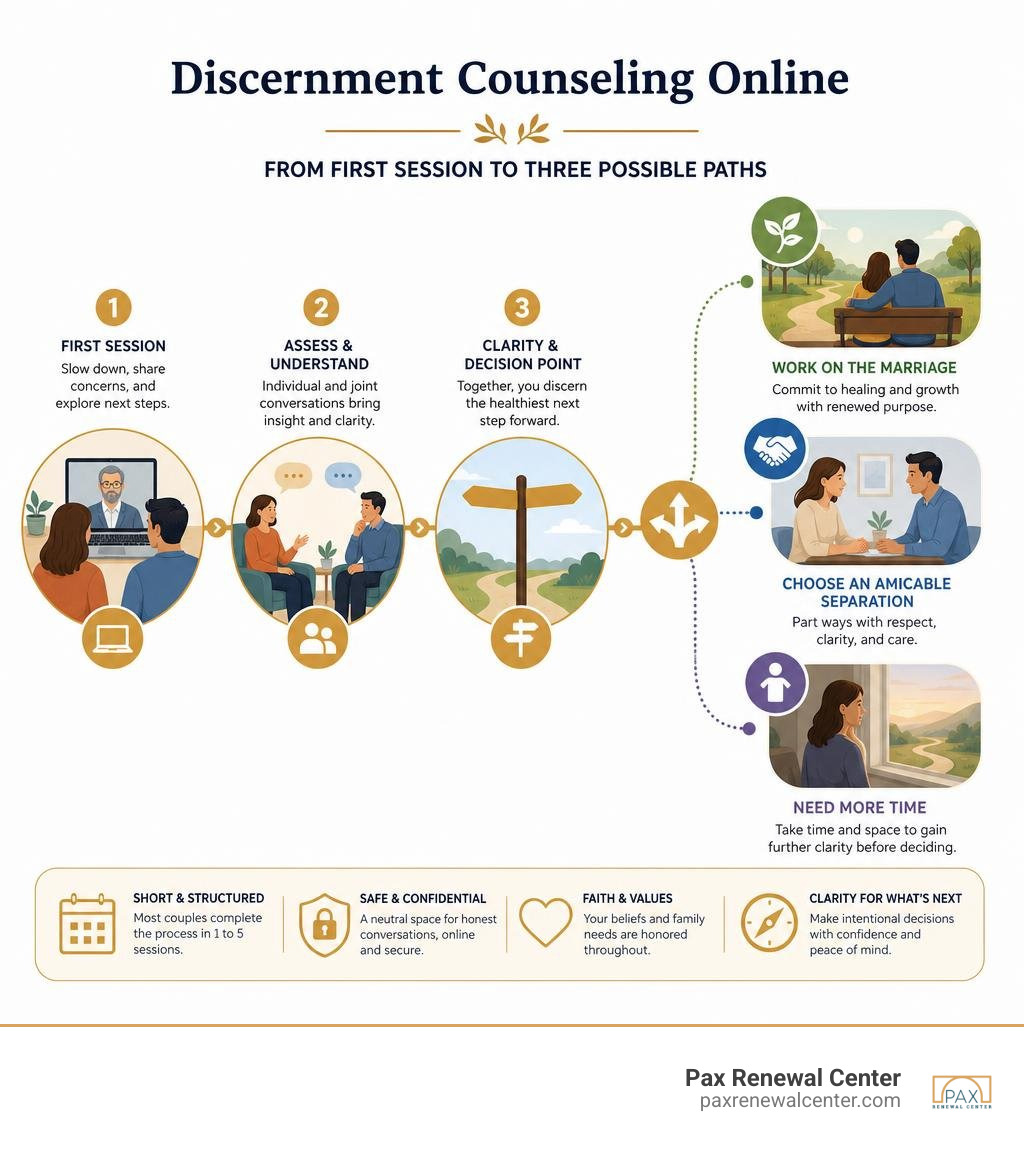
- Use the first session to slow down the crisis, understand each person’s concerns, and explore the next right step – without pressure to save or end the marriage immediately.
Unlike regular couples therapy, this process does not start by trying to fix communication or resolve every conflict. Its first goal is clarity and confidence about the future of the relationship. Most couples complete the process in one to five sessions, beginning with a longer initial meeting and using both joint and individual conversations.
For couples facing a painful decision, that clarity can reduce impulsive choices, help each person understand their part in the relationship’s struggles, and make the next step more intentional. Faith, values, family needs, and practical concerns can all be part of the conversation.
I am Dan Jurek, M.A., LPC-S, LMFT-S, founder and clinical director of Pax Renewal Center, with more than 35 years of clinical experience and specialized training in Discernment Counseling for Couples. In Discernment counseling online and in person, I help couples facing marital uncertainty consider their options with sound clinical guidance and faith-integrated care.
Discernment counseling online terms to learn:
Understanding Discernment Counseling vs. Traditional Couples Therapy
When a marriage is strained to its breaking point, traditional marriage counseling can often feel like trying to rebuild an airplane mid-flight. Standard therapy assumes that both partners enter the room with a shared goal: to roll up their sleeves, work through emotional wounds, and repair the union.
In many distressed marriages, this assumption falls apart. Developed by Dr. Bill Doherty, discernment counseling was engineered specifically for “mixed-agenda” couples. In these partnerships, spouses are not standing on the same side of the fence:
- The Leaning-Out Partner: Ambivalent about staying married, feeling emotionally exhausted, questioning whether change is possible, and doubting whether therapy will help.
- The Leaning-In Partner: Highly motivated to save the relationship, eager to attend counseling, and deeply fearful of divorce.
For a deeper dive into the foundations of this approach, explore our introductory guide to discernment counseling.
When a mixed-agenda couple is thrust into traditional therapy, the leaning-out spouse often feels pressured or cornered, while the leaning-in spouse experiences false hope. Discernment counseling establishes a safe harbor where ambivalence is accepted, respected, and unpacked according to official protocol guidelines. Over 1,708 professionals worldwide have completed specialized training in this modality to support couples in crisis.
| Feature | Traditional Couples Therapy | Discernment Counseling |
|---|---|---|
| Primary Objective | Relationship repair, conflict resolution, intimacy building | Decision clarity and confidence regarding the marital future |
| Client Mindset | Both partners committed to working on the marriage | Mixed agendas (one leaning out, one leaning in) |
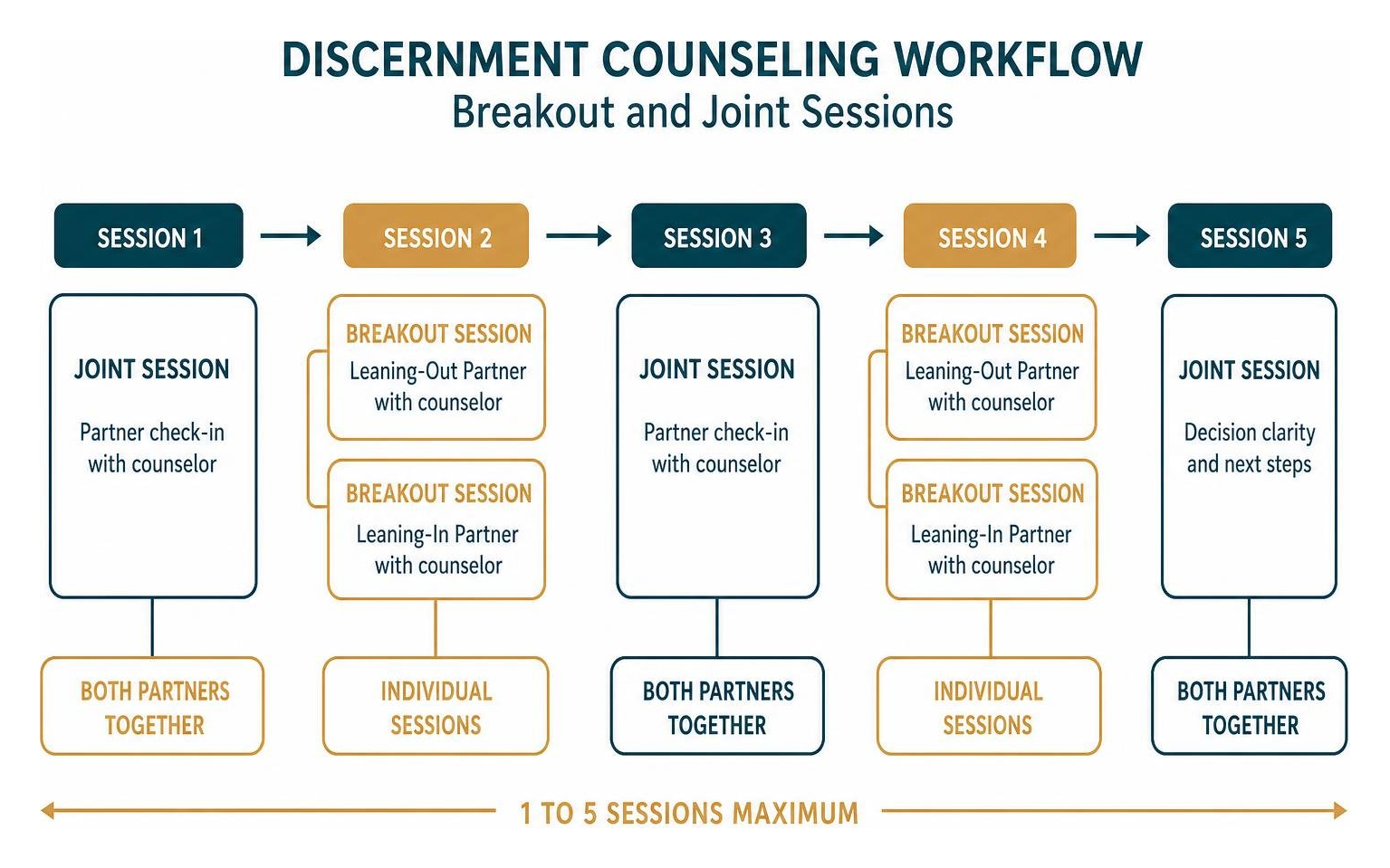
| Session Structure | Conjoint dialogue and communication exercises | Structured individual breakouts with brief joint check-ins |
| Time Commitment | Open-ended (months to years) | Short-term (1 to 5 sessions maximum) |
| Role of Counselor | Relationship coach and facilitator | Neutral guide exploring viability without taking sides |
The Core Differences in Goals and Structure
The structural brilliance of discernment counseling lies in its strict brevity and targeted scope. It is not an open-ended therapeutic journey. As detailed in our comprehensive discernment counseling guide, the protocol caps at a maximum of five sessions.
Instead of jumping into deep communication exercises that often trigger familiar arguments, the discernment counselor acts as a neutral facilitator. The therapist does not advocate for saving the marriage at all costs, nor do they encourage divorce. This objective neutrality creates emotional de-escalation, lowering the defensive walls of the leaning-out partner while helping the leaning-in partner step out of panic mode.
Who Is Eligible for Discernment Counseling Online?
Discernment counseling is crafted specifically for couples on the brink of divorce who are caught in chronic indecision. If you find yourself wondering whether your marriage has reached an absolute end or still holds a spark worth rekindling, you can take our interactive discernment quiz to reflect on where your relationship currently stands.
However, discernment counseling is not suitable for every situation. Clinical contraindications include:
- Active domestic violence or fear for physical safety.
- Coerced participation, where one spouse is being forced or threatened to attend.
- A unilateral final decision, where one partner has firmly and irreversibly decided to end the marriage and is merely seeking an exit interview.
The Three Paths Explored in Discernment Counseling

Discernment counseling is structured to help couples evaluate three specific directions for their relationship:
Path 1: Remaining in the Status Quo
Path 1 involves pausing any immediate legal or therapeutic action and choosing to remain in the marriage as it currently exists.
Couples who choose Path 1 often need time to let practical realities settle before making permanent life alterations. If you are navigating mixed feelings about marriage, this path provides a breather, allowing partners to step out of active crisis while acknowledging that underlying relational issues remain unaddressed.
Path 2: Moving Toward Separation or Divorce
If the leaning-out partner concludes that their energy for the marriage is entirely depleted, or if both partners realize their differences are insurmountable, Path 2 offers a structured transition toward separation or divorce.
Rather than entering a litigious battlefield fueled by anger, discernment counseling helps couples approach separation with mutual respect and emotional closure. This framework is vital when children are involved. As we explore in our guide on navigating divorce before the final split, establishing collaborative communication early on lays the foundation for healthy co-parenting.
Path 3: Committing to Six Months of Intensive Couples Therapy
Path 3 is an all-in commitment to relationship restoration. When couples select Path 3, they agree to:
- Take divorce entirely off the table for six months.
- Engage in dedicated online relationship counseling or specialized clinical frameworks like EFT (Emotionally Focused Therapy) and the Gottman Method.
- Participate in focused marriage intensives or couples mastermind programs to rebuild relational trust.
- Address their personal contributions to the marital breakdown with full emotional effort.
Why Choose Discernment Counseling Online for Marital Ambivalence
Navigating relationship ambivalence via telehealth offers distinct advantages for modern couples. Engaging in virtual therapy removes the logistical friction of coordinating busy work schedules, arranging childcare, or commuting through heavy traffic.
For many distressed couples, sitting in an office waiting room together can heighten anxiety and trigger arguments before the session even begins. As outlined in our online relationship therapy guide, meeting with a counselor virtually allows each spouse to engage from a secure, comfortable setting, preserving emotional energy for the discernment process itself.
Preparing for Your Discernment Counseling Online Telehealth Session

To maximize the benefits of online sessions, thoughtful preparation is key:
- Ensure Visual and Auditory Privacy: Choose a room where doors can be closed and conversations cannot be overheard by children, roommates, or coworkers.
- Use Separate Devices When Needed: While sitting together in front of one camera during joint check-ins is common, having access to separate devices or rooms ensures seamless individual breakout conversations.
- Verify State Authorization: Clinical licensure laws require counselors to be licensed in the state where the client is physically located during the session. At Pax Renewal Center, our licensed clinicians provide comprehensive care and virtual Christian therapy for individuals and couples located across Louisiana.
What to Expect During the Step-by-Step Session Flow
A standard discernment counseling sequence follows a clear, predictable rhythm:
- Initial Intake (2 Hours): The counselor meets with the couple together for approximately 10 to 15 minutes to review goals and establish ground rules. The counselor then transitions into separate individual conversations (around 45 to 50 minutes each) with both the leaning-out and leaning-in spouse. Finally, the couple reconvenes for the last 10 minutes to summarize what was learned.
- Follow-Up Sessions (80 Minutes Each): Subsequent sessions (up to four additional meetings) maintain this format—brief joint opening, focused individual breakouts, and a structured concluding check-in.
- Session-by-Session Decision Making: Couples never commit to a long block of sessions upfront. At the conclusion of each meeting, the counselor asks both partners individually: “Are you willing to return for one more session of discernment counseling, or are you ready to choose Path 1, Path 2, or Path 3?”
Frequently Asked Questions About Online Discernment Counseling
Is online discernment counseling as effective as in-person sessions?
Yes. Clinical experience and telehealth research demonstrate that virtual discernment counseling is just as effective as in-person meetings. Because the core work involves individual reflective conversations with the therapist rather than physical interactive exercises, the virtual format provides a safe, focused environment that lowers stress and encourages honest dialogue.
What if my spouse wants a divorce and refuses counseling?
It is common for a spouse who wants out of the marriage to refuse traditional marriage therapy because they fear being pressured to stay. However, leaning-out spouses are often open to discernment counseling once they understand it is not traditional therapy, has a strict limit of 1 to 5 sessions, and does not push for reconciliation. You can read our detailed guidance for when a spouse wanting divorce refuses help to better understand how to navigate this dynamic.
What are common myths about discernment counseling?
- Myth 1: The counselor’s goal is to save our marriage. Reality: The counselor’s goal is to help you reach clarity and confidence about your path forward, whether that means staying together or separating amicably.
- Myth 2: It is just standard marriage counseling under a different name. Reality: Discernment counseling does not attempt to fix relationship problems; it determines whether both spouses want to do the work to fix them.
- Myth 3: Both spouses must be fully committed to the process. Reality: Discernment counseling was created specifically for couples who have differing levels of commitment.
Conclusion: Taking the First Step Toward Clarity
Marital ambivalence is an exhausting place to live. Remaining stuck between wanting to save a family and wanting to escape chronic unhappiness creates constant emotional turmoil. Discernment counseling offers a respectful, structured, and compassionate way out of that cycle.
Whether your journey leads to restoring your marriage with renewed purpose or parting ways with mutual dignity, clarity is possible. At Pax Renewal Center, our team integrates proven clinical methods with faith-aligned values to guide couples through their most challenging transitions. When you are ready to gain confidence about your marital future, start your online couples counseling journey with us.