
Why Long-Distance Couples Need Specialized Support
Long distance couples counseling has become essential as more than 14 million couples in the United States steer relationships across miles and time zones. Whether separated by military deployment, career demands, or educational pursuits, these couples face unique challenges that require specialized therapeutic support.
Quick Answer: Best Long-Distance Couples Counseling Options:
- Online therapy platforms with HIPAA-compliant video sessions
- Licensed therapists with multi-state credentials (PSYPACT/Counseling Compact)
- Evidence-based approaches like Gottman Method and EFT adapted for virtual sessions
- Flexible scheduling to accommodate different time zones
- Faith-integrated counseling for couples seeking spiritual guidance
Long-distance relationships create distinct challenges that traditional couples don’t face. The absence of physical presence, reliance on digital communication, and feelings of loneliness can strain even the strongest bonds. Research shows that 63% of people find online therapy effective, making virtual counseling a viable solution for couples separated by distance.
Unlike couples who see each other daily, long-distance partners must work harder to maintain emotional intimacy, steer trust issues, and manage the stress of uncertain reunion timelines. These relationships require specialized strategies for communication, conflict resolution, and future planning that general relationship advice often doesn’t address.
As Dan Jurek, M.A., LPC-S, LMFT-S, founder of Pax Renewal Center, I’ve helped countless couples strengthen their relationships through faith-based therapy approaches over my 35+ years of clinical experience. My work with long distance couples counseling combines proven therapeutic methods with the unique understanding that love can thrive across any distance when partners have the right tools and support.
Understanding the Unique Landscape of Long-Distance Relationships
When you’re in a long-distance relationship, you’re navigating uncharted territory that most couples never have to explore. While the distance can actually strengthen your independence and make you treasure your time together even more, it also creates challenges that can feel overwhelming at times. The good news? You’re definitely not alone in this journey.

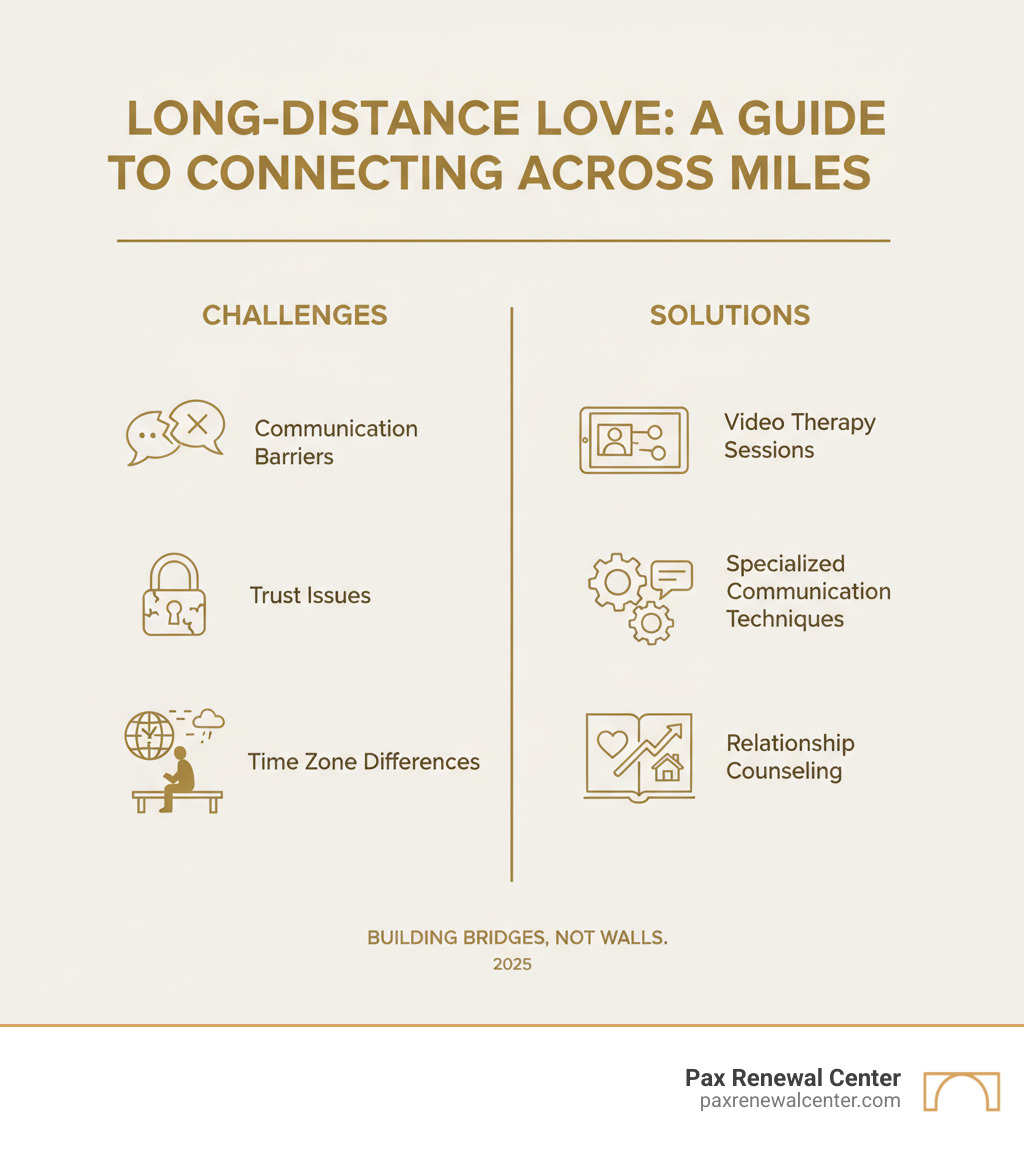
The physical separation is probably the most obvious challenge, but it’s the ripple effects that really test your relationship. Loneliness hits differently when your person isn’t just across town – they’re across states or even continents. You might find yourself staring out the window, wondering what they’re doing right now, wishing you could just reach out and touch them.
Communication barriers become magnified when you’re relying mostly on texts, calls, and video chats. Think about it – so much of how we communicate happens through body language, facial expressions, and those little moments of physical touch. When those non-verbal cues are missing, it’s like trying to have a conversation with half the words missing.
This creates what we call emotional distance – not because you love each other any less, but because maintaining that intimate connection requires so much more intentional work. Trust and insecurity can creep in more easily when you’re not sharing daily life together. Your mind might start playing tricks on you, filling in the gaps with worst-case scenarios.
Jealousy can rear its ugly head too, especially when your partner mentions new friends or social activities you’re not part of. You’re trying to balance being your own independent person while staying deeply connected to someone you rarely see in person. It’s a delicate dance between independence and togetherness.
If these challenges aren’t addressed, couples can experience what we call Marital Drift – slowly growing apart without even realizing it’s happening.
Common Issues That Arise from Miles Apart
Let’s be honest about the everyday struggles that come with loving someone from a distance. Misunderstandings via text are practically inevitable. You send a quick message that sounds perfectly normal in your head, but your partner reads it as cold or angry. Without hearing your tone of voice or seeing your smile, even innocent comments can spark unnecessary conflicts.
Sexual frustration is real and difficult to steer. Physical intimacy is a crucial part of most romantic relationships, and when visits are weeks or months apart, couples have to get creative about maintaining that connection. It requires open, sometimes awkward conversations about needs and boundaries.
Differing social lives can create tension too. Maybe you’re out making new friends while your partner is stuck in a small town with limited social opportunities. Or perhaps one of you is naturally more social while the other prefers quiet nights in. These differences feel magnified when you can’t easily share these experiences.
The financial strain from travel hits many couples hard. Plane tickets, gas money, time off work – it all adds up quickly. Some couples find themselves choosing between seeing each other and paying bills, which adds stress that local couples never face.
Feeling out of sync is another common struggle. You’re living in different time zones, dealing with different weather, different daily routines. Sometimes it feels like you’re living in completely different worlds, making it hard to feel connected to each other’s daily experiences.
Unspoken expectations can be relationship killers. How often should you text? Who should visit whom? What happens during holidays? When these expectations aren’t clearly discussed, resentment can build up fast.
All of these external pressures can significantly impact your relationship’s health. Understanding 5 Ways Outside Stress Can Impact Your Marriage and How to Manage It becomes especially important when distance adds another layer of complexity to your love story.
Long distance couples counseling can help you steer these unique challenges with professional guidance custom specifically to your situation. You don’t have to figure this out alone.
How Therapy Bridges the Distance and Strengthens Your Bond
When you’re miles apart from your partner, long distance couples counseling becomes more than just a helpful resource—it’s a lifeline that can transform your relationship. We’ve seen countless couples find that therapy isn’t just about fixing problems; it’s about building something stronger than what they had before.
The beauty of couples therapy lies in how it creates a safe space where both partners can be completely honest. You’ll learn to cultivate emotional intimacy that goes deeper than surface-level conversations. We help you develop conflict resolution skills that turn arguments into opportunities for understanding. Most importantly, we guide you in building the kind of trust that can weather any storm—or any distance.
Having a neutral third-party perspective makes all the difference. When you’re caught up in the emotions of your relationship, it’s hard to see the patterns that might be holding you back. We help couples become more aware of their interactions—like when one person keeps reaching out while the other pulls away. Once you see these patterns, you can start changing them.
The research backs this up too. Studies show that online therapy can be just as effective as meeting in person, which is perfect news for long-distance couples. We’ve watched couples make incredible progress through video sessions, often reporting that they feel closer than ever because they’re listening better and fighting less.
If you’re looking to deepen your connection even further, exploring 3 Secrets to Achieving Emotional Satisfaction in Marriage can provide valuable insights that work hand-in-hand with therapy.
Strengthening Emotional Intimacy and Trust
True intimacy isn’t just about being physically close—it’s about being emotionally connected. In long distance couples counseling, we guide you through exercises that help you share your deepest thoughts, fears, and dreams with your partner. These vulnerability exercises might feel scary at first, but they’re the foundation of genuine intimacy.
We teach active listening techniques that ensure both of you feel truly heard, even through a computer screen. When you know your partner is really listening—not just waiting for their turn to talk—it changes everything. You’ll learn to pick up on emotional cues and respond with empathy, creating a secure connection that distance can’t break.
Trust issues are especially challenging in long-distance relationships. Whether you’re dealing with jealousy, rebuilding after infidelity, or just learning to trust each other with your hearts, we provide a structured path forward. This involves honest conversations, setting clear boundaries, and learning to offer reassurance when your partner needs it most.
The goal is to create shared meaning in your relationship—a sense that you’re building something beautiful together, even when you’re apart. You can explore more relationship-building resources on our Tag: Relationships page.
Improving Communication and Resolving Conflict
Communication is the heartbeat of any relationship, but it’s absolutely vital when you’re separated by distance. We help you identify those negative patterns that keep showing up—the same arguments that happen over and over, or the way conversations seem to spiral out of control.
Learning fair fighting rules changes everything. Instead of trying to win arguments, you’ll learn how to solve problems together. We teach you to express your needs clearly without blame and to validate each other’s feelings, even when you disagree.
The change we see in couples is remarkable. They learn to articulate what they need in ways their partner can actually hear. They find how to truly understand their partner’s perspective, not just wait for their turn to defend themselves. Conflict becomes a bridge to deeper understanding rather than a wall between you.
These communication skills work whether you’re texting, calling, or video chatting. They’re the foundation of healthy interaction that will serve your relationship long after the distance ends. For those in our local area, our Couples Counseling Lafayette LA services offer these same proven approaches in person.
Your Guide to Finding and Starting Long-Distance Couples Counseling
Taking the first step toward long distance couples counseling can feel overwhelming, especially when you’re already navigating the challenges of a relationship across miles. But here’s the good news: teletherapy has transformed how couples access professional support, making quality counseling available no matter where you and your partner call home.

Virtual counseling connects you with your therapist through secure, HIPAA-compliant platforms that protect your privacy while providing the same quality care as in-person sessions. These video sessions create a safe space where both partners can participate fully, even from different states or time zones.
The beauty of online therapy lies in its accessibility. You don’t need to worry about finding a therapist in both your locations or coordinating travel for appointments. Instead, you can focus on what matters most: strengthening your relationship with professional guidance custom to the unique dynamics of long-distance love.
Before diving in, consider your budget and whether you’d like to use insurance coverage. Many therapists offer initial consultations to discuss fees and explore payment options that work for your situation. It’s also helpful to prepare for your first session by thinking about the key challenges you want to address together.
Choosing the Right Therapist for Long-Distance Couples Counseling
Finding the right therapist for long distance couples counseling is like finding the missing piece of a puzzle – when it fits, everything clicks into place. The search might seem complex at first, but understanding what to look for makes the process much smoother.
Licensing requirements are your starting point. Your therapist must be licensed in the state where each partner lives, which can get tricky when you’re in different locations. Fortunately, multi-state licensing compacts like PSYPACT for psychologists and the Counseling Compact for counselors are breaking down these barriers, allowing qualified professionals to serve clients across state lines.
Look for therapists with specialized training in couples work. The Gottman Method focuses on building friendship, managing conflict, and creating shared meaning in relationships. Emotionally Focused Therapy (EFT) helps couples understand and reshape their emotional responses to create stronger bonds. Both approaches adapt beautifully to virtual sessions and address the core challenges that long-distance couples face.
When you’re interviewing potential therapists, ask about their experience with long-distance relationships specifically. Do they understand the unique pressures of maintaining intimacy across miles? How do they handle time zone differences when scheduling? What’s their approach to ensuring both partners feel equally heard during virtual sessions?
You’ll also want to discuss practical matters: their fee structure, cancellation policies, and how they maintain privacy and confidentiality in online sessions. Don’t hesitate to ask about their therapeutic approach and whether they offer any sliding scale options if cost is a concern.
At Pax Renewal Center, we understand that many couples seeking counseling also want to integrate their faith into the healing process. Our Virtual Christian Therapy combines clinical expertise with spiritual guidance, helping couples build stronger relationships grounded in their shared values.
What to Expect from Long-Distance Couples Counseling Sessions
Once you’ve found your therapist, preparing for sessions helps you get the most from each appointment. Setting up your space matters more than you might think. Choose a private area where you can speak freely without interruptions – this isn’t the time to worry about roommates overhearing or family members walking through the background.
Technology preparation is straightforward but important. Test your internet connection beforehand and ensure your camera and microphone work properly. Visual cues play a crucial role in therapy, so keeping your video on helps your therapist pick up on nonverbal communication that might otherwise be missed.
Time zone coordination becomes part of your routine, and most therapists are flexible about finding times that work for both partners. Some couples find that having a set weekly appointment time helps create structure and anticipation for their therapeutic work together.
The session structure typically mirrors in-person therapy, with your therapist guiding conversations about communication patterns, conflict resolution strategies, and ways to deepen intimacy despite the distance. You’ll likely receive homework assignments – exercises designed to help you practice new skills between sessions and strengthen your connection.
Privacy considerations are handled through secure, encrypted platforms that meet healthcare standards. Your therapist will guide you through any technical aspects and ensure you’re comfortable with the setup before diving into deeper work.
What often surprises couples is how natural virtual therapy feels once they get started. The screen becomes a window into healing, and many find they can be just as open and vulnerable as they would be in a traditional office setting. For more insights into our couples counseling approach, explore our Tag: Couples Counseling resources.
Strategies for Long-Term Success and Planning Your Future
In long distance couples counseling, we often find that couples who thrive are those who dare to dream together. Looking ahead isn’t just about surviving the separation—it’s about creating a roadmap for the love story you’re writing together.

One of the most important conversations we help couples have is what we call the “endgame” conversation. This isn’t about rushing to close the distance, but rather about creating a realistic timeline that honors both partners’ goals and circumstances. Maybe it’s finishing school, securing a job transfer, or waiting for the right moment to relocate. Having this plan removes uncertainty and gives you both something concrete to work toward.
We’ve learned that balancing individual and couple goals is crucial for long-term success. Your personal dreams don’t disappear because you’re in love—they become part of your shared vision. Whether it’s career aspirations, educational pursuits, or family plans, therapy helps you weave these individual threads into a beautiful mix of shared purpose.
Setting realistic goals is where we see couples either flourish or struggle. It’s tempting to promise daily three-hour video calls or monthly visits, but sustainability matters more than intensity. We help couples create achievable expectations that strengthen rather than strain their relationship.
Maintaining connection between sessions becomes a lifeline for many couples. The tools and insights you gain during therapy need daily practice to become second nature. This isn’t just about relationship survival—it’s about building something extraordinary together.
As we often remind our couples, love isn’t diminished by distance; it’s refined by it. For deeper insights into building lasting satisfaction in your relationship, we encourage you to read It Ain’t Easy, But It’s Worth It: Finding Greater Satisfaction in Your Marriage.
Creating Rituals and Shared Experiences
The secret ingredient to thriving long-distance relationships isn’t grand gestures—it’s the small, consistent rituals that weave your lives together across the miles. We help couples understand that shared experiences don’t require shared geography.
Virtual date nights become sacred time when you cook the same recipe while video chatting, or dress up for dinner even though you’re eating alone. Watching movies simultaneously through streaming party apps turns a lonely evening into quality time together. Some couples find they love online games that let them team up and play together, creating new memories and inside jokes.
Reading the same book gives you endless conversation topics and shared references. One couple we worked with started a tradition of daily check-in rituals—a good morning selfie, a voice message during lunch, and a brief video call before bed. These simple touchstones created rhythm and predictability in their relationship.
Planning future visits becomes an art form, but it’s also a source of hope and excitement. We encourage couples to dream together about the places they’ll go and experiences they’ll share when reunited.
These rituals aren’t just about filling time—they’re about creating a shared life despite the separation. They remind you that you’re building something beautiful together, one video call, one shared movie, one planned visit at a time.
For couples ready to take their connection even deeper, our Creating Connection Marriage Retreat offers intensive support for building lasting intimacy and understanding.
Frequently Asked Questions about LDR Counseling
When couples are considering long distance couples counseling, they naturally have questions about how it all works. We’ve helped many couples across different states and time zones, and these are the questions we hear most often.
Is online couples therapy as effective as in-person therapy?
Here’s the encouraging news: research consistently shows that online therapy can be just as effective as sitting in a therapist’s office together. The key factors that make therapy successful—trust with your counselor, commitment to the process, and willingness to be vulnerable—aren’t dependent on being in the same room.
We’ve actually found that some couples feel more comfortable opening up when they’re in their own familiar spaces. There’s something about being at home that can make difficult conversations feel a bit safer. The convenience and accessibility of online sessions also means you’re more likely to stick with therapy, which is crucial for seeing real progress.
Of course, the effectiveness does depend on finding the right fit with your therapist and how well each partner connects with the online format. A recent study found that 63% of people who tried online therapy found it to be effective, which is pretty encouraging for couples considering this option.
How much does online couples therapy cost and does insurance cover it?
The cost of long distance couples counseling varies depending on several factors—your therapist’s experience, whether you choose individual sessions or subscription-style platforms, and your location. We always encourage couples to discuss fees directly with potential therapists during initial consultations.
Insurance coverage for couples therapy can be a bit tricky to steer. Many insurance plans view relationship counseling as support rather than medical treatment, so coverage isn’t always guaranteed. However, if one partner has a “medically necessary” diagnosis like depression or anxiety that’s affecting the relationship, insurance might step in to help.
Don’t forget to check if your employer offers an Employee Assistance Program (EAP)—these often cover several therapy sessions at no cost to you. We always recommend calling your insurance provider directly and asking specific questions about couples therapy coverage before your first session.
How do we find a therapist who is licensed to see us in two different states?
This is probably the most practical question we get, and it’s a smart one to ask. Your therapist must be licensed in the state where each partner lives—it’s not just a good idea, it’s legally required.
The good news is that licensing laws are becoming more flexible through interstate compacts. PSYPACT allows psychologists to practice across participating states, while the Counseling Compact does the same for licensed counselors. These agreements are making it much easier for couples in different states to work with the same therapist.
When you’re searching for a therapist, look for online directories that let you filter by state. But here’s our biggest piece of advice: always ask directly about multi-state licensure when you contact a potential therapist. Don’t assume anything based on their website or directory listing.
At Pax Renewal Center, we’re committed to helping couples steer these licensing requirements. We understand how important it is to find accessible care, whether you’re both in Louisiana or spread across the country, and we work within appropriate licensure guidelines to serve couples wherever they are.
Go the Distance: Build a Stronger Relationship Today
Your love story doesn’t have to end because of miles. In fact, long distance couples counseling has shown us that relationships separated by distance often develop extraordinary strength, deeper communication skills, and a profound appreciation for each other that many couples never experience.
The journey isn’t easy—we won’t pretend it is. But here’s what we’ve learned after helping countless couples bridge the gap: distance can actually become your relationship’s greatest teacher. When you can’t rely on physical presence, you learn to connect on levels that go far deeper. You find communication skills that serve you long after you’re reunited. You build trust that can weather any storm.
At Pax Renewal Center, we’ve walked alongside couples from all over the country through our virtual counseling services. We’ve seen military families maintain unbreakable bonds across deployments. We’ve watched college sweethearts grow stronger while pursuing degrees in different states. We’ve celebrated with couples who used their time apart to build the foundation for marriages that truly thrive.
Our team of faith-based therapists brings together the best of both worlds—proven clinical approaches like EFT and the Gottman Method combined with spiritual guidance rooted in Catholic and Christian values. We understand that your relationship isn’t just about the two of you; it’s part of a larger story of love, commitment, and hope.
Dan Jurek and our experienced therapists create a compassionate space where both partners feel heard, understood, and equipped with practical tools. Whether you’re struggling with trust issues, communication breakdowns, or simply feeling disconnected across the miles, we’re here to help you not just survive the distance, but use it to build something beautiful.
Taking that first step toward long distance couples counseling takes courage. It means admitting that love alone isn’t always enough—sometimes we need guidance, support, and new skills. But that courage is also what makes great relationships possible.
Your shared future is worth fighting for. The distance is temporary, but the strength you build together can last a lifetime. We’re ready to help you turn this challenging chapter into the foundation for something extraordinary.
Ready to begin? Contact us today and let’s start building the relationship you both deserve—one that truly can go the distance.