
Understanding What Discernment Counseling Can Do for Your Marriage
Discernment counseling is a specialized, short-term approach for couples where one partner wants to work on the marriage while the other is considering divorce. Instead of trying to solve marital problems, its goal is to help you gain clarity and confidence about your relationship’s future.
Key Facts About Discernment Counseling:
- Purpose: Decision-making clarity, not problem-solving
- Duration: 1-5 sessions
- Format: Mix of joint and individual conversations
- Three Paths: Stay as-is, pursue divorce, or commit to 6 months of couples therapy
- Success: Helps couples make intentional decisions
It’s designed for a “mixed-agenda” situation, where one spouse is leaning in to save the marriage while the other is leaning out and considering divorce. Research shows that 36% of couples seeking therapy fall into this category, yet traditional therapy assumes both partners are committed to working on the relationship.
Developed by Dr. William Doherty, this process helps couples choose one of three paths. Studies show that after completing discernment counseling, 47% chose reconciliation through couples therapy, 41% chose separation or divorce, and 12% decided to maintain their current situation.
The therapist remains neutral, not pushing for either outcome. Instead, they help each of you understand your role in the marital problems and explore what each path forward might look like.
I’m Dan Jurek, M.A., LPC-S, LMFT-S, one of the few therapists in Louisiana certified in discernment counseling through the Doherty Relationship Institute. With over 35 years of clinical experience, I’ve helped countless couples steer this crossroads by integrating proven discernment counseling techniques with faith-based guidance that honors your Christian values.
What Is Discernment Counseling?
When you’re at a crossroads in your marriage—one of you wanting to save it, the other considering leaving—you’re in what experts call a “mixed-agenda” situation. Discernment counseling is a specialized, short-term process designed specifically for this painful uncertainty. Unlike traditional marriage counseling, which assumes both partners want to fix the relationship, discernment counseling helps you and your partner gain clarity to make a well-informed decision about the future.
Developed by Dr. William Doherty, the process typically lasts one to five sessions. The goal isn’t to solve your problems but to help you confidently choose one of three paths: maintaining the status quo for now, moving toward separation, or committing to six months of intensive couples therapy with divorce off the table. The unique format combines time together with individual conversations with the therapist. This allows the “leaning-out” partner to speak freely without pressure, while the “leaning-in” partner gains new understanding. Scientific research on mixed-agenda couples supports this approach as highly effective.
Is Discernment Counseling Right for Us?
This approach is most effective for couples in a crisis marriage, especially if traditional therapy hasn’t worked or if one partner has serious doubts. It’s designed for those with a lifelong commitment, whether legally married or not, who have built a life together.
However, discernment counseling is not appropriate in certain situations. It is not a tool to change the mind of a spouse who has already made a final decision to divorce. Most importantly, in cases involving domestic violence, abuse, or coercion, safety is the priority, and we would direct you to more suitable resources. The process requires both partners to participate willingly and authentically.
Discernment Counseling vs. Traditional Couples Therapy
It’s crucial to understand the key difference: traditional therapy is about problem-solving, while discernment counseling is about decision-clarifying. Think of it as an expert assessment to see if your marriage is repairable, rather than starting the repairs immediately.
Traditional therapy relies on joint sessions to improve communication and resolve conflict. Discernment counseling uses a mix of joint and separate conversations. These individual meetings are vital for honest exploration. The therapist remains strictly neutral, helping you understand your options without pushing for reconciliation or divorce. Starting couples therapy when one partner is ambivalent often fails; discernment counseling honors where you are now and helps you move forward with confidence.
The Discernment Counseling Process: Sessions, Paths & Timeline
The discernment counseling process is structured and short-term, typically spanning just one to five sessions. The first session is about two hours, with any subsequent sessions lasting 1.5 hours. This focused timeline is designed to help you reach a decision without getting stuck in prolonged uncertainty.
Each session blends joint conversations with crucial individual time with the counselor. This private space allows the “leaning-out” partner to explore their ambivalence without pressure, while the “leaning-in” partner can process their own emotions and gain perspective. Between sessions, you may be given prompts for reflection to deepen your insight into your relationship dynamics.
What Happens in Discernment Counseling Sessions?
Sessions are carefully structured to foster clarity. You will each share your perspective on the marital story, both together and individually. The focus then shifts to individual insight work, where we explore your own contributions to the marital problems—not to assign blame, but to build self-awareness.
For the “leaning-out” partner, we explore the reasons behind their feelings. For the “leaning-in” partner, we focus on understanding their spouse’s perspective and developing healthy coping strategies. At the end of each session, you’ll come back together to share a key takeaway from your individual time. This is not a debate, but a chance to acknowledge what you’ve learned. Throughout this, the therapist remains completely neutral, committed only to helping you find clarity.
Understanding the Three Decision Paths
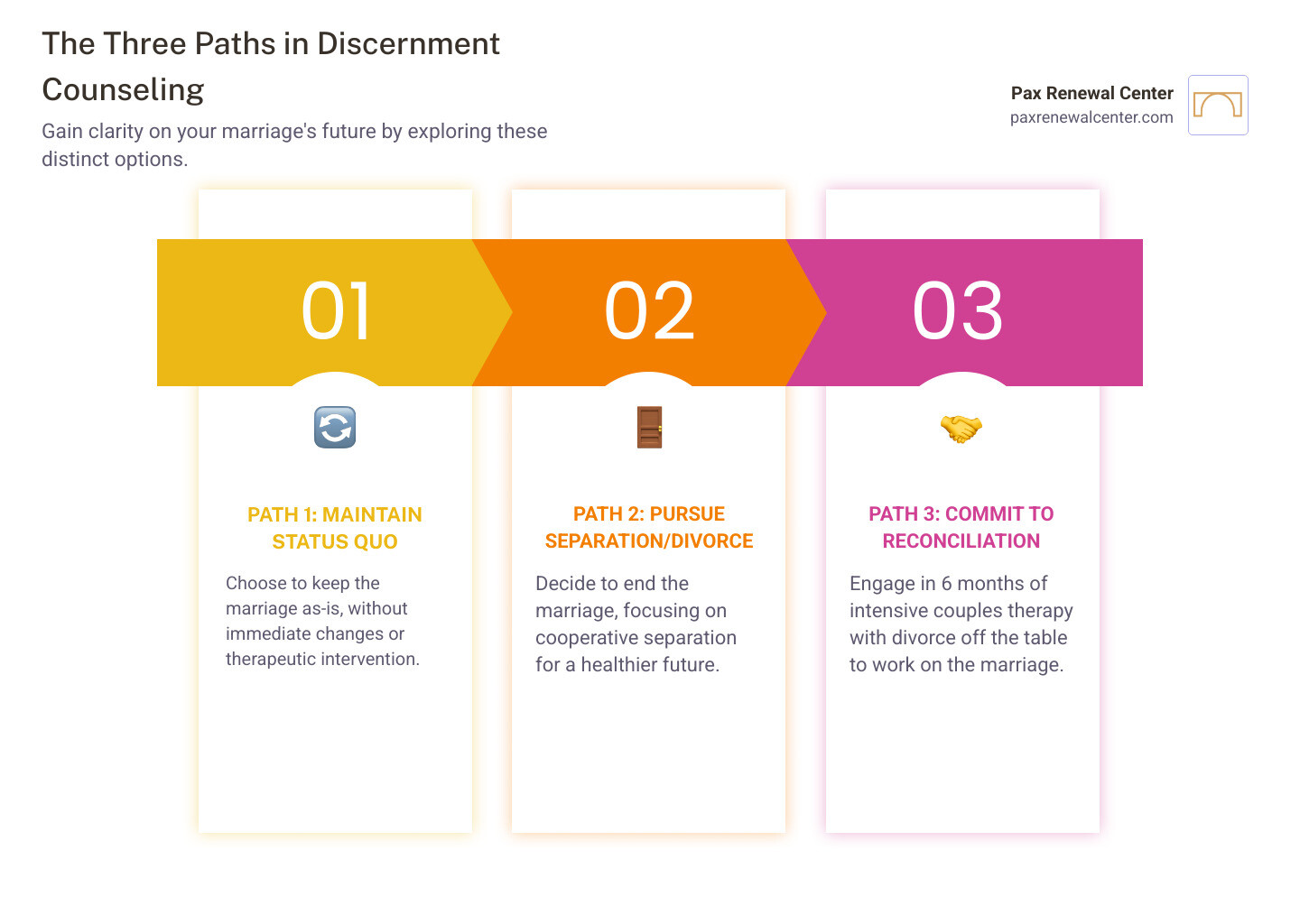
The goal of discernment counseling is to help you choose one of three distinct paths:
-
Path One: Maintain the Status Quo. This path involves pausing the decision about divorce for a set period. It’s a deliberate choice to take a break from the pressure, often while one or both partners pursue individual therapy to work on personal issues.
-
Path Two: Move Towards Separation or Divorce. If it becomes clear that ending the marriage is the right choice, this path helps you do so intentionally and with less conflict. The focus shifts to creating a “good divorce,” especially if children are involved, and may include referrals to mediators or co-parenting specialists.
-
Path Three: Commit to Six Months of Couples Therapy. This path is for couples who agree to an all-in effort to repair the marriage. It involves a commitment to six months of couples therapy, with divorce taken off the table for that period. This allows the subsequent therapy to begin with full commitment from both partners.
Here’s a summary of the paths:
| Path | Primary Goal | Next Steps |
|---|---|---|
| Maintain Status Quo | Put decision on hold | Individual therapy, intentional pause, address underlying issues individually |
| Separate/Divorce | Move towards intentional separation | Referrals for mediation, legal counsel, co-parenting support; focus on a “good divorce” |
| 6 Months Couples Therapy | Dedicated effort to reconcile | Transition to traditional couples therapy with divorce off the table; active problem-solving and relationship repair |
Outcomes, Effectiveness, and Research Findings
Does discernment counseling actually work? Research provides encouraging answers, showing that the process consistently helps couples find the clarity they need.
A key study of couples who completed discernment counseling found that nearly half (47%) chose to pursue reconciliation through couples therapy. Another 41% chose to move toward separation or divorce, making the decision with more confidence and less anger. The remaining 12% chose to maintain the status quo, giving themselves more time.
These numbers show the process working as intended—not to force a particular outcome, but to create space for thoughtful decision-making. Interestingly, the study found that couples who had already contacted a lawyer were less likely to choose reconciliation, suggesting that seeking help earlier can make a significant difference.
Post-Counseling Choices and Co-Parenting
A 28-month follow-up study revealed that these decisions were intentional and lasting. Of those who chose divorce, 80% followed through, indicating they made a clear, committed choice. Of those who chose reconciliation, 36% successfully reconciled, while others gave their marriage a wholehearted effort before separating. The value isn’t in a specific percentage but in the reduction of regret and an increase in self-awareness for all involved.
One of the most hopeful findings relates to couples who do divorce. The process can lay the groundwork for healthier future relationships, which is vital when children are involved. A follow-up study found that 64% of divorced individuals characterized their post-divorce relationship as cooperative. By helping each person understand their own contributions to the marital problems, discernment counseling reduces blame and resentment. This fosters more respectful communication, allowing parents to focus on their children’s well-being.

Even if a marriage ends, discernment counseling can help ensure the family thrives in a new form, prioritizing respect and stability for the children.
Practical Considerations: Cost, Credentials & Finding a Counselor
When you’re facing a marital crisis, practical details shouldn’t add to your stress. Here’s what you need to know about the logistics of discernment counseling.
Session fees reflect the longer session lengths (a 2-hour initial session, followed by 1.5-hour sessions). However, the process is short-term (a maximum of five sessions), making it a focused financial commitment. While insurance coverage for this specific type of counseling can be tricky, some plans may cover portions of the service. We recommend contacting your provider to clarify your mental health benefits. At Pax Renewal Center, we offer both online and in-person sessions from our Lafayette, LA office, and provide faith-integrated options that align with Christian values.
Training and Certification for Discernment Counselors
Not every therapist is qualified to offer discernment counseling. This specialized approach requires advanced training and certification, typically through the Doherty Relationship Institute, founded by the model’s creator, Dr. William Doherty. Certified counselors have mastered the unique framework and the skill of maintaining neutrality in emotionally charged situations. Choosing a certified professional ensures you are working with someone who truly understands the needs of mixed-agenda couples.
How to Locate a Qualified Discernment Counselor
To find a qualified professional, start with the official directory on the Doherty Relationship Institute website. When searching locally, ask therapists specifically about their training and certification in discernment counseling. You can also ask for referrals from family lawyers, mediators, or your pastor.
Dan Jurek at Pax Renewal Center holds a certification in discernment counseling and brings over 35 years of clinical experience to help couples in crisis. We are committed to providing compassionate, expert guidance that honors your faith and values.
Ready to take the next step? More info about discernment services
Benefits, Limitations & Faith-Integrated Support
Discernment counseling offers a path toward clarity and confidence during one of life’s most difficult decisions. The primary benefits include:
- Clarity and Confidence: Move from uncertainty to intentional action, knowing you made a well-considered choice.
- Avoids Half-Hearted Therapy: Ensures that if you do choose couples therapy, both partners are fully committed.
- Respects Autonomy: Your perspective is heard and validated, whether you are leaning in or leaning out.
- Reduces Blame: By exploring each person’s role, couples often develop a more mature understanding, which is invaluable for future co-parenting.
However, discernment counseling has important limitations. Safety is paramount; the process is not appropriate in cases of domestic violence, abuse, or coercion. It is also not effective if one spouse has already made an irreversible decision to divorce and is unwilling to explore the options. Finally, remember this is not problem-solving therapy; its purpose is to help you decide if you want to work on solving the problems in couples therapy later.
At Pax Renewal Center, we recognize that faith is often the bedrock of a marriage. Our faith-integrated approach means you don’t have to set aside your spiritual beliefs. We combine clinical excellence with a deep respect for Christian values, helping you explore your future through both psychological insight and spiritual discernment. Integrating faith can provide additional strength and wisdom, ensuring your decision aligns with your deepest values.

Frequently Asked Questions about Discernment Counseling
Here are answers to some common questions about the discernment counseling process.
How long does discernment counseling take?
Discernment counseling is a brief and focused process, typically lasting between one and five sessions. The first session is about two hours, with any follow-up sessions lasting 1.5 hours. The goal is to help you reach a clear decision efficiently.
What if only one partner wants counseling?
This is the exact situation discernment counseling is designed for. It was created for “mixed-agenda” couples, where one partner is “leaning out” (considering divorce) and the other is “leaning in” (wanting to save the marriage). The process creates a safe space for the ambivalent partner to explore their feelings without pressure.
Can discernment counseling be done online?
Yes. At Pax Renewal Center, we offer discernment counseling both in-person at our Lafayette, LA office and through secure online video sessions. Online counseling provides the same level of professional, confidential support with added convenience and flexibility.
Conclusion
It’s truly heartbreaking to face the possibility of your marriage ending. We know how confusing, painful, and overwhelming this time can be. But here at Pax Renewal Center, we want you to know you don’t have to walk through this uncertainty by yourselves.
Discernment counseling offers a unique and compassionate pathway. It helps you both find the clarity and confidence you need about your relationship’s future. It’s about moving from feeling stuck to making a clear, intentional choice.
Whether that path leads to rekindling your marriage, moving towards a healthier separation, or simply pausing to gain more insight, our deepest desire is to empower you. We want you to make an intentional choice that truly aligns with your heart and your values.
As one of the few centers specializing in discernment counseling and integrating it with a compassionate, faith-based approach, we’re here to offer the understanding, guidance, and support you deserve during this critical season.
You don’t have to let uncertainty keep you stuck. Take that brave first step towards clarity and renewed hope today. We’re ready to help you discern your path forward.
For more information about our counseling services, including discernment counseling, marriage counseling, and individual therapy rooted in Christian values, please visit our website: More info about counseling services.