
What Is an Online Therapy Group — and Is It Right for You?
An online therapy group is a structured, therapist-led session where a small group of people meet over secure video to work through shared mental health challenges — from anxiety and depression to grief, trauma, and relationship stress.
Here is a quick overview of what to expect:
| Feature | Details |
|---|---|
| Format | Live video sessions via secure, HIPAA-compliant platform |
| Group size | Typically 3 to 15 participants |
| Session length | Usually 60 to 90 minutes per week |
| Who leads it | A licensed mental health therapist |
| Common topics | Anxiety, depression, PTSD, grief, trauma, parenting, LGBTQ+ support |
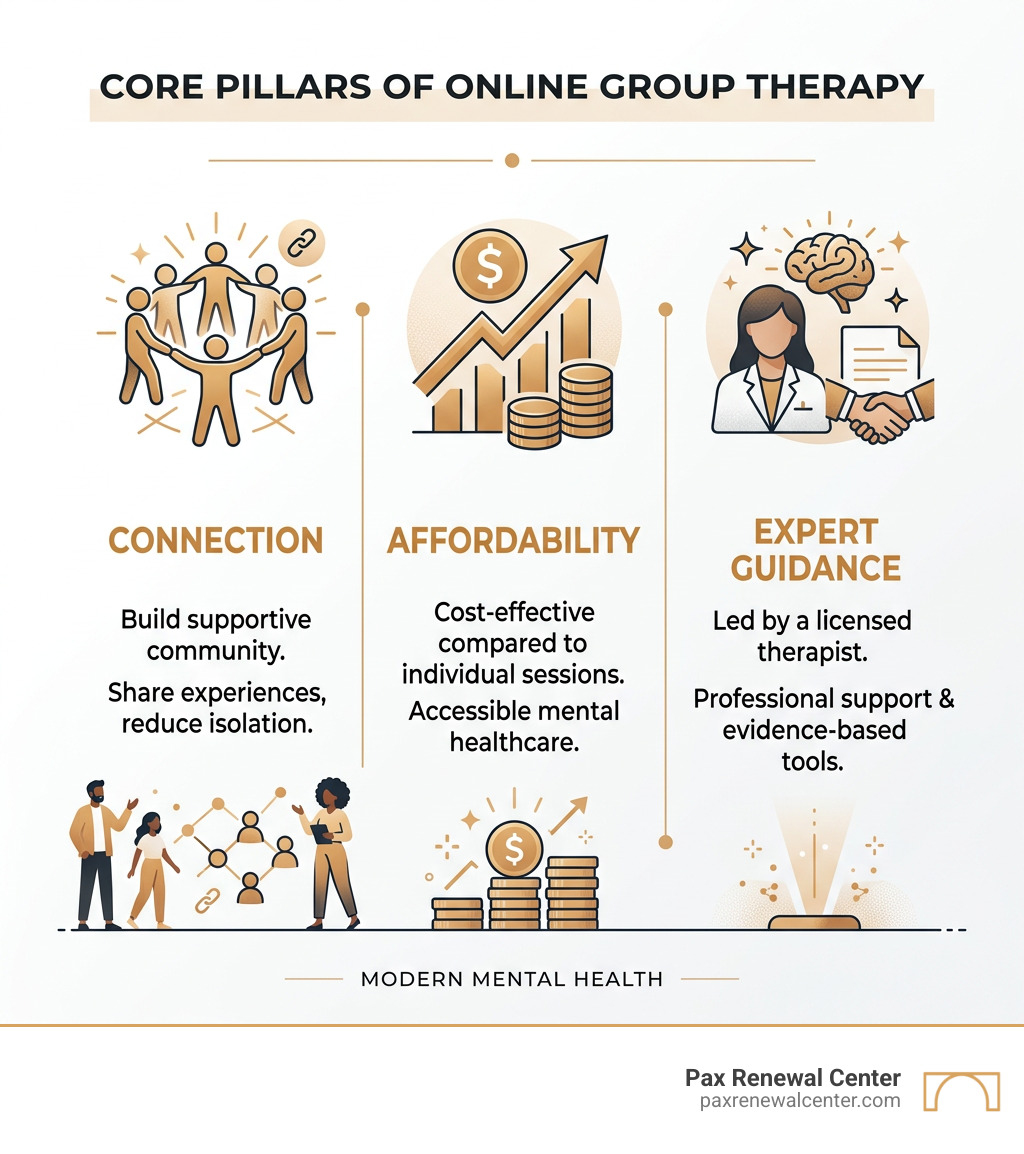
| Key benefits | Connection, affordability, expert guidance, peer support |
| Who it’s for | Adults, teens, and specialized communities |
Many people are surprised to learn that group therapy can be just as effective as individual therapy — and in some cases, even more so. Research supports its use for conditions like depression, anxiety, PTSD, and substance use disorders. And because sessions are held online, you can join from your living room in Lafayette, Louisiana or anywhere else in the state.
Still, choosing the right format for your needs takes some thought. This guide walks you through everything — how online groups work, what to look for, and how to get started.
I’m Dan Jurek, M.A., LPC-S, LMFT-S, founder and clinical director of Pax Renewal Center in Lafayette, Louisiana, with over 35 years of clinical experience helping individuals, couples, and families heal. I’ve seen how an online therapy group can open doors to healing for people who might never have sought help otherwise — especially when that group is grounded in faith, expert guidance, and genuine community.
What is an online therapy group and How Does It Work?
At its core, an online therapy group brings the traditional “circle of support” into the digital age. Instead of driving to a clinic in Lafayette, you log into a secure, private video room. These sessions are not just “chat rooms”; they are clinical environments led by a licensed therapist who facilitates the conversation, ensures everyone is heard, and introduces evidence-based tools for healing.

In these virtual spaces, we focus on creating a safe haven. We utilize virtual counseling in Lafayette, LA to bridge the gap between isolation and community. A typical session follows a consistent structure:
- The Check-in: Members share how their week has gone and any immediate “wins” or struggles.
- The Skill-Building: The therapist introduces a specific concept, such as a Cognitive Behavioral Therapy (CBT) technique or a mindfulness exercise.
- The Discussion: The group processes how these tools apply to their lives, offering feedback and encouragement to one another.
- The Wrap-up: We set goals for the coming week to ensure the progress made in the session translates to real-world change.
Privacy is our highest priority. To ensure your safety, we use HIPAA-compliant, encrypted video software. This means your data and your face-to-face conversations are protected by the same level of security used by major medical institutions.
The Difference Between Individual and online therapy group Sessions
While individual therapy offers a deep dive into your personal history, an online therapy group offers something a one-on-one session cannot: the power of the “social mirror.” In a group, you see your struggles reflected in others, which instantly reduces the shame and isolation that often accompany mental health challenges.
Group therapy is also incredibly cost-effective. By sharing the therapist’s time with others, the cost per session is significantly lower, making high-quality care accessible to more families in Louisiana. For those focusing on their partnerships, online-relationship-counseling can often be supplemented by group work where couples learn that they aren’t the only ones navigating communication hurdles or trust issues.
Platform Requirements and Technology for Your First Session
Getting started is simpler than most people think. You don’t need to be a “tech genius” to participate. To join an online therapy session, you generally need:
- A Private Space: A room where you won’t be interrupted and can speak freely.
- Stable Internet: A reliable Wi-Fi or cellular connection to prevent lag.
- A Device with a Camera: A smartphone, tablet, or laptop works perfectly.
- The Link: Your therapist will send a secure, clickable link via email or a member portal.
Many groups also utilize digital worksheets or shared screens to help you visualize the concepts being discussed, making the experience interactive and engaging.
The Mental Health Benefits of Joining a Virtual Community
The primary benefit of an online therapy group is the immediate reduction in social isolation. In our modern world, it is easy to feel like you are the only one struggling with a “heavy heart” or a “noisy mind.” Entering a virtual community changes that narrative instantly.
When you participate in online therapy and psychotherapy in Lafayette, LA, you gain access to collective wisdom. You aren’t just getting the perspective of one therapist; you are getting the lived experience of 5 to 10 other people who have walked in your shoes. This real-time feedback helps foster interpersonal growth and emotional regulation in a way that feels natural and supportive.
| Benefit | Individual Therapy | Online Group Therapy |
|---|---|---|
| Cost | Higher per session | Significantly more affordable |
| Focus | Deep personal history | Social skills and peer support |
| Perspective | Clinical expert only | Clinical expert + Peer experiences |
| Isolation | One-on-one connection | Community connection |
| Skill Practice | Roleplay with therapist | Real-time interaction with peers |
Common Conditions Addressed in an online therapy group
Online groups are versatile. Research shows they are particularly effective for:
- Depression and Anxiety: Breaking the cycle of withdrawal and ruminating thoughts.
- PTSD and Trauma: Finding safety among others who understand the “survival mode” of trauma.
- Substance Use Disorders: Providing accountability and a “sober community” that is accessible 24/7.
- ADHD Coping Skills: Learning executive function hacks from others who navigate neurodiversity.
- Grief and Loss: Sharing the burden of mourning with a community that won’t tell you to “just move on.”
For those seeking a spiritual component, our faith-based-therapy-guide explains how we integrate these clinical goals with Christian values. We believe that emotional healing and spiritual renewal go hand-in-hand. Whether you are looking for Louisiana online counseling or specialized local support, group therapy provides a robust framework for lasting change.
Specialized Support for Unique Communities
We recognize that “one size does not fit all.” That is why many providers offer specialized groups tailored to specific identities and life stages:
- LGBTQ+ Resilience: A safe space to discuss identity-affirming care and navigate societal challenges.
- Parenting Groups: For those feeling the “burnout” of raising children in a digital age.
- Trauma Survivors: Utilizing specialized approaches like virtual-christian-therapy to find peace after past hurts.
- Postpartum Support: Helping new moms navigate the “baby blues” and the massive identity shift of motherhood.
Effectiveness and Accessibility of Virtual Group Support
Is it actually as good as meeting in person? The data says yes. Numerous studies have shown that the clinical outcomes for an online therapy group are equivalent to traditional, in-office groups. In fact, some participants find they are more honest and vulnerable when they are in the comfort of their own homes.
For a broad overview of how group psychotherapy works (including common goals and formats), see Group psychotherapy.
Accessibility is the other major win. For many in Louisiana, finding a specialist can mean a long drive to a major city. By accessing digital platforms, you remove the barriers of traffic, childcare, and travel time.
Affordability is also a key factor. While individual therapy is a vital investment, group therapy sessions often average between $23 and $32 per session over time, compared to over $100 for individual work. Many insurance plans, including Medicare and Medicaid, now recognize and cover virtual group sessions, making professional mental health care a reality for those on a budget.
Qualifications of Group Facilitators
You aren’t just talking to a “listener”; you are working with a highly trained professional. Facilitators of an online therapy group are typically licensed mental health professionals (LPCs, LMFTs, or LCSWs) who have undergone specific training in group dynamics.
At Pax Renewal Center, our facilitators are well-versed in clinical best practices like the is-online-gottman-method-right-for-you-a-deep-dive-into-digital-learning for relationships and EMDR for trauma. This ensures that the group isn’t just a “venting session,” but a therapeutic environment where real, measurable progress happens.
Frequently Asked Questions about Online Group Therapy
How do I get started and find the right match?
The process usually begins with an initial mental health assessment. This is a one-on-one meeting with a provider to discuss your goals and determine which group would be the best fit for your personality and needs. We look at factors like group size—typically keeping groups between 3 to 15 participants—to ensure everyone has the opportunity to speak. If you are specifically looking for long-distance-relationship-therapy, we can help match you with a community of other couples navigating similar dynamics.
Can I combine group sessions with individual therapy?
Absolutely. In fact, this is often the “gold standard” for care. Individual therapy allows you to process deep-seated issues, while the online therapy group serves as a “lab” where you can practice the skills you’ve learned. This combination often leads to accelerated healing. For example, a couple might use our best-long-distance-couples-counseling-guide to work on their specific issues while joining a group to build broader communication skills.
What are the typical cancellation and privacy policies?
Most online platforms operate on a subscription or flat-rate monthly model. This provides you with a predictable cost and ensures the group remains consistent. Privacy is maintained through strict confidentiality agreements—what is said in the group stays in the group. Providers in Louisiana must adhere to state regulations, ensuring that all member portals and billing systems are secure and HIPAA-compliant.
Conclusion
Finding your “people” is one of the most transformative steps you can take for your mental health. Whether you are struggling with the weight of the past or the anxieties of the future, an online therapy group offers a unique blend of professional expertise and peer compassion.
At Pax Renewal Center, we are dedicated to helping you experience emotional healing, relational restoration, and spiritual renewal. We believe that no one should have to walk the path of healing alone. If you are ready to find a community that understands your heart and supports your growth, we invite you to take that first step with us.