

What Registered Play Therapist Training Requires
Registered play therapist training is the structured path licensed mental health professionals follow to earn the Association for Play Therapy’s Registered Play Therapist (RPT) credential. In simple terms, it combines advanced play therapy education, supervised work with child clients, and guidance from an approved play therapy supervisor.
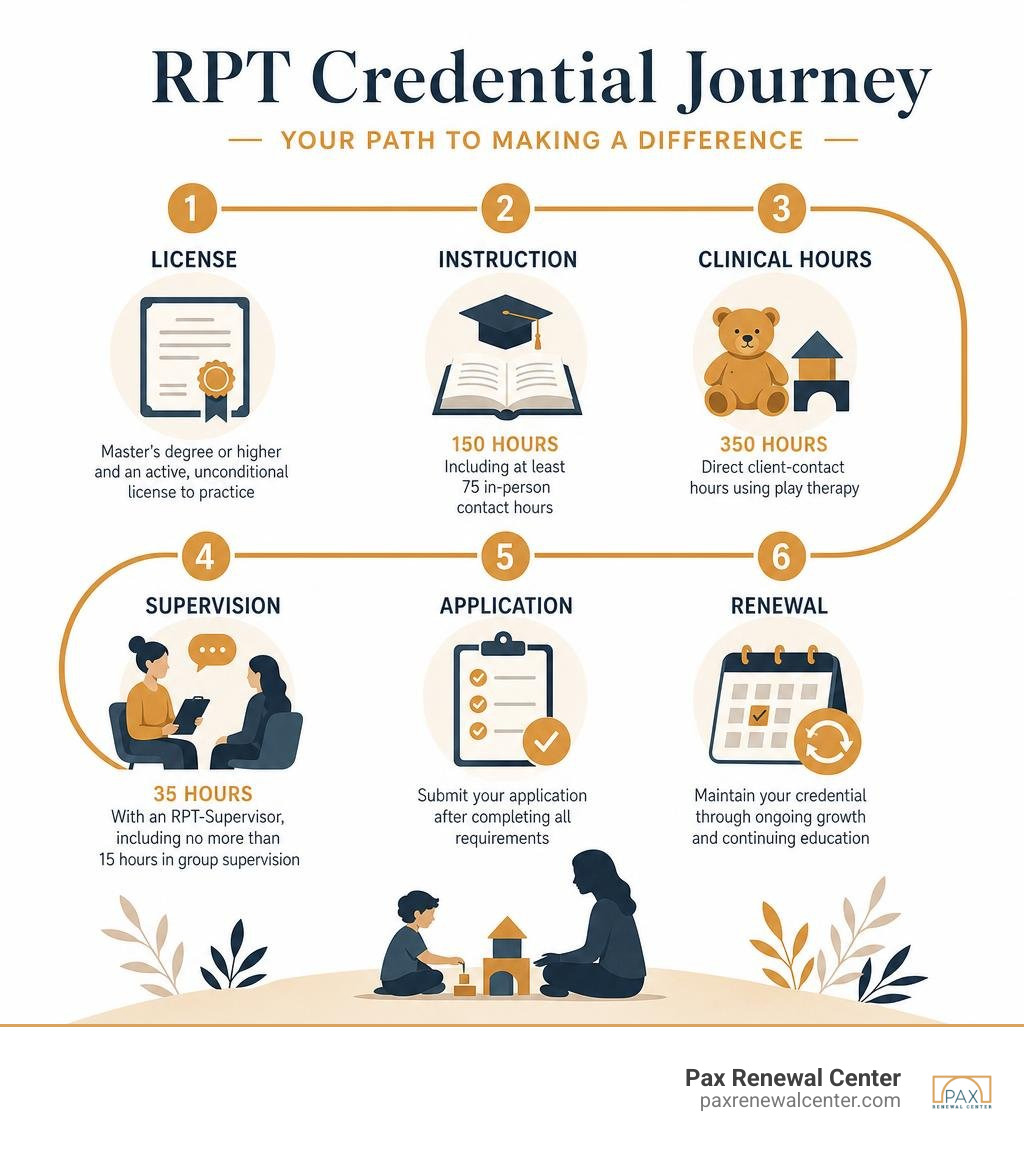
To qualify for the RPT credential, an applicant generally needs:
- A master’s degree or higher in a clinical mental health field and an active, unconditional license to practice independently.
- 150 hours of play therapy instruction, including at least 75 in-person contact hours.
- 350 direct client-contact hours using play therapy.
- 35 hours of supervision with an RPT-Supervisor, including no more than 15 hours in group supervision.
- Completion of these requirements over at least 2 years and no more than 10 years.
This credential is not the same as a general workshop certificate. It is a national professional designation that helps families identify clinicians with documented education, clinical experience, and supervision in play therapy. For parents, that can matter when a child is struggling to express fear, grief, behavior concerns, trauma, or big changes at home.
As of August 2026, APT standards also separate in-person instruction from virtual learning: even live webinars count as non-contact hours. The full path can feel detailed, but each requirement is meant to build safe, skilled, developmentally appropriate care for children and families.
I am Dan Jurek, M.A., LPC-S, LMFT-S, a Louisiana counselor and marriage and family therapist with more than 35 years of clinical experience serving individuals, couples, and families. While my work includes family and child mental health concerns, this guide explains registered play therapist training standards so families and clinicians can better understand what this specialized credential represents.
Relevant articles related to registered play therapist training:
APT Credentials Overview and Eligibility Standards
The Association for Play Therapy (APT) manages national credentialing standards to ensure that mental health practitioners possess specialized competence in therapeutic play modalities. When a clinician displays an official credential from APT, it signifies rigorous academic preparation, deliberate clinical practice, and direct supervision. APT confers three primary credentials depending on a clinician’s professional background, supervisory status, and clinical setting:
- Registered Play Therapist (RPT): The flagship credential designed for fully licensed mental health clinicians providing direct outpatient or clinical play therapy services.
- Registered Play Therapist-Supervisor (RPT-S): An advanced credential for seasoned RPT holders who possess the clinical experience and specialized supervisory training necessary to oversee RPT candidates.
- School-Based Registered Play Therapist (SB-RPT): A specialized designation for certified school counselors and educational mental health specialists delivering play-based interventions within academic institutions.
To establish eligibility for any APT credential, applicants must hold a graduate degree (master’s or doctoral) in a mental health field from an accredited institution. Furthermore, candidate clinicians must demonstrate foundational graduate-level coursework covering six core mental health topics: child development, theories of personality, principles of psychotherapy, child and adolescent psychopathology, cultural and social diversity, and ethics.
For the traditional RPT credential, candidates must maintain an active, unconditional state license to independently provide clinical mental health services. This includes professions such as Licensed Professional Counselors (LPC), Licensed Marriage and Family Therapists (LMFT), Licensed Clinical Social Workers (LCSW), licensed psychologists, or psychiatrists.
| Credential | Minimum Degree & Licensure Requirement | Direct Play Therapy Hours | Supervision Hours Required | Prerequisites & Supervisory Scope |
|---|---|---|---|---|
| Registered Play Therapist (RPT) | Master’s or higher in mental health; active, unconditional independent clinical license | 350 direct client-contact hours | 35 supervision hours from an RPT-S (max 15 group) | Graduate coursework in 6 core areas; 2 to 10 year accrual window |
| Registered Play Therapist-Supervisor (RPT-S) | Master’s or higher; active independent clinical license; active RPT status | Ongoing clinical practice beyond initial RPT requirements | Advanced supervisory training (3 CE hours per 36-month cycle) | 3 consecutive years as an active RPT prior to application; qualified to supervise RPT candidates |
| School-Based Registered Play Therapist (SB-RPT) | Master’s or higher; state department of education certification as a school counselor | 350 direct school play therapy client hours | 35 supervision hours from an RPT-S | Specific focus on school setting interventions; clinical scope limited to educational practice |
SB-RPT Licensure Requirements
While the standard RPT credential mandates independent clinical mental health licensure, school counselors often operate under state department of education credentials rather than health department licensing boards. The School-Based Registered Play Therapist (SB-RPT) credential was created specifically to accommodate these dedicated professionals.
Applicants pursuing the SB-RPT designation must hold a master’s degree in counseling or school psychology alongside valid state certification as a school counselor. Because state educational credentials restrict practice to school settings, the SB-RPT credential reflects a specialized clinical scope. SB-RPT professionals utilize play-based interventions within educational frameworks to support academic, social, and emotional growth, but they cannot legally provide independent private practice or outpatient therapy under this specific title unless they also maintain full clinical licensure.
Core Pathways for Registered Play Therapist Training
Acquiring registered play therapist training is an intentional, structured process. APT requires candidates to build competencies sequentially over a timeframe of no less than two (2) years and no more than ten (10) years. This ensures that clinical skill development occurs through an integrated model where theoretical education, direct clinical work with children, and supervisory reflection reinforce one another.
To successfully navigate the credentialing pathway, candidates must fulfill three main requirements:
- 150 Hours of Play Therapy Instruction: Specialized clock-hour coursework covering play therapy history, theories, techniques, and populations.
- 350 Direct Client-Contact Hours: Documented individual, family, or group play therapy sessions with child clients.
- 35 Hours of Play Therapy Supervision: Individual and group mentoring provided exclusively by a designated RPT-S, accompanied by direct session evaluations.
Clinicians looking for approved workshops and university programs can search the official Find Play Therapy Training directory to locate accredited contact and non-contact learning opportunities.
Phase Structure in Registered Play Therapist Training
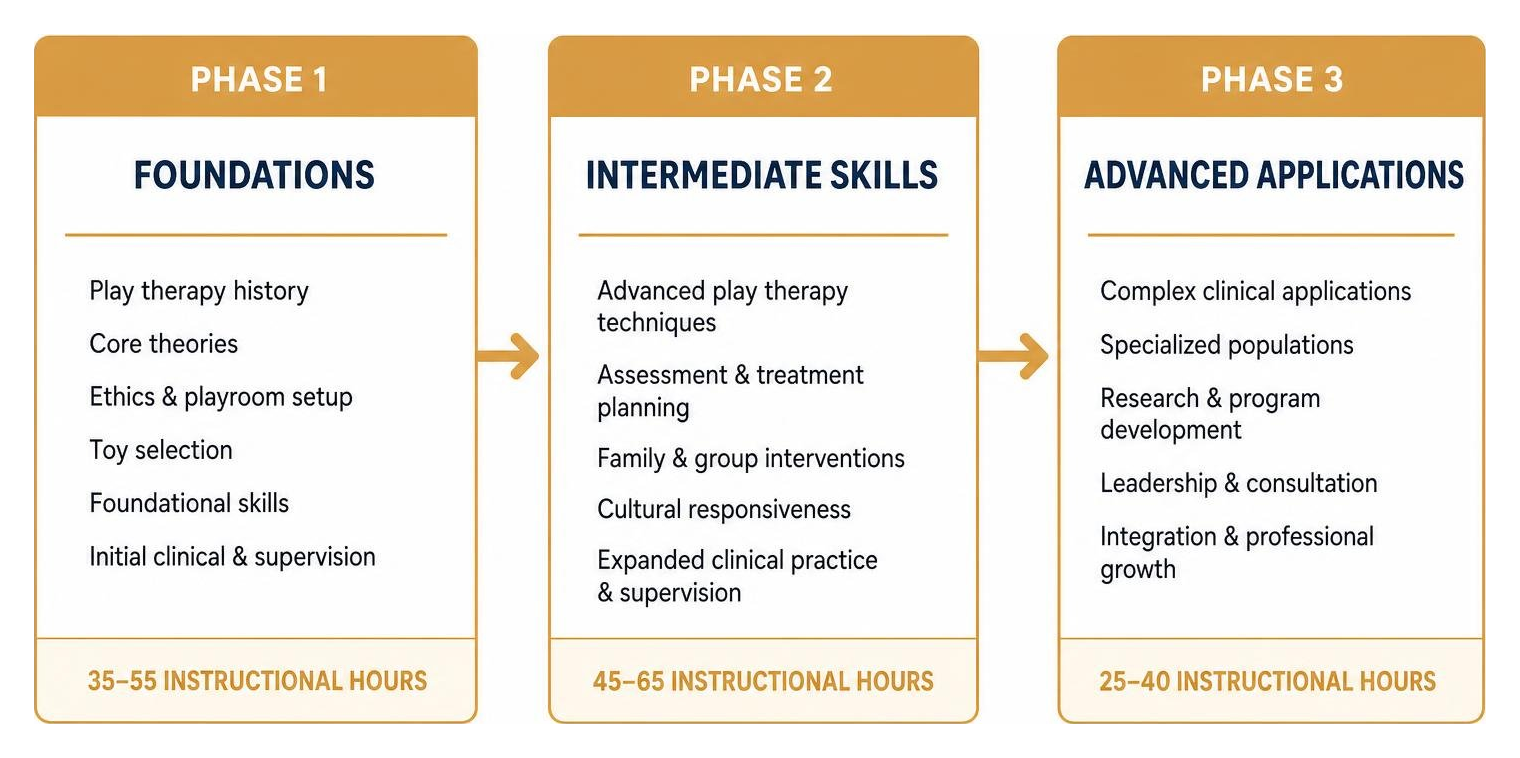
APT organizes the 150 required instructional clock hours into three distinct phases to promote continuous professional growth:
- Phase 1 (Foundations & History): Focuses on foundational play therapy theories (such as Child-Centered, Gestalt, and Adlerian), history, ethics, playroom setup, toy selection, and core therapeutic skills. Phase 1 typically comprises 35 to 55 instructional hours alongside initial clinical hours and supervisory sessions.
- Phase 2 (Intermediate Skills & Modalities): Expands into assessment, treatment planning, specialized interventions (like sandtray, expressive arts, and directive play therapy), child psychopathology, and family systems integration. Phase 2 requires 55 to 70 instructional hours as candidates refine their clinical application.
- Phase 3 (Advanced Application & Cultural Competency): Focuses on complex trauma, neurobiological applications, neurodivergent adaptations, and mandatory cultural and social diversity competencies. Candidates complete the remaining 45 to 60 instructional hours during Phase 3 while finalizing their supervised practice.
Because training must occur concurrently with practice, date ranges across phases must be clear and sequential without overlapping.
Contact vs Non-Contact Instruction Requirements
Instructional delivery formats play a central role in meeting APT standards. Effective April 1, 2025, APT updated its training delivery policy: of the 150 total required instructional hours, a minimum of 75 hours must be completed in-person (contact training). The remaining 75 hours may be fulfilled through contact or non-contact formats.
APT maintains strict definitions for instruction delivery:
- Contact Hours: Earned strictly through physical, in-person attendance at workshops, university classrooms, or institute seminars where real-time interactive skill practice occurs.
- Non-Contact Hours: Fulfills the remaining instruction balance through independent home study, recorded webinars, book studies, and virtual learning.
- Live Webinar Classification: Under current APT guidelines, all webinars—including live interactive virtual seminars—are categorized as non-contact training. Candidates must plan carefully to ensure they accumulate sufficient physical, in-room contact hours.
Role of the RPT-Supervisor and Clinical Supervision Hours
The Registered Play Therapist-Supervisor (RPT-S) serves as a mentor, teacher, and evaluator throughout the credentialing journey. Candidates cannot complete supervision under a general clinical supervisor; hours must be logged under an active RPT-S who oversees the candidate’s development, client dynamics, and adherence to ethical play therapy principles.
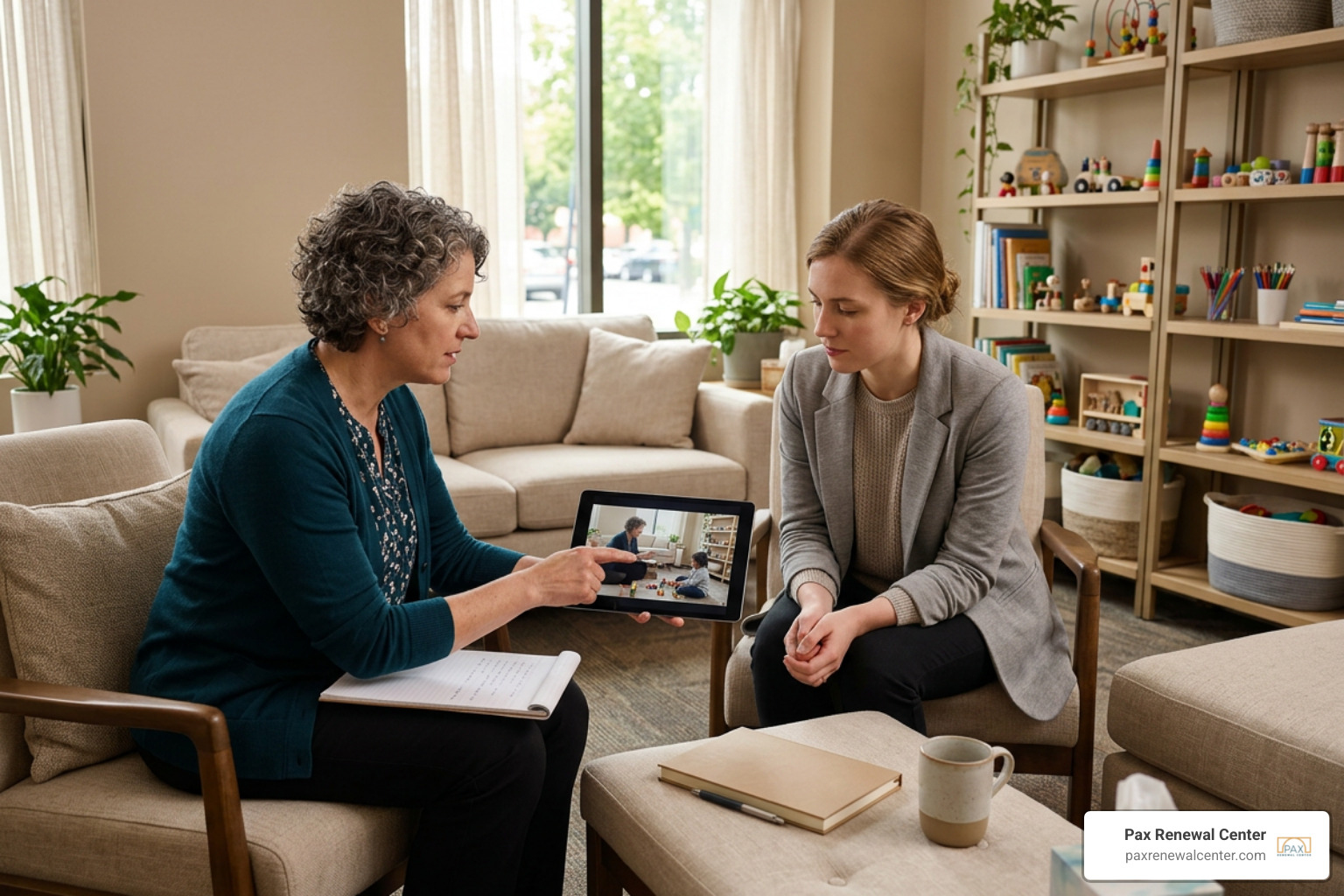
During supervision, the candidate presents clinical cases, reviews videotaped play sessions, discusses playroom dynamics, and evaluates intervention effectiveness. The supervisor acts as a gatekeeper for the profession, attesting to the applicant’s ethical conduct and clinical readiness before APT grants the credential.
Supervision Hours and Group Session Limits
To fulfill supervisory requirements, candidates must complete 35 total hours of play therapy supervision with an RPT-S across the three training phases:
- Individual Supervision: A minimum of 20 hours must occur in a 1-on-1 setting or paired setting (triadic) with the supervisor.
- Group Supervision Allowance: Candidates may complete up to 15 hours of supervision in a group setting. APT expanded this limit from 10 hours to 15 hours to provide greater accessibility for trainees.
- Direct Session Observations: As part of the 35 supervision hours, the RPT-S must directly observe the candidate conducting play therapy across at least 5 separate client sessions. Observations may occur via live in-room observation, live audio-visual feeds, or recorded video review.
- Supervisor Attestation: Upon completing all phases, the RPT-S must sign official verification forms attesting to the candidate’s skill mastery, theoretical grounding, and ethical compliance.
Specialized Certifications vs National APT Credentials
Many therapists wonder how modality-specific certifications differ from national credentials like the RPT. Modality certifications focus on mastery of a single theoretical model, whereas national APT credentials represent general professional competence across multiple play therapy theories and populations.
A prominent example is the Child-Centered Play Therapy (CCPT) certification issued by the Center for Play Therapy at the University of North Texas. Rooted in Virginia Axline’s non-directive principles and further developed by Dr. Garry Landreth and Dr. Dee Ray, CCPT is an evidence-based intervention for children aged 3 to 10.
| Feature / Standard | APT Registered Play Therapist (RPT) | Certified CCPT Practitioner (Center for Play Therapy) |
|---|---|---|
| Primary Scope | Comprehensive national credential covering diverse play therapy theories | Modality-specific certification focusing exclusively on Child-Centered Play Therapy |
| Instructional Hours | 150 instruction hours (minimum 75 in-person contact hours) | 30 focused CCPT education hours (CCPT 101 & CCPT 102) |
| Supervised Clinical Hours | 350 direct play therapy client hours | 40 CCPT clinical sessions with at least 3 children (aged 3–10) |
| Supervision Requirements | 35 hours under an RPT-S (minimum 5 direct observations) | 20 hours of continuous supervision from a CCPT supervisor |
| Examination & Recertification | Application review; annual renewal & 3-year CE tracking | 40-question exam (90% passing score); 5-year recertification (12 CEs) |
International Play Therapy Pathways
Mental health professionals operating outside the United States pursue play therapy credentials through dedicated international bodies or regional associations. While APT credentials are directly tied to U.S. state licensure boards, international systems adapt training to local legislative and educational contexts:
- Canadian Association for Play Therapy (CAPT): Requirements call for 180 hours of play therapy training from approved providers, along with supervised clinical hours, to earn the Certified Play Therapist (CPT) designation.
- British Columbia Association of Play Therapy (BCPTA): Aligns credentialing standards closely with CAPT requirements, recognizing 180 instruction hours across foundational, advanced, and specialized streams.
- Australian Qualifications Framework: Evaluates play therapy competence through structured vocational diplomas. For instance, the accredited course National Training Register – 11380NAT Graduate Diploma of Play Therapy provides recognized units covering sandtray therapy, neurodivergent play adaptations, trauma-informed applications, and family systems interventions.
Educational Pathways and Approved Provider Organizations
Therapists can complete their registered play therapist training through several accredited educational tracks. APT evaluates and approves training organizations to ensure academic rigor and consistency.

- University-Based Approved Centers: Higher education institutions with dedicated play therapy graduate certificates or coursework embedded within CACREP-accredited counseling programs. For example, the Online Play Therapy Graduate Certificate | University of Wyoming delivers an online post-master’s sequence specifically designed to satisfy APT’s 150 clock-hour requirement.
- Dedicated Play Therapy Institutes: Continuing education institutes offering structured cohorts, hybrid models, and color-coded streams. Programs offered by the Play Therapy Training Programs | Rocky Mountain Play Therapy Institute provide multi-stream instruction (such as Green Stream Foundations and Red Stream Advanced) that map directly onto APT’s 150-hour credentialing requirements.
- Approved Providers & State Branch Conferences: APT Approved Providers host targeted weekend workshops, annual state conferences, and specialized webinars covering diverse topics like sandtray, play therapy ethics, trauma interventions, and family play therapy.
Selecting an Approved Registered Play Therapist Training Program
When evaluating training providers, candidates should verify specific criteria to ensure their investment translates directly into credential approval:
- APT Approved Provider Status: Ensure the training institute displays an active APT Approved Provider number.
- Contact Hour Balance: Verify how many hours are delivered physically in-room versus virtually, ensuring you meet the 75 in-person contact hour minimum.
- Curriculum Alignment: Confirm that the coursework covers APT’s required competencies across Phase 1, Phase 2, and Phase 3, including diversity and ethics requirements.
- Cohort Flexibility: Choose a schedule that aligns with your clinical practice, whether that involves an intensive post-master’s certificate or modular weekend workshops completed over 2 to 3 years.
Credential Maintenance, Annual Renewal, and Continuing Education
Earning the RPT credential is a significant milestone, but maintaining it requires ongoing professional learning. APT mandates annual credential renewal alongside a three-year continuing education tracking cycle.
- Annual Renewal: Registrants pay an annual renewal fee and verify that their state mental health license remains active, unrestricted, and in good standing.
- Three-Year CE Cycle: Every three years, RPT holders must document 18 continuing education hours dedicated specifically to play therapy.
- Diversity CE Requirement: As part of each 3-year renewal cycle, play therapists must complete mandatory continuing education focused on cultural diversity, social justice, or implicit bias in child therapy.
- RPT-S Maintenance: Supervisors must complete an additional 3 clock hours of supervisor-specific continuing education per 3-year cycle to maintain their supervisory designation.
At Pax Renewal Center, our practice values clinical education and therapeutic excellence. Grounded in evidence-based practices—such as Emotionally Focused Therapy (EFT), Gottman Method, Cognitive Behavioral Therapy (CBT), and EMDR—alongside Christian values, we emphasize continuous training so children and families receive compassionate care.
Frequently Asked Questions About Registered Play Therapist Training
How long does it take to complete registered play therapist training?
Completing all requirements for the RPT credential takes a minimum of 2 years and a maximum of 10 years. Most practicing clinicians complete their instruction, clinical client contact hours, and supervision over a 2- to 4-year period while working in clinical settings.
Do live webinars count as in-person contact hours for APT credentials?
No. Under APT credentialing standards, all webinars—including live, interactive webinars—are classified as non-contact hours. To satisfy the 150-hour instruction requirement, at least 75 hours must be completed through physical, in-person contact training.
What is the difference between an RPT and a certified CCPT practitioner?
An RPT is a broad national credential administered by the Association for Play Therapy that requires an active clinical mental health license, 150 instruction hours across various modalities, 350 direct play therapy client hours, and 35 supervision hours. A certified CCPT practitioner holds a specialized certification focused strictly on Child-Centered Play Therapy from the UNT Center for Play Therapy, requiring 30 targeted education hours, 40 CCPT client sessions, 20 supervision hours, and a passing score on a exam.
Conclusion
Embarking on registered play therapist training is a rewarding investment for mental health professionals dedicated to helping children heal and thrive. By combining 150 instructional hours, 350 direct play therapy client hours, and 35 supervised hours under an RPT-S, clinicians gain the skill, insight, and confidence needed to decode the natural language of childhood play.
At Pax Renewal Center in Lafayette, Louisiana, our mission is to support emotional healing, relational restoration, and spiritual renewal for individuals, couples, and families. Whether you are seeking therapy for a child navigating emotional challenges, couples counseling, or individual trauma recovery, our team is committed to walking alongside you with compassionate, expert care.
Learn more about our mental health services and discover how our faith-aligned, clinical counseling can support your family’s journey toward healing.