
Does Insurance Cover Online Couples Counseling?
Couples counseling online insurance coverage is possible, but it is not automatic. Most plans cover virtual couples sessions only when one partner has a diagnosed mental health condition and the joint session is part of that person’s treatment; counseling focused only on relationship growth, communication, or premarital concerns is often excluded.
- Online sessions may be covered under the same behavioral-health benefit as in-person care.
- One partner is usually listed as the identified patient for billing and diagnosis purposes.
- Coverage depends on the plan, therapist network status, and medical-necessity rules.
- Private-pay options, HSA/FSA funds, and employee assistance programs can help when insurance does not apply.
For couples in Lafayette and across Louisiana, virtual care can make it easier to meet consistently, whether you are at home, traveling, or joining from separate locations. But insurance rules can feel confusing, especially when you are already carrying the stress of conflict, betrayal, distance, anxiety, or a marriage at a crossroads.
I am Dan Jurek, M.A., LPC-S, LMFT-S, a marriage and family therapist with more than 35 years of clinical experience supporting couples through relationship and mental-health concerns. In this guide to couples counseling online insurance, I will explain the practical coverage questions that can help you make an informed next step.
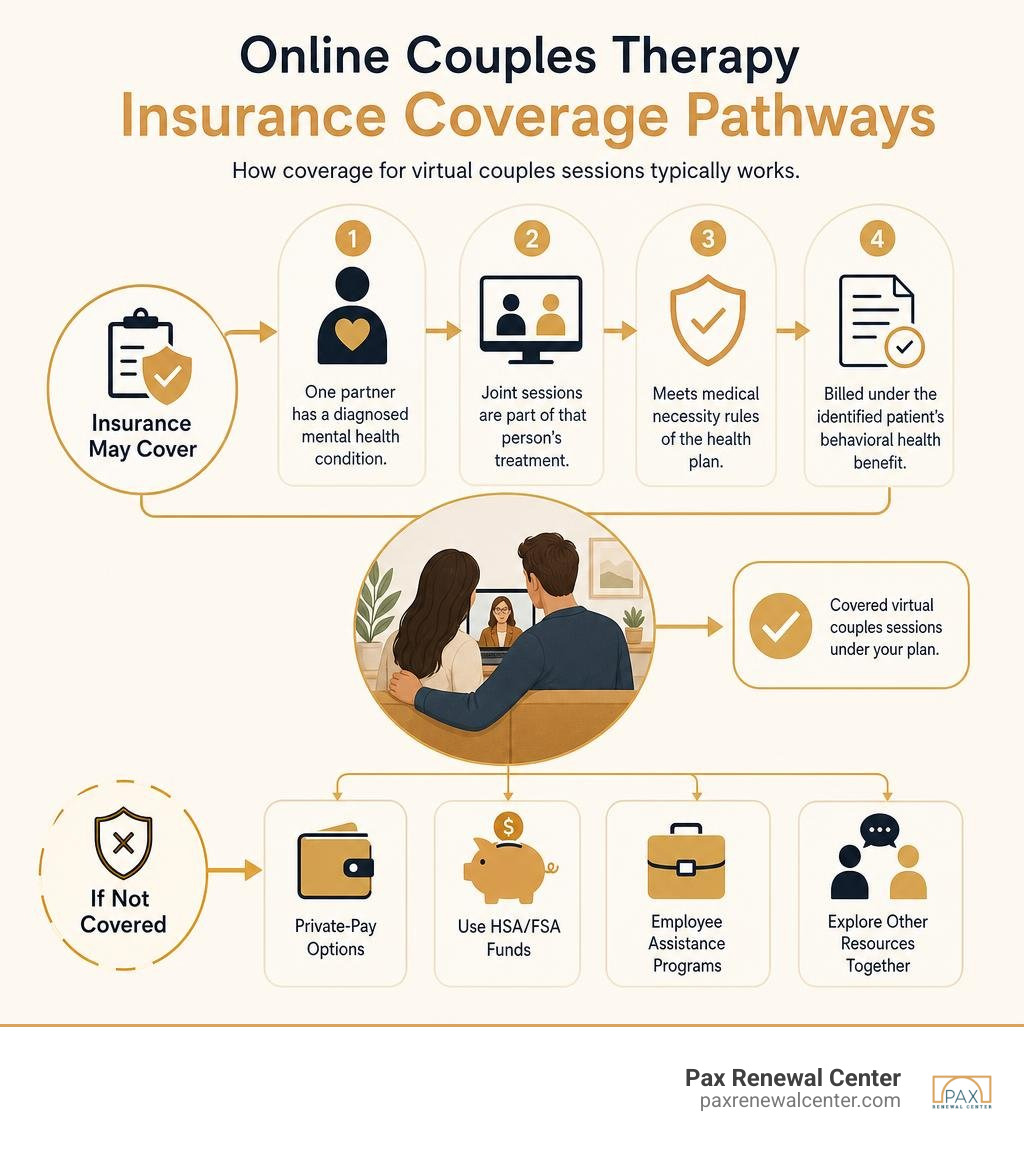
Couples counseling online insurance terms explained:
How Insurance Coverage Works for Virtual Marriage and Relationship Therapy
Understanding how health insurance handles virtual marital and relationship therapy begins with knowing the concept of telehealth parity and medical necessity. Telehealth parity laws in many jurisdictions require insurance providers to reimburse virtual mental health care at equivalent rates to traditional in-person visits. However, reimbursement always hinges on whether the service meets the insurer’s definition of medical necessity.
Health insurance is designed primarily as a medical contract meant to treat diagnosed clinical conditions. Because standard relationship distress, marital dissatisfaction, or communication breakdowns are not classified as mental health disorders in clinical diagnostic manuals, insurers generally will not cover therapy designed strictly for relationship enhancement.
For broader insights into virtual relational care, read our Online Relationship Therapy Complete Guide.
Diagnostic Requirements and Identified Patient Framework
To bill insurance for couples therapy, standard insurance protocols require establishing an “identified patient.” This framework designates one partner as the primary insured individual who possesses a formal clinical diagnosis recognized by the Diagnostic and Statistical Manual of Mental Disorders (DSM-5).
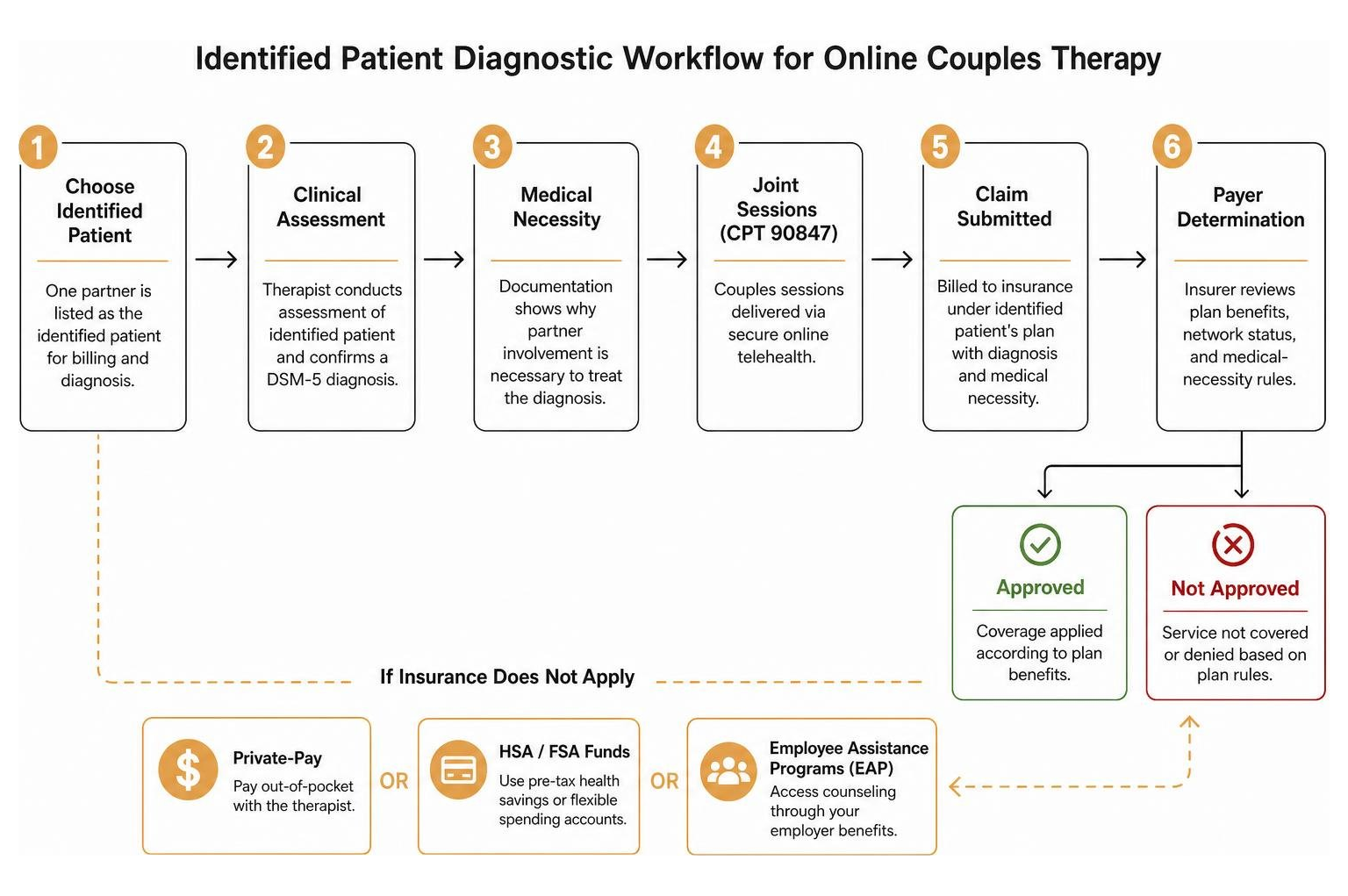
When joint sessions are billed to insurance, the clinical documentation must demonstrate that involving the spouse or partner is directly necessary for treating the identified patient’s clinical diagnosis, such as:
- Major depressive disorder or clinical anxiety disorders
- Post-traumatic stress disorder (PTSD) or complex trauma recovery
- Obsessive-compulsive disorder (OCD) or acute adjustment reactions
If neither partner meets the criteria for a diagnosed mental health condition, insurance companies usually classify the service as non-covered relationship counseling.
CPT Codes Used in Telehealth Couples Billing
Medical billing relies on standardized Current Procedural Terminology (CPT) codes to identify services submitted to health plans. When seeking couples counseling online insurance reimbursement, specific CPT codes dictate how claims are processed:
- CPT 90847: Family or couples psychotherapy with the identified patient present. This is the primary code used for joint couples therapy.
- CPT 90846: Family or couples psychotherapy without the identified patient present (used when consulting with the partner regarding the patient’s treatment plan).
- CPT 90791: Initial psychiatric diagnostic evaluation, used during the assessment phase to establish diagnostic eligibility.
Telehealth sessions billed under CPT 90847 carry specific modifier codes (such as GT or 95) or place-of-service indicators (02 or 10) to signal to the insurer that the appointment took place virtually over secure, HIPAA-compliant video systems.
Navigating Couples Counseling Online Insurance Rules and Limits
Navigating health insurance policies requires a clear understanding of network status. In-network providers have contracted directly with an insurance plan to accept predetermined rates, while out-of-network providers operate independently of insurance contracts.
For comprehensive strategies on maximizing your care options, explore our Online Couples Counseling Complete Guide.
Verification Steps for Couples Counseling Online Insurance Benefits
Before beginning virtual marriage counseling, calling your insurance company’s member services department is essential. Preparing ahead with direct questions prevents unexpected financial surprises.
Use this simple verification script during your call:
- “Does my specific plan cover outpatient family therapy, specifically CPT code 90847?”
- “Is telehealth covered under CPT 90847 at the same rate as in-office therapy?”
- “Is a clinical DSM-5 diagnosis required on file for CPT 90847 to be approved?”
- “Do I have an active deductible that must be met before family therapy sessions are covered?”
- “Does my plan require prior authorization or referral from a primary care physician?”
Comparing In-Network vs Out-of-Network Costs
The financial framework of your care depends significantly on whether your provider is in-network or out-of-network.
| Category | In-Network Coverage | Out-of-Network (PPO) Reimbursement |
|---|---|---|
| Billing Mechanism | Provider bills insurance directly | Patient pays therapist, submits superbill |
| Out-of-Pocket Expense | Standard copay or co-insurance | Full session rate paid upfront |
| Deductible Application | Subject to in-network deductible | Subject to out-of-network deductible |
| Reimbursement Rate | Contracted rate set by insurer | Typically 50% to 80% of allowed amount |
| Diagnostic Record | Diagnostic code required on file | Diagnostic code required on superbill |
When using out-of-network PPO benefits, your therapist supplies a itemized receipt called a superbill. You submit this document to your insurance portal for direct partial reimbursement once your out-of-network deductible is fulfilled.
Out-of-Pocket Costs, Subscription Models, and Alternative Payment Options
When insurance coverage is restricted, unavailable, or undesirable due to privacy preferences, alternative payment structures ensure couples can still access high-quality care.
To learn more about tailored virtual options, see our guide on Online Relationship Counseling.
Utilizing HSA, FSA, and EAP Benefits
You can manage therapy costs by leveraging tax-advantaged accounts or workplace benefits:
- Health Savings Accounts (HSA) & Flexible Spending Accounts (FSA): Mental health services and specialized couples therapy are recognized as qualified medical expenses. Paying with pre-tax dollars provides significant overall financial savings.
- Employee Assistance Programs (EAP): Many employers offer short-term EAP benefits, providing several free initial counseling sessions. EAP sessions often support couples dealing with communication issues without requiring a formal mental health diagnosis.
Handling Denials and Filing Insurance Appeals
If an insurance claim for virtual couples counseling is unexpectedly denied, you have statutory rights to appeal the claim decision.

When appealing a denial:
- Request the Explanation of Benefits (EOB) in writing to identify the exact rejection code.
- Review Parity Compliance: The Mental Health Parity and Addiction Equity Act requires insurance carriers to provide mental health benefits equitable to medical and surgical benefits.
- Submit a Formal First-Level Appeal: Include clinical notes from your therapist emphasizing how joint counseling addresses the identified patient’s primary diagnosis.
- Request a Peer-to-Peer Review: Have your therapist speak directly with the medical director of the insurance company to discuss treatment necessity.
How to Choose the Right Online Couples Therapist
Selecting a qualified clinician ensures that your virtual therapy experience is safe, effective, and tailored to your unique relational dynamics.

When preparing for your future together, visit our page on Online Premarital Counseling.
Pros and Cons of Couples Counseling Online Insurance Billing
Weighing the advantages and drawbacks of utilizing insurance for online couples therapy helps you make an informed choice for your marriage:
Pros:
- Reduced out-of-pocket costs per session when covered
- Structured clinical oversight and parity protections
- Access to licensed, vetted clinical professionals
Cons:
- Requires one partner to hold a permanent mental health diagnosis on their medical record
- Insurance companies can limit session count or enforce 45-minute caps
- Pure relationship growth or premarital support is strictly excluded from coverage
- Reduced personal privacy regarding medical documentation
Finding Specialized Care for Your Relationship
At Pax Renewal Center, located in Lafayette, Louisiana, our team led by Dan Jurek offers compassionate, evidence-based care integrating proven clinical frameworks like Emotionally Focused Therapy (EFT) and the Gottman Method with faith-grounded guidance.
Whether you are seeking trauma recovery, affair resolution, or spiritual renewal, specialized care ensures both partners feel equally heard, respected, and supported. Explore our tailored services including Virtual Christian Therapy and local support through Couples Counseling Lafayette La.
Frequently Asked Questions about Couples Therapy and Insurance
Does insurance cover couples therapy if neither partner has a diagnosis?
No. Standard health insurance policies require at least one participating partner to meet diagnostic criteria for a recognized clinical mental health condition (such as anxiety or depression). Services aimed exclusively at general communication improvement, premarital preparation, or general relationship enrichment are classified as non-medical and are not eligible for insurance reimbursement.
Can both partners bill their individual insurance plans for the same session?
No. Insurance industry regulations prohibit dual billing or “double dipping” for a single therapeutic session. Only one partner can be designated as the identified patient whose insurance plan is billed under CPT 90847 for that specific appointment.
Is online couples therapy as effective as in-person sessions?
Yes. Clinical research confirms that telehealth couples therapy provides clinical outcomes equivalent to traditional in-office therapy. Virtual care offers added convenience, removes travel stress, and allows partners to practice constructive communication tools directly in their shared living environment.
Conclusion
Navigating couples counseling online insurance requires understanding diagnostic criteria, billing codes, and health plan limits. While insurance can offset costs when clinical necessity is met, self-pay options, HSA/FSA funds, and structured community support offer privacy, flexibility, and freedom from third-party restrictions.
At Pax Renewal Center, we help couples in Lafayette and throughout Louisiana achieve emotional healing and relational restoration. To explore your options and find helpful tools for your relationship, read our Marriage Counseling Lafayette La Guide or visit our Contact page to speak with our team.
Ready to take the next step toward a stronger relationship? Start your journey with our complete online couples counseling guide.