

What Is Exposure Therapy? A Quick Answer Before We Dive In
Exposure therapy is a type of cognitive behavioral therapy (CBT) where a trained therapist helps you gradually face the things, situations, or memories you fear — in a safe, controlled environment — so that your fear response weakens over time.
Here’s the core idea at a glance:
- What it is: A scientifically proven psychological treatment for fear and anxiety
- How it works: Gradual, repeated exposure to feared triggers reduces avoidance and anxiety
- Who it helps: People with phobias, PTSD, OCD, panic disorder, social anxiety, and GAD
- Who provides it: Licensed psychologists, LPCs, and LCSWs trained in the method
- How long it takes: Typically 8–15 sessions over several weeks to a few months
- Does it work? Studies show over 90% of people with specific phobias who complete it see significant improvement
Most of us have felt the pull to avoid something that scares us. Avoiding a crowded room. Not driving past the place where an accident happened. Staying away from anything that brings back a painful memory.
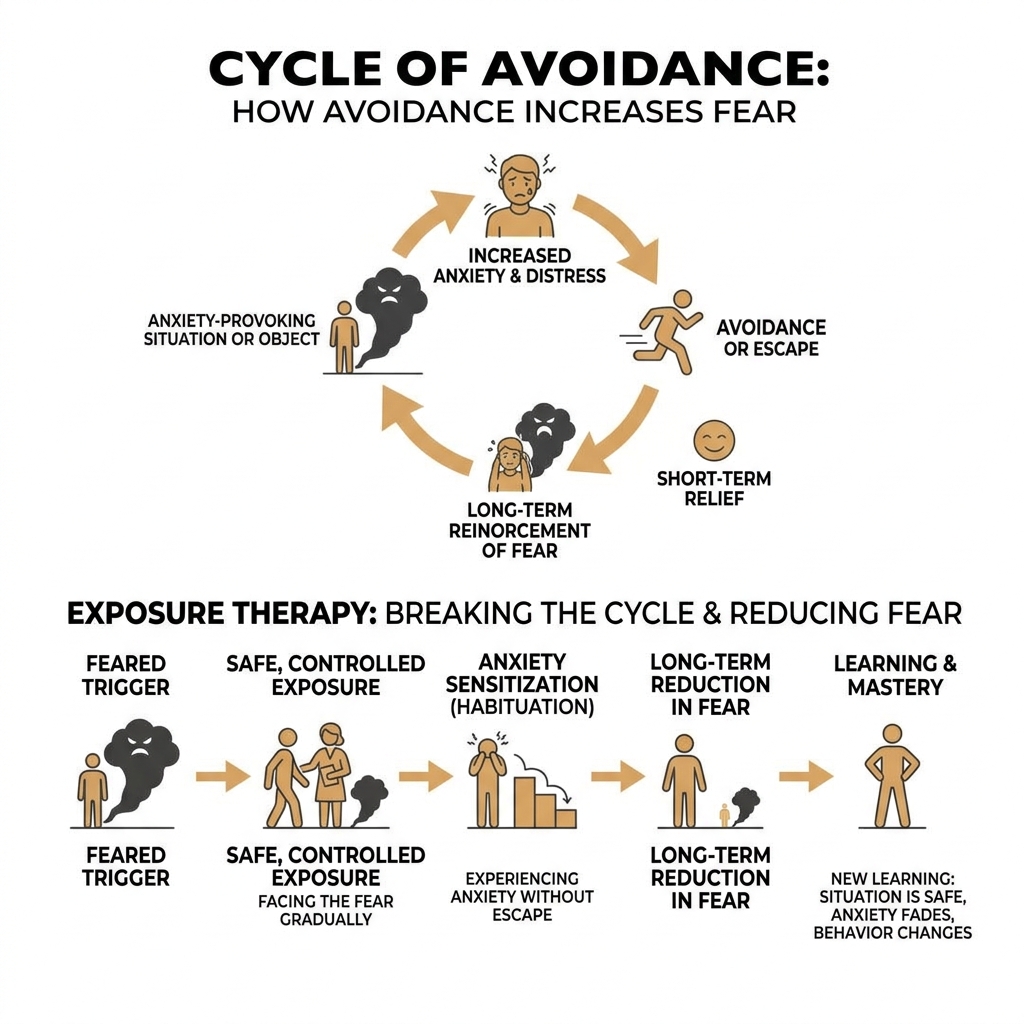
That avoidance feels like relief — but it’s actually keeping the fear alive.
Over time, avoidance tightens its grip. The feared thing grows bigger in our minds. Daily life starts to shrink around it. This cycle is at the heart of anxiety disorders, phobias, OCD, and PTSD — and it’s exactly what exposure therapy is designed to break.
Rather than running from fear, exposure therapy turns toward it — carefully, gradually, and with professional support. The result? Your nervous system learns that the feared thing is not actually dangerous. The anxiety fades. Life opens back up.
I’m Dan Jurek, M.A., LPC-S, LMFT-S, founder and clinical director of Pax Renewal Center in Lafayette, Louisiana, and with over 35 years of clinical experience I’ve seen how exposure therapy — integrated within a compassionate, faith-sensitive framework — can bring lasting relief to individuals and couples struggling with anxiety, trauma, and fear. In this guide, I’ll walk you through everything you need to know about exposure therapy: how it works, the different types, what to expect, and whether it might be right for you.
What is Exposure Therapy and How Does it Work?
At its heart, exposure therapy is about teaching your brain a new story. When we struggle with anxiety or trauma, our “internal alarm system” (the amygdala) becomes hypersensitive. It starts treating harmless things—like a bridge, a social gathering, or a memory—as if they are life-threatening emergencies.

According to the American Psychiatric Association, this therapy works by creating a safe environment where you can confront these “alarms” without the feared consequence actually happening. We use several psychological mechanisms to make this happen:
- Habituation: This is the natural process where your reaction to a stimulus decreases after repeated exposure. Think of it like jumping into a cold pool; at first, it’s shocking, but after a few minutes, your body adjusts and the water feels fine.
- Extinction: This weakens the association between a specific trigger (like a dog) and a fear response (like a panic attack).
- Self-Efficacy: As you successfully face your fears, you gain confidence in your ability to manage anxiety. You stop feeling like a victim of your emotions and start feeling like the driver.
- Emotional Processing: We help you “digest” traumatic memories or fears that have been stuck. Instead of pushing them away, we process them so they no longer have power over you.
- Inhibitory Learning: This is the modern “gold standard” explanation. You aren’t necessarily “erasing” the old fear, but you are building a new, stronger “safety” memory that inhibits the old fear response.
In our Anxiety Counseling Complete Guide, we often discuss how avoidance provides short-term relief but fuels long-term suffering. Exposure therapy flips that script, offering short-term work for long-term freedom.
The Different Types of Exposure Therapy
There isn’t just one way to face a fear. Depending on what you are struggling with, we tailor the “how” to fit your specific needs. Some fears require real-world action, while others—especially those rooted in trauma—require us to work within the theater of the mind.
As noted by Harvard Health, the pace of therapy also matters. We generally choose between two main pacing strategies:
| Strategy | Definition | Best For |
|---|---|---|
| Graded Exposure | Starting with the least scary item on a “fear hierarchy” and slowly working up. | Most anxiety disorders and phobias. |
| Flooding | Starting with the most challenging exposure immediately. | Rarely used today, but effective for rapid results in specific cases. |
In Vivo and Imaginal Exposure Therapy
In Vivo Exposure refers to “real-life” confrontation. If you have a phobia of spiders, in vivo exposure might involve looking at a spider in a jar, then moving the jar closer, and eventually touching the spider. It is incredibly effective for specific phobias and social anxiety.
Imaginal Exposure, on the other hand, involves vividly imagining the feared object, situation, or memory. This is a cornerstone of Prolonged Exposure (PE) for PTSD. For many of our clients in Lafayette, we find that combining these techniques with our EMDR Therapy Lafayette Guide helps process trauma memories that feel too “big” to face in the physical world all at once.
Virtual Reality and Interoceptive Exposure Therapy
Sometimes, the thing we fear isn’t easily accessible. You can’t just hop on a plane ten times a day to cure a fear of flying. That’s where Virtual Reality Exposure (VRE) comes in. We use simulations to recreate the sights and sounds of the feared environment in the safety of the office.
Interoceptive Exposure is unique because it targets the fear of physical sensations. Many people with panic disorder aren’t afraid of spiders or heights; they are afraid of their own racing heart or shortness of breath. In this type of exposure therapy, we might have a client run in place or breathe through a straw to intentionally trigger those sensations. The goal is to learn that a racing heart is uncomfortable, but it isn’t dangerous. This is a powerful tool we discuss in our resources for EMDR for Anxiety.
Specialized Approaches: ERP and Prolonged Exposure
While general exposure therapy is great for phobias, certain conditions require a more specialized “recipe.” Two of the most successful protocols are ERP and PE.
Exposure and Response Prevention (ERP) for OCD
If you struggle with OCD, you know that the “obsession” (the scary thought) isn’t the only problem—it’s the “compulsion” (the ritual you do to feel safe) that keeps you trapped.
In Exposure and Response Prevention (ERP), we expose you to the thought or situation that triggers your anxiety, but—and this is the crucial part—we help you resist performing the compulsion. If you fear germs, we might have you touch a doorknob and then prevent you from washing your hands for an hour. This teaches your brain that the “disaster” you fear won’t happen even if you don’t do the ritual. You can learn more about this in our OCD Therapy Lafayette LA Guide.
Prolonged Exposure (PE) for PTSD
For those who have experienced trauma, the brain often tries to protect itself by “numbing out” or avoiding anything that reminds them of the event. Prolonged Exposure (PE) is a highly recommended first-line treatment that typically lasts 8 to 15 sessions.
In PE, we use breathing retraining to manage physical stress while we gradually approach trauma-related memories (imaginal) and real-world reminders (in vivo). This helps the survivor realize that the memory is just a memory—it cannot hurt them anymore. At Pax Renewal Center, we often integrate this with EMDR Therapy Lafayette LA to provide a comprehensive, trauma-informed path to healing.
What to Expect: The Process and Benefits
Walking into your first session can feel intimidating. We want you to know that we never “throw you in the deep end.” The process is collaborative and structured.
- Assessment: We start by understanding your history and identifying your specific triggers.
- The Fear Hierarchy: Together, we create a “ladder” of fears, ranked from 1 to 10. We might start at a 2 or 3.
- In-Session Exposure: We practice facing the fear in the office where you are supported.
- Homework: To make the healing stick, you’ll practice small exposures at home between sessions.
The benefits are backed by staggering statistics. Studies show that exposure therapy helps over 90% of people with specific phobias who complete the treatment. Even four years later, 90% of those people retain their progress, and 65% remain completely symptom-free. By weakening negative associations and restoring your sense of control, this method offers a level of freedom that traditional talk therapy often cannot reach on its own. For more on how this fits into a broader treatment plan, see our CBT Therapy Lafayette LA Ultimate Guide.
Frequently Asked Questions about Exposure Therapy
How long does exposure therapy typically last?
There is no “one-size-fits-all,” but most protocols are designed to be short-term and intensive. For specific phobias, you might see results in just a few sessions. For more complex issues like PTSD or OCD, a standard course is typically 8 to 15 sessions over about three months. The goal is to give you the tools to become your own therapist.
Are there risks or challenges involved?
The primary “risk” is temporary distress. Because you are facing things you’ve spent a long time avoiding, your anxiety will likely go up before it goes down. However, this is done under the supervision of a trained professional who ensures the environment is safe. It is a controlled “workout” for your emotional resilience.
Who can provide this type of therapy?
Exposure therapy should only be provided by licensed mental health professionals who have received specialized training in these protocols. This includes:
- Licensed Professional Counselors (LPCs)
- Licensed Clinical Social Workers (LCSWs)
- Licensed Psychologists (PhD or PsyD)
At Pax Renewal Center, our team is specifically trained to provide these evidence-based treatments while respecting your spiritual and personal values.
Conclusion
Fear doesn’t have to be the permanent boundary of your life. Whether you are a veteran dealing with PTSD, a parent whose child is struggling with a phobia, or someone trapped in the cycle of OCD, exposure therapy offers a scientifically proven way out.
At Pax Renewal Center in Lafayette, Louisiana, we believe that emotional healing and spiritual renewal go hand-in-hand. Led by Dan Jurek, our team integrates clinical best practices like CBT and ERP with faith-based values to help you find the bravery to face your fears. You don’t have to do this alone. We are here to provide the compassionate, professional care you need to restore your relationships and reclaim your life.
If you’re ready to take that first step toward freedom, we invite you to explore our CBT Therapy Lafayette LA Ultimate Guide or contact us to learn how we can support your journey toward healing.