

Why Faith-Based Trauma Therapy Offers Hope for Lasting Healing
Faith-based trauma therapy combines proven clinical methods with spiritual support to help you heal from life’s deepest wounds. This approach recognizes that trauma affects your mind, body, and spirit – and true healing addresses all three.
What Faith-Based Trauma Therapy Includes:
- Clinical Excellence: Evidence-based methods like EMDR, CBT, and EFT
- Spiritual Integration: Prayer, scripture, and faith community support
- Holistic Healing: Mind-body-spirit approach to recovery
- Cultural Sensitivity: Therapists who understand your faith background
- Safe Environment: Judgment-free space to process trauma and spiritual struggles
Research shows that 27-33% of U.S. adults have experienced religious trauma, while nearly 75% of individuals in one UK study felt “damaged by a church experience.” Yet for the 63% of Americans who identify as Christian, integrating faith into trauma recovery often provides the most meaningful path to healing.
Traditional trauma therapy focuses primarily on psychological symptoms. Faith-based approaches go deeper; they help you process how trauma has affected your relationship with God, your spiritual community, and your sense of purpose.
The healing process isn’t about choosing between science and spirituality; it’s about using both together. Licensed Christian therapists combine advanced clinical training with a deep understanding of how faith intersects with trauma recovery.
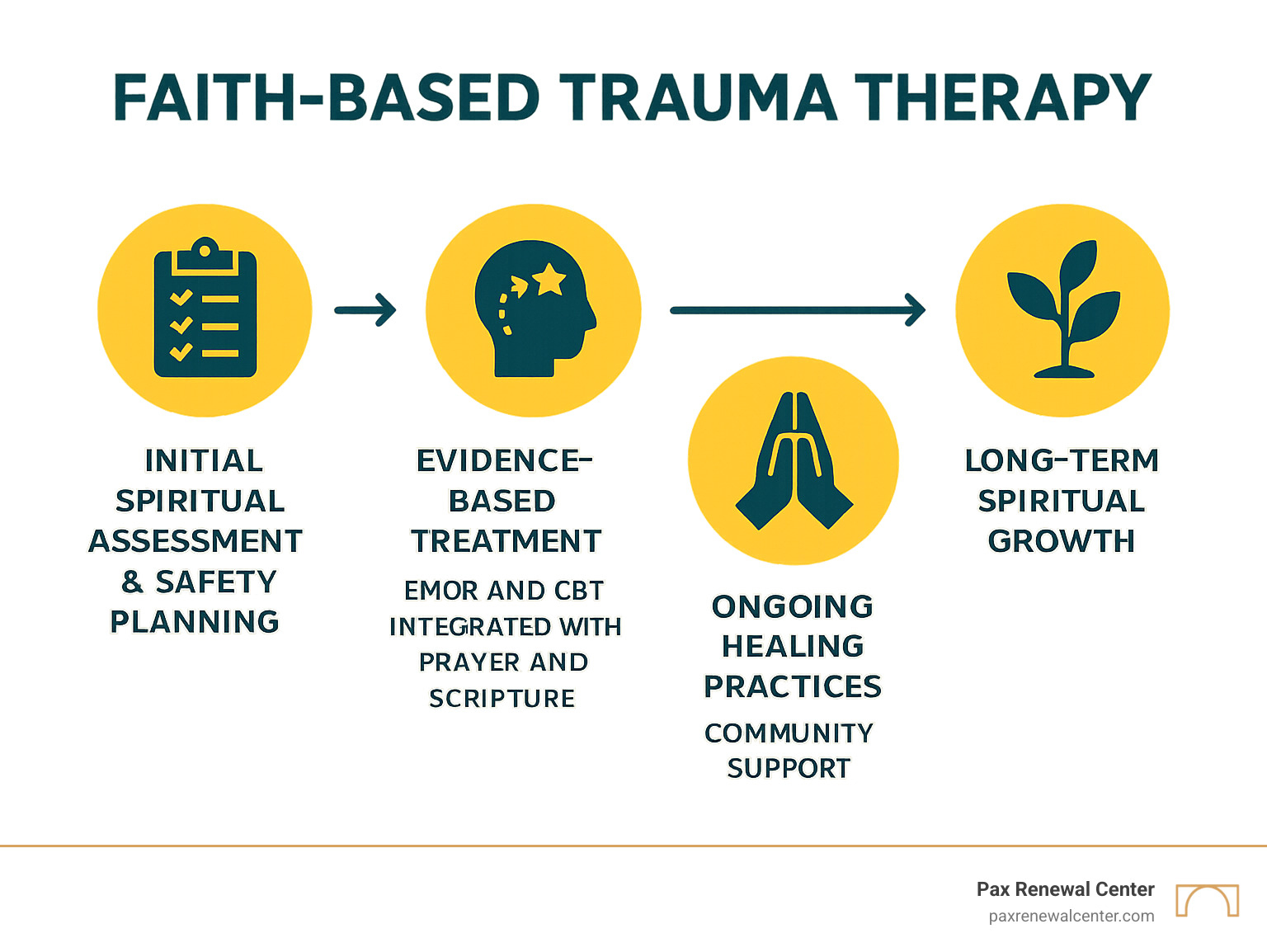
What Is Faith-Based Trauma Therapy?
Faith-based trauma therapy treats your whole person, not just your symptoms. When you’ve experienced trauma, it affects your mind, emotions, and spirit, sometimes shaking the very foundations of what you believe about God, yourself, and the world.
This approach recognizes that healing happens on three levels: mind, body, and spirit. Traditional therapy might help you process traumatic memories and reduce anxiety, but if you’re a person of faith, you might still struggle with deeper questions like “Where was God when this happened?” These spiritual wounds need attention, too.
The beauty of faith-based trauma therapy lies in how it weaves together clinical excellence with spiritual wisdom. We naturally integrate proven treatments like EMDR, CBT, and EFT with prayer, scripture meditation, and theological reflection throughout your healing journey.
Your biblical worldview shapes how we understand both trauma and recovery. We live in a fallen world where painful things happen, but we also hold onto hope, the promise that God can bring redemption and restoration from even the deepest wounds.
Trauma-informed care remains our foundation. We understand how trauma affects your nervous system and creates hypervigilance. We create safety first, then help you process difficult memories at a pace that respects your limits. The difference is we also recognize how trauma creates spiritual wounds, like feeling abandoned by God or losing trust in religious leaders.
Scientific research on religious demographics shows that faith remains central to most Americans’ lives. For many people, addressing spiritual questions isn’t optional, it’s essential for complete healing.
At Pax Renewal Center, we integrate Catholic values and biblical wisdom into every aspect of treatment while maintaining the highest clinical standards. More info about Catholic counseling can help you understand how this integration works in practice.
Faith Based Trauma Therapy vs. Traditional Approaches
| Aspect | Faith-Based Trauma Therapy | Traditional Trauma Therapy |
|---|---|---|
| Spiritual Integration | Prayer, scripture, and theological reflection woven throughout treatment | Spirituality may be acknowledged but not actively incorporated |
| Clinical Modalities | EMDR, CBT, EFT, IFS combined with spiritual practices | Same evidence-based methods without spiritual components |
| Treatment Goals | Symptom reduction plus spiritual healing and growth | Primarily focused on symptom reduction and psychological functioning |
| View of Suffering | Trauma understood within framework of redemption and hope | Trauma viewed through psychological and medical models |
| Community Support | Incorporates faith community and church relationships | May include family/friends but not specifically religious community |
The key difference is that faith-based trauma therapy recognizes the spiritual dimension of human experience. For people of faith, ignoring this dimension can leave significant aspects of trauma unaddressed.
Core Principles & Techniques in Christian Trauma Counseling

Faith-based trauma therapy rests on foundational principles that transform how we understand both suffering and healing. The principle of imago Dei – that you are created in God’s image – anchors everything we do. When trauma whispers lies about your worth, this truth speaks louder.
Redemptive suffering offers another cornerstone of our work. We never minimize your pain, but we hold space for both the reality of your trauma and the hope that God can bring healing through your wounds.
The body of Christ principle recognizes that healing happens best in community. While individual therapy provides crucial one-on-one work, we also help you reconnect with healthy faith communities that support your recovery.
When it comes to therapeutic techniques, we seamlessly weave proven clinical methods with spiritual practices:
EMDR (Eye Movement Desensitization and Reprocessing) helps your brain process traumatic memories while reducing their emotional intensity. In faith-based EMDR, we might begin sessions with prayer, use scripture as positive affirmations, or invite you to imagine Jesus present during difficult memories. Scientific research on EMDR therapy demonstrates its remarkable effectiveness for trauma recovery.
Cognitive Behavioral Therapy (CBT) helps identify and change negative thought patterns that developed as a result of trauma. In Christian CBT, we examine these thoughts against biblical truth. When trauma has left you believing “I’m worthless,” we explore how this contradicts God’s view of you as precious and beloved.
Emotionally Focused Therapy (EFT) proves particularly helpful for couples dealing with trauma’s impact on their relationship. We help partners understand how trauma responses affect their emotional connection while drawing on biblical principles about marriage and forgiveness.
Internal Family Systems (IFS) recognizes that we all have different “parts” of ourselves, some wounded, some protective, some wise. In Christian IFS work, we help you connect with your core Self while also inviting God’s presence into the healing of wounded parts.
Prayer and scripture aren’t just added onto these techniques; they’re woven throughout the therapeutic process in natural, meaningful ways. More info about trauma treatment provides additional details about our comprehensive approach.
Forgiveness work often becomes central to Christian trauma counseling, though we approach this with great care. We never rush you toward forgiveness or suggest that forgiveness means excusing harmful behavior. Instead, we help you understand forgiveness as a process that ultimately frees you from the burden of carrying resentment.
Integrating Scripture, Sacraments, and Neuroscience
One of the most beautiful aspects of faith-based trauma therapy is how it bridges ancient wisdom with cutting-edge neuroscience. Romans 12:2 speaks of being “transformed by the renewing of your mind.” Modern neuroscience confirms that our brains can indeed form new neural pathways throughout our lives.
Psalm 34:18 promises that “The Lord is close to the brokenhearted and saves those who are crushed in spirit.” When you feel God’s presence during difficult emotions, your nervous system can shift from hyperarousal into a state of calm connection. This is both spiritually and neurologically profound.
We help you understand how spiritual practices actually support your neurological healing. Regular prayer and scripture meditation can help regulate your nervous system, reduce cortisol levels, and strengthen your prefrontal cortex, the part of your brain responsible for emotional regulation.
Types of Trauma Addressed & Unique Challenges of Spiritual Harm

Faith-based trauma therapy addresses every type of traumatic experience, from childhood wounds to combat experiences to medical crises that left you questioning God’s presence.
Childhood abuse carries particularly deep wounds when it happens within religious settings. When the very people who were supposed to teach you about God’s love instead caused harm, it creates confusion about what divine love actually looks like.
Combat trauma affects veterans in ways that go beyond psychological impact; it’s about moral injury. When you witness things that shake your faith in humanity, the spiritual wounds run as deep as the psychological ones.
Medical trauma can shatter your sense of God’s protection. A sudden diagnosis or watching a loved one suffer brings flooding questions: “Why didn’t God prevent this?” “Where is He now?”
But there’s another category that secular therapy often misses: religious or spiritual trauma. This happens when the very faith that should bring healing becomes a source of harm. Research shows that 27-33% of U.S. adults have experienced some form of religious trauma.
LGBTQ+ individuals face especially high rates of spiritual trauma, particularly those raised in conservative religious communities. One study found that almost 90% of LGBTQ+ participants from certain religious backgrounds met components of PTSD diagnostic criteria due to spiritual trauma.
Recognizing Religious or Spiritual Trauma
Religious trauma creates symptoms that don’t fit neatly into traditional diagnostic categories:
Shame-relief cycles trap people in exhausting spiritual patterns. You might feel crushing shame about your thoughts or behaviors, then experience temporary relief through religious practices, only to have the shame return stronger.
Loss of community often hits hardest when questioning your faith means losing your entire social network. Sunday mornings become painful reminders of relationships that are gone.
Identity crises develop when your entire sense of self was built around your role in a religious community. Losing that identity can leave you wondering who you are without those labels.
Hypervigilance around religious content can make everyday life challenging. You might experience anxiety or panic attacks when you hear certain hymns or see religious imagery.
How Faith-Based Therapy Heals Spiritual Wounds
Healing spiritual trauma requires walking a careful line between clinical expertise and spiritual wisdom:
Grace-centered narrative helps you understand that your worth isn’t based on performance or adherence to religious rules. Many clients experience God’s unconditional love for the first time in our work together.
Safe theology involves examining religious beliefs that may be harmful or distorted. We help you distinguish between healthy spiritual truth and toxic religious teaching.
Spiritual reparenting helps you develop a healthy relationship with God as a loving parent figure, especially when your earthly parents or religious authority figures were harmful.
More info about PTSD awareness can help you understand how trauma symptoms manifest and why specialized treatment is important.
Getting Started: Choosing a Faith-Aligned Therapist & What to Expect

Starting your journey with faith-based trauma therapy can feel overwhelming, but taking this first step shows incredible courage and wisdom.
Finding the right therapist isn’t just about credentials, though those matter tremendously. It’s about finding someone who truly understands both the clinical aspects of trauma and the spiritual dimensions of your healing journey.
Cultural sensitivity makes all the difference. When your therapist understands your faith tradition, you don’t have to spend precious session time explaining basic spiritual concepts. Instead, you can dive deeper into how trauma has affected your relationship with God.
Therapist licensure remains absolutely crucial. Look for licensed professionals like LPCs, LMFTs, LCSWs, or psychologists who have specialized training in trauma treatment. At Pax Renewal Center, our team combines advanced clinical training with deep understanding of how faith intersects with mental health.
The importance of trauma-specific training cannot be overstated. Your therapist should be trained in approaches like EMDR, trauma-focused CBT, or other evidence-based methods. Don’t hesitate to ask about their experience with your particular type of trauma.
Your first session will focus on creating safety and beginning to understand your story. In faith-based therapy, this includes exploring your spiritual background and how trauma has affected your relationship with God.
Safety planning is a priority, especially if you’re dealing with recent trauma. Your therapist will work with you to develop practical strategies for managing difficult emotions between sessions.
More info about services at Pax Renewal Center can help you understand our comprehensive approach to trauma recovery.
Questions to Ask Before You Begin
Credentials and experience form the foundation of effective treatment. Ask about their licenses, certifications, and specific training in trauma treatment. Find out how they prepared to integrate faith into therapy.
Therapeutic approach questions help you understand what to expect. Ask about the trauma treatment methods they use and how they weave spiritual elements into therapy.
Faith understanding conversations reveal whether your therapist truly gets the role of spirituality in healing. Ask how they view faith in the recovery process and whether they’re comfortable discussing difficult spiritual questions.
First-Session Roadmap
History taking involves sharing your story in a safe, non-judgmental environment. This includes your family background, religious upbringing, trauma history, and current symptoms.
Spiritual genogram is a unique tool that maps your spiritual family tree. It shows how faith has been passed down through generations and where spiritual wounds may have occurred.
Grounding exercises give you practical tools for managing anxiety. These might include breathing techniques or faith-based practices like centering prayer.
Goal setting happens collaboratively as you identify what you hope to achieve. In faith-based treatment, these goals often include both symptom reduction and spiritual growth.
The first session might feel overwhelming, but healing is a process. You’re taking a courageous step toward the wholeness God desires for you.
Evidence of Effectiveness & Ongoing Healing Practices
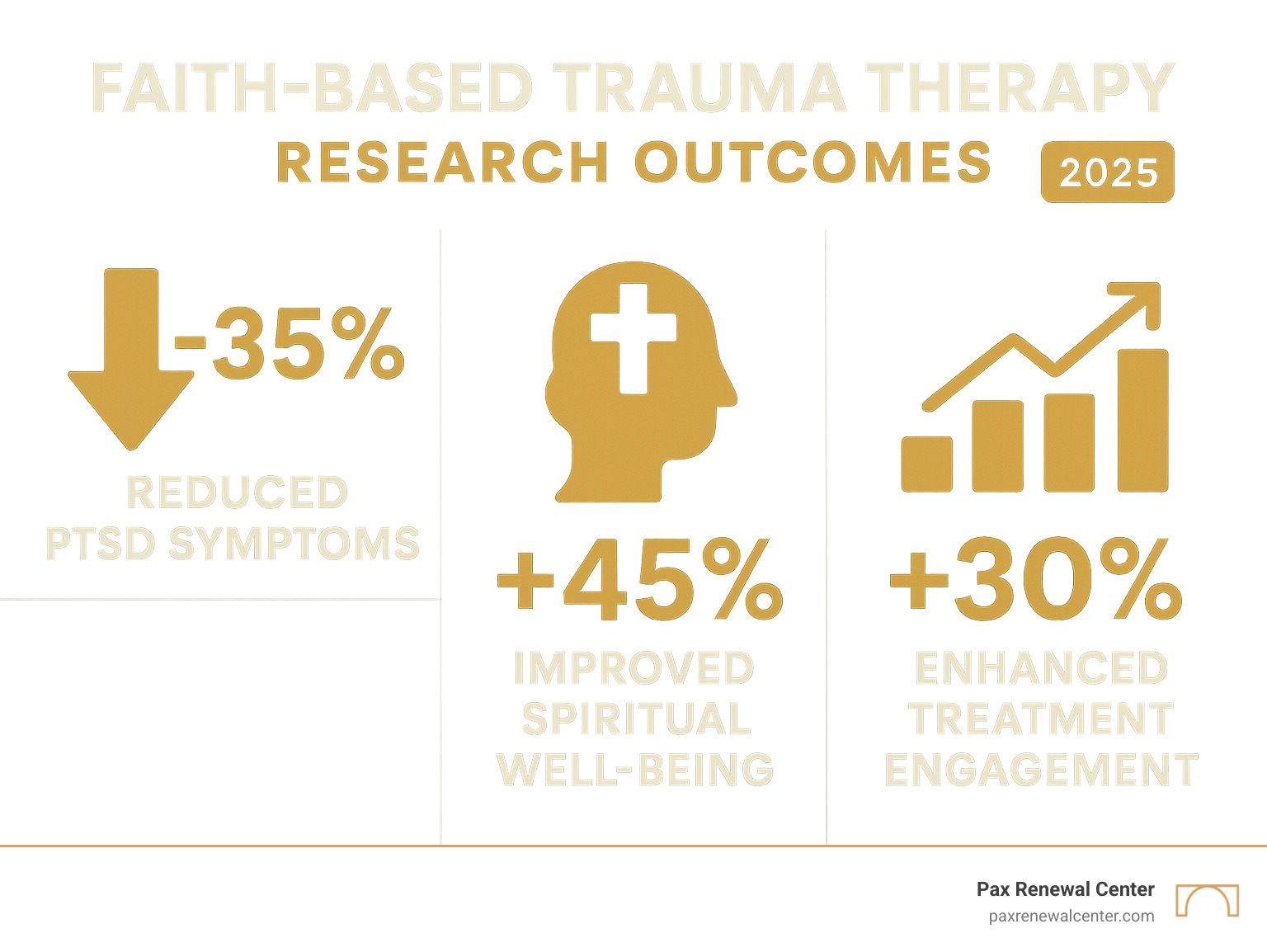
The research on faith-based trauma therapy tells a compelling story of hope and healing. Clinical studies consistently show that when we honor the spiritual dimension of recovery, people don’t just get better – they often heal faster and more completely.
Religious Cognitive Behavioral Therapy (RCBT) has become a particularly well-studied approach. When researchers compared RCBT to standard CBT, they found something remarkable: religious clients experienced faster initial improvement when their therapy included spiritual elements.
The protective effect of faith shows up powerfully in suicide prevention research. A comprehensive review of 141 studies found that 75% showed religious involvement correlated with fewer suicidal tendencies.
Treatment engagement improves dramatically when therapists understand and respect their clients’ spiritual beliefs. Trust builds more quickly, people stay in therapy longer, and they’re more willing to do the hard work of healing.
Group support amplifies the benefits of individual therapy. Faith-based trauma support groups create space for people to connect with others who understand both their pain and their beliefs.
Community resources within healthy faith communities provide ongoing support that extends far beyond therapy sessions. Churches often offer pastoral care, support groups, and practical assistance that complement professional treatment.
Spiritual practices like journaling, worship, and meditation create ongoing healing opportunities between therapy sessions. Research shows that regular spiritual practices help regulate the nervous system and promote emotional well-being. Latest research on PTSD continues to support comprehensive treatment approaches.
Combining Professional Care with Daily Spiritual Habits
Healing from trauma happens not just in therapy sessions, but in the daily rhythms where faith and recovery intersect.
Prayer rhythm creates anchoring points throughout your day. Morning prayers for strength, midday prayers for peace, and evening prayers for gratitude help regulate your nervous system while maintaining your connection with God.
Scripture meditation goes deeper than casual Bible reading. When you slowly contemplate passages like Psalm 34:18, you’re allowing God’s truth to penetrate areas where trauma has created lies.
Church community requires careful navigation for trauma survivors. Your therapist can help you learn how to engage with healthy faith communities while protecting yourself from further harm.
Worship and music engage multiple parts of your brain and can help process emotions that are difficult to express in words. Singing can be particularly healing for trauma survivors who have lost their voice.
Sabbath rest provides regular opportunities for your nervous system to reset and for you to remember that your worth isn’t based on productivity. Learning to rest becomes an act of faith and healing.
Frequently Asked Questions about Faith-Based Trauma Therapy
Is faith-based trauma therapy evidence-based?
Absolutely. Faith-based trauma therapy stands firmly on the foundation of proven clinical methods while adding the powerful dimension of spiritual healing. The core techniques we use – like EMDR, CBT, and EFT – have decades of research backing their effectiveness.
What makes our approach special is that we carefully weave together clinical excellence with spiritual wisdom. Religious Cognitive Behavioral Therapy (RCBT) has been tested in randomized controlled trials and performs just as well as standard CBT. Some studies show that religious clients actually experience faster initial improvement when their therapy includes spiritual elements.
EMDR integrated with spiritual components follows the exact same eight-phase protocol proven effective in clinical trials. The spiritual elements are research-informed integrations that can actually improve the healing process.
How long does faith based trauma therapy take?
Healing happens on your timeline, not ours. Every person’s journey is unique, and we believe in honoring your individual pace rather than rushing toward arbitrary deadlines.
Trauma complexity plays the biggest role in determining treatment length. Single traumatic incidents might see significant improvement in 3-6 months of consistent therapy. Complex trauma, especially childhood abuse or repeated experiences, often requires 6-12 months or longer.
The treatment methods we use also influence timing. EMDR can sometimes produce remarkable results relatively quickly, with some clients experiencing major breakthroughs in 6-12 sessions for single-incident trauma. However, complex trauma typically requires extended treatment.
Your readiness is perhaps the most important factor. Some clients come ready to dive deep immediately. Others need months of preparation work to develop coping skills and build trust. We never rush this foundation-building phase because safety and stability always come first.
What if my trauma happened inside a church?
When trauma occurs within religious contexts, it creates a particularly painful form of betrayal that attacks both your psychological well-being and your spiritual foundation. Religious trauma requires specialized care because it involves the very institutions that should have been sources of safety.
Your safety comes first, always. If you’re still in contact with individuals or institutions that caused harm, we’ll work together to develop protective strategies. This might involve setting boundaries, limiting contact, or removing yourself from harmful situations.
Creating healthy spiritual boundaries becomes crucial. We help you distinguish between toxic religious practices and authentic faith. Many survivors find that the harmful behaviors they experienced weren’t actually representative of God’s heart or a healthy spiritual community.
Rebuilding faith is often possible, though it requires time and careful attention. Many survivors find that their faith ultimately becomes stronger and more authentic after working through their wounds.
Conclusion
Your journey through faith-based trauma therapy doesn’t end when you walk out of our office – it continues as you integrate healing into every aspect of your life. The wounds that once defined your story can become sources of strength, wisdom, and deep compassion for others who are struggling.
At Pax Renewal Center, we’ve witnessed countless individuals find that their darkest moments can become the foundation for their greatest growth. Faith-based trauma therapy offers something unique, it doesn’t just help you manage symptoms or develop coping strategies. It helps you find meaning in your suffering and experience the profound healing that comes when clinical excellence meets spiritual truth.
The integration of evidence-based treatments like EMDR, CBT, and EFT with the timeless wisdom of scripture creates a powerful pathway to wholeness. When you can process traumatic memories while drawing on the strength of your faith, healing happens at levels that purely secular approaches often miss. Your relationship with God, which trauma may have damaged or complicated, can be restored and even deepened through this process.
We understand that taking the first step toward healing requires tremendous courage. Whether you’re dealing with childhood trauma, spiritual abuse, combat experiences, or any other form of traumatic stress, know that you’re not alone in this journey. Our team of faith-aligned counselors in Lafayette, Louisiana, brings both clinical expertise and spiritual sensitivity to every session.
The beauty of faith-based trauma therapy lies in its recognition that you are more than your symptoms. You are a beloved child of God, faith-based, created with purpose and dignity that trauma cannot diminish. As you work through your healing process, you’ll likely find that your faith becomes a source of strength you never knew you had.
Recovery isn’t a destination, it’s an ongoing journey of growth, findy, and renewal. The spiritual practices you develop during therapy, the community connections you rebuild, and the deeper relationship with God you cultivate will continue supporting your healing long after formal treatment ends.
If you’re ready to begin this journey, we invite you to reach out to our compassionate team at Pax Renewal Center. We’re here to walk alongside you as you find that even the deepest wounds can become places where God’s light shines through. Your story of healing can become a testimony of hope for others who are still struggling in the darkness.
Seeking help is an act of faith in the possibility of healing, faith in God’s desire for your wholeness, and faith in your own capacity for growth and change. You deserve to experience life with peace, joy, and the deep satisfaction that comes from knowing you are fully known and completely loved.
More info about finding hope and empowerment through professional counseling can help you understand how our comprehensive approach supports your journey toward wholeness and renewal.