

Why Relationship OCD Feels So Real—and How to Break Free
ERP for ROCD (Exposure and Response Prevention for Relationship Obsessive-Compulsive Disorder) is a proven therapy approach that helps you confront intrusive relationship doubts without performing compulsive rituals—breaking the cycle of anxiety and restoring peace to your romantic life.
Quick Answer: What is ERP for ROCD?
- ERP = Exposure and Response Prevention therapy, the gold standard for OCD treatment.
- ROCD = Relationship Obsessive-Compulsive Disorder, a subtype of OCD focused on romantic partners.
- How it works: Gradually face relationship fears (exposures) while resisting compulsions (response prevention) like reassurance-seeking or mental reviewing.
- Success rate: Approximately 80% of people with OCD see significant improvement within 8-16 weeks of consistent ERP practice.
- Key principle: Learning to tolerate uncertainty instead of seeking constant proof of love, attraction, or compatibility.
If you’ve ever questioned whether your partner is “the one,” wondered if your feelings are real, or felt paralyzed by doubts about your relationship—you are not alone. However, when these questions become intrusive, chronic, and overwhelming, you may be dealing with Relationship OCD. This condition is particularly painful because it is “ego-dystonic,” meaning it attacks the very things you value most: your partner and your commitment.
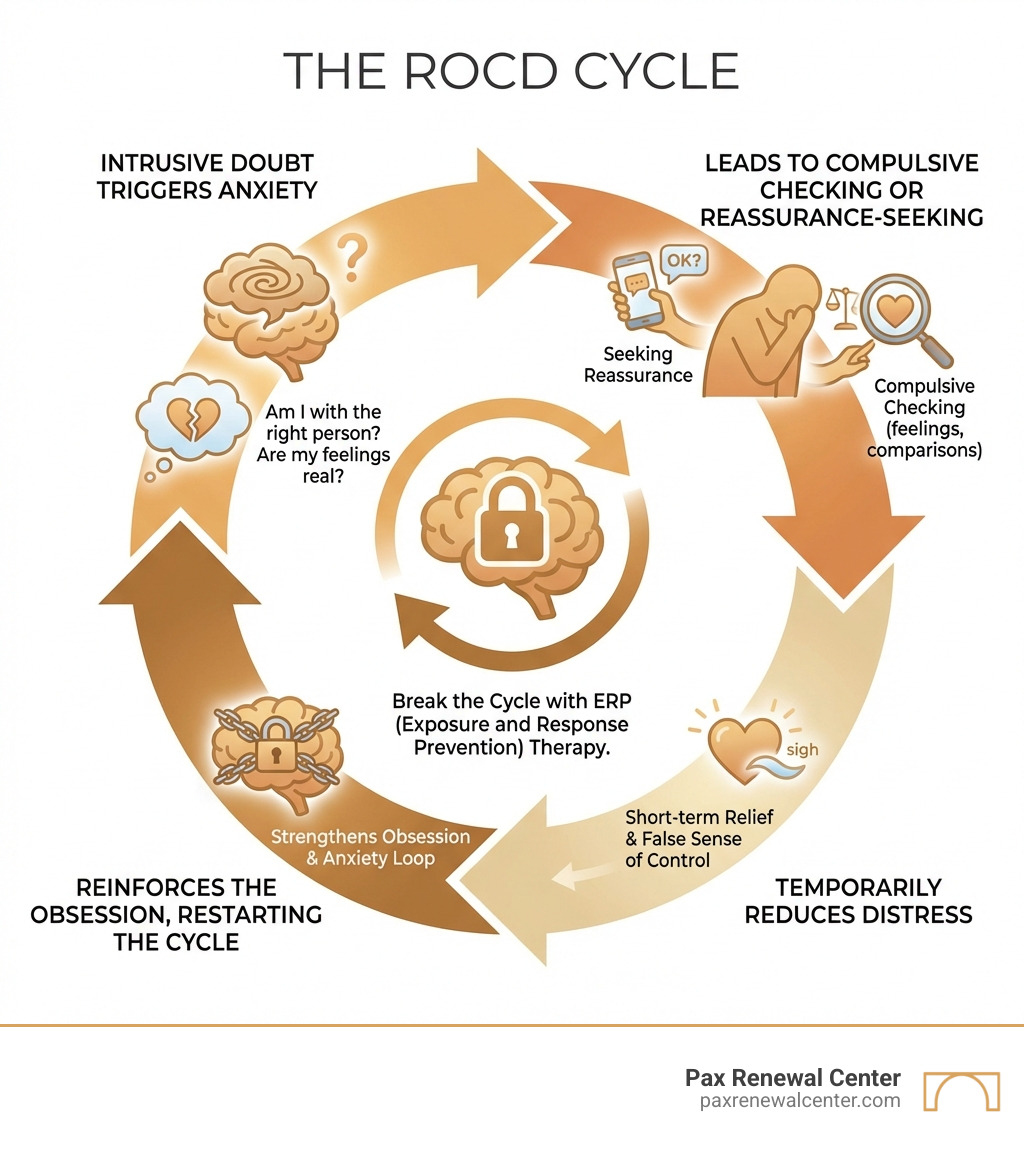
ROCD isn’t just normal relationship anxiety. It’s a pattern of obsessive thoughts paired with compulsive behaviors—checking your feelings, comparing your partner to others, and seeking reassurance over and over. The more you try to find certainty, the more trapped you feel. The anxiety cycle feeds on your desire for a perfect answer that doesn’t exist.
Why ROCD feels so real is that your brain is doing what anxious brains do: it treats uncertainty as danger. When you get a scary thought (“What if I don’t love them enough?”), your nervous system reacts as if a threat is present. You feel urgency, dread, guilt, or panic. Then you naturally reach for something to make the feeling go away—asking a friend for reassurance, googling relationship compatibility, scanning your partner’s flaws, or replaying conversations to “figure it out.”
Unfortunately, those strategies work only briefly. The relief becomes the brain’s proof that the thought was important, which makes the thought return stronger. Over time, ROCD can also spill into other areas of life: sleep, appetite, work performance, spiritual peace, and your ability to be present with your partner.
The good news? ERP therapy offers a way out. Unlike traditional talk therapy that can accidentally feed the doubt cycle by analyzing the “meaning” of the thoughts, ERP teaches you to sit with uncertainty and resist the rituals that keep anxiety alive. It’s not about proving your love is real—it’s about learning to live fully even when doubt shows up.
If you want a well-known overview of OCD symptoms and evidence-based treatment principles, the National Institute of Mental Health provides a helpful summary here: Obsessive-Compulsive Disorder (OCD).
I’m Dan Jurek, M.A., LPC-S, LMFT-S, founder of Pax Renewal Center in Lafayette, Louisiana. I’ve spent over 35 years helping individuals and couples steer anxiety, relationship struggles, and faith-based healing. I specialize in ERP for ROCD and faith-integrated therapy that honors both clinical science and your spiritual values. At Pax Renewal Center, we believe in relational restoration and spiritual renewal.
In this guide, you’ll learn exactly how ERP works, what exercises look like in real life, and how to move from constant doubt to confident connection.
Understanding Relationship OCD: Beyond Normal Doubts
Relationship Obsessive-Compulsive Disorder (ROCD) is a subtype of Obsessive-Compulsive Disorder (OCD) where the obsessions and compulsions are specifically focused on romantic relationships. It’s characterized by persistent and distressing doubts regarding one’s romantic relationship or partner. While it’s normal to have occasional doubts or concerns in a relationship, ROCD takes these to an extreme, changing them into overwhelming and intrusive thoughts that can hijack your peace of mind and significantly impact your ability to function in daily life.
Around 1-2% of people experience ROCD symptoms at some point in their lives. Among those already diagnosed with OCD, ROCD is even more common, affecting up to 20-30% of individuals. This highlights its significant presence within the broader OCD landscape.
So, how does ROCD differ from normal relationship doubts? The key distinction lies in the intensity, intrusiveness, and compulsive nature of the thoughts and behaviors. Normal doubts are typically fleeting, manageable, and don’t lead to repetitive, ritualistic actions. ROCD, however, tricks you into believing there’s something fundamentally wrong, even when your relationship is healthy and loving. It’s an anxiety-driven cycle that demands constant certainty, which is ultimately unattainable.
Here’s a comparison to help clarify the difference:
| Feature | Healthy Relationship Doubts | Relationship OCD (ROCD) |
|---|---|---|
| Frequency | Occasional, situation-based | Persistent, intrusive, repetitive |
| Emotional tone | Concern, sadness, or curiosity | Intense anxiety, urgency, guilt, shame |
| Flexibility | You can set it down and re-engage with life | Thoughts feel sticky and hard to disengage from |
| Impact on functioning | Limited disruption | Can interfere with work, sleep, intimacy, and spiritual peace |
| Behavior | Constructive communication, problem-solving | Compulsions like checking feelings, mental reviewing, reassurance-seeking |
| Goal | Understanding and growth | Certainty and total elimination of doubt |
Partner-focused obsessions and relationship-centered anxiety
ROCD can show up in two common patterns (and many people experience both):
- Partner-focused ROCD: The mind fixates on your partner’s perceived flaws (appearance, personality, intelligence, faith maturity, social skills, etc.), then treats those perceptions as evidence that you are with the wrong person.
- Relationship-centered ROCD: The mind fixates on the relationship itself (“Do I love them enough?” “Are we compatible?” “Is God calling me to leave?”), often demanding a level of certainty that no relationship can provide.
In both cases, the mind is not asking a neutral question. It’s sounding an alarm. That alarm can push you into constant analysis, compulsive confession, repeated conversations, or a pattern of on-and-off breakups meant to relieve anxiety rather than reflect true discernment.
Core fears beneath ROCD
ROCD obsessions often attach to meaningful values: love, commitment, honesty, faithfulness, and the desire to choose wisely. Common underlying fears include:
- Fear of making the wrong choice and harming your future (or your partner’s future)
- Fear of being stuck or trapped
- Fear of settling or missing out
- Fear of being dishonest if you feel doubt
- Fear that anxiety is a sign you should leave
These fears can feel especially intense for people trying to make values-based decisions (including those guided by Catholic and Christian convictions). ERP doesn’t dismiss values; it helps you stop treating anxiety as a reliable spiritual compass.
It’s also worth noting that ROCD can intensify during major relationship milestones—engagements, weddings, moving in together, or having children. These transitions naturally increase emotional vulnerability, and for someone with ROCD tendencies, the heightened stakes can amplify the obsessive cycle. Understanding that these spikes are predictable can help you prepare and respond with ERP skills rather than panic.
Scientific research on OCD impact and treatment
OCD is well-researched, and ERP is widely recognized as a first-line behavioral treatment. For a detailed review of how OCD affects functioning and how evidence-based treatments work, see: Scientific research on OCD impact and treatment.
If you’re also noticing broader anxiety symptoms (panic, rumination, avoidance, or physical tension), you may benefit from learning more about anxiety treatment options as part of a comprehensive plan: More info about anxiety counseling.
Common Symptoms and Obsessions
ROCD symptoms can look different from person to person, but several themes show up repeatedly:
- Attraction anxiety: “What if I’m not attracted enough? What if I never feel fireworks?”
- Compatibility doubts: Fixating on differences in hobbies, communication styles, family backgrounds, or faith practices.
- Flaw fixation: Getting stuck on one trait (voice, laugh, a habit, a weakness) and treating it as catastrophic.
- Comparison rituals: Comparing your partner to an ex, a friend’s spouse, or people you see online.
- “The One” myth: Believing you must feel constant certainty and perfect emotional alignment to be truly committed.
Many people with ROCD also experience what clinicians call “backdoor spikes”—moments when a temporary feeling of relief or clarity is immediately followed by a new wave of doubt. For example, you might feel genuinely happy with your partner during dinner, only to have your mind respond with, “But was that happiness real, or were you just distracted?” Recognizing this pattern as part of the OCD cycle, rather than meaningful information, is a critical step in recovery.
The Hidden Toll of Compulsions
Compulsions are anything you do to reduce anxiety, eliminate doubt, or get certainty. They can be obvious actions or subtle mental rituals. Common ROCD compulsions include:
- Reassurance seeking: Asking your partner, friends, family, pastors, or therapists for repeated confirmation.
- Mental reviewing: Replaying interactions, scanning memories, or testing whether past feelings were “real.”
- Social media monitoring: Checking others’ relationships for comparison, or monitoring your partner’s online behavior to feel safe.
- Feeling checking: Testing your feelings during dates, intimacy, worship, or prayer: “Do I feel in love right now?”
These patterns create a painful paradox: the harder you try to be sure, the less sure you feel. ERP interrupts that cycle by helping you allow the thought, allow the feeling, and choose behavior aligned with your values rather than your anxiety.
If you want a deeper overview of treatment options for OCD (including ERP) and how therapy can be structured, see: More info about OCD therapy.