

Why Finding the Right Co-Parenting Counselor Can Save Your Family
If you’re searching for a co-parenting counselor, you’re likely dealing with separation stress while trying to protect your children from ongoing conflict. A co-parenting counselor helps separated or divorced parents improve communication, reduce conflict, and create child-focused parenting plans.
What to look for in a co-parenting counselor:
- Licensed therapist (LMFT, LCSW, or LPC) with family therapy experience
- Specialized training in co-parenting or family mediation
- Child-centered approach focused on your kids’ emotional well-being
- Experience with conflict resolution and communication skills training
When co-parenting counseling works best:
- Both parents are willing to participate and focus on the children
- Conflict levels are mild to moderate (not high-conflict situations)
- You need help with communication, not legal custody decisions
- You want confidential support rather than court-reportable services
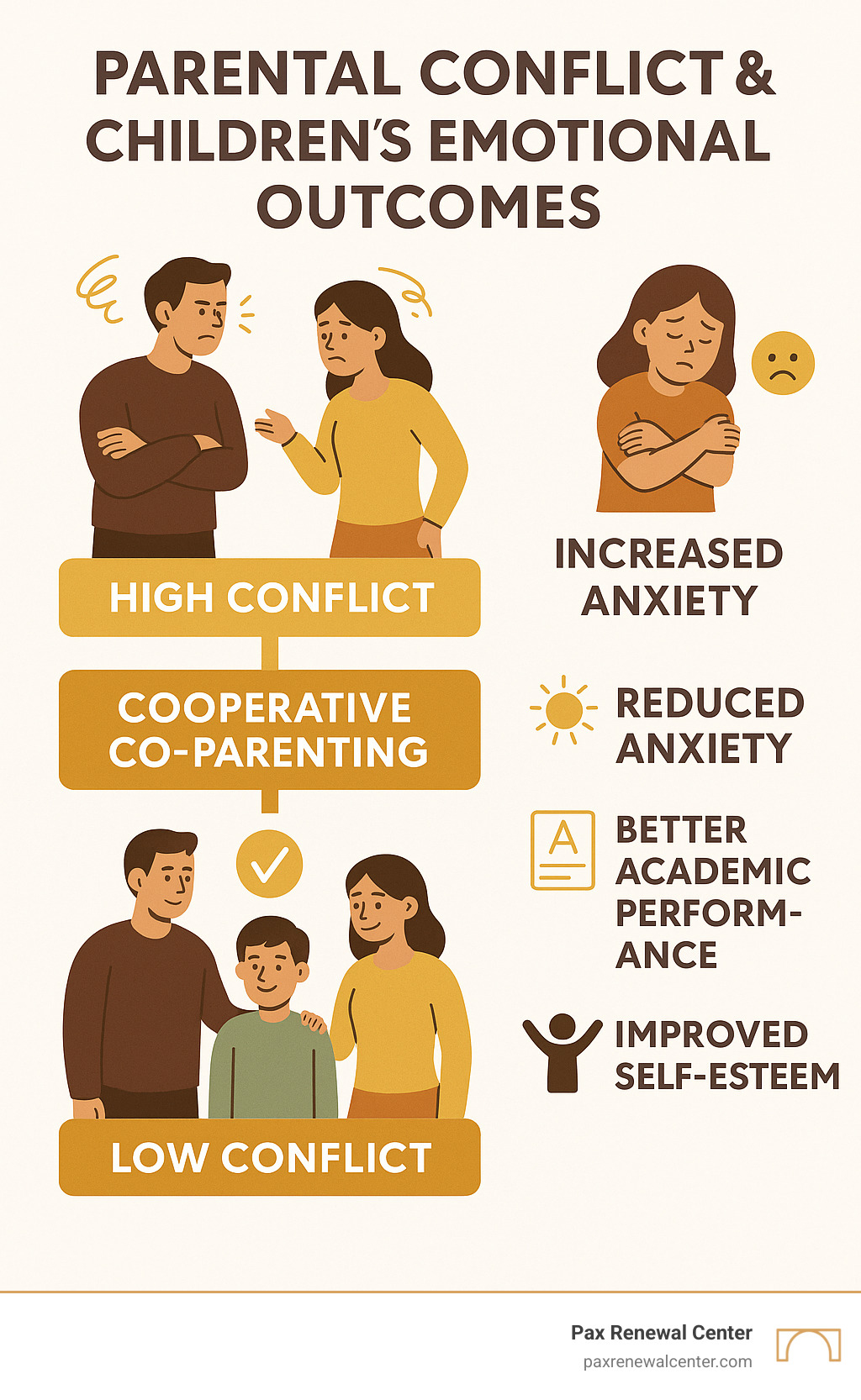
Research shows that consistent parental conflict after divorce stresses children most, sometimes for years. But children whose parents engage in cooperative co-parenting experience better emotional well-being, higher self-esteem, and improved academic performance.
Co-parenting counseling typically costs between $100-$250 per hour, and many extended health benefit programs cover sessions with registered social workers.
What Is Co-Parenting Counseling & Why It’s Not Couples Therapy
When your marriage ends, parenting doesn’t. Co-parenting counseling is specialized therapy designed to help divorced or separated parents work together effectively for their children’s sake – without trying to fix the romantic relationship.
Think of it as transitioning from married partners to business partners in raising healthy, happy children. A co-parenting counselor helps you steer this shift with skill and grace.
Unlike couples therapy, which focuses on healing romantic relationships, co-parenting counseling accepts that the marriage is over. There’s no pressure to rekindle feelings. Instead, the focus stays on one goal: helping you both become the best co-parents possible.
The scope includes improving communication patterns, developing conflict resolution skills, creating structured parenting plans, and establishing consistent rules across both homes. Most importantly, it provides emotional support as you learn to put your children’s needs first.
Scientific research on parental conflict and child stress shows that ongoing conflict between parents causes more long-term damage to children than the divorce itself. But children whose parents learn to cooperate show remarkable resilience and healthy development.
Key Differences at a Glance
| Service Type | Primary Focus | Confidentiality | Best For |
|---|---|---|---|
| Co-Parenting Counseling | Communication & relationship skills | Confidential | Mild conflict, future-focused |
| Family Therapy | Entire family system dynamics | Confidential | Addressing family-wide issues |
| Mediation | Reaching specific agreements | May be confidential | Resolving specific disputes |
When a Co-Parenting Counselor Is the Best Fit
Co-parenting counseling works when both parents can sit in the same room without explosive arguments. It’s perfect for families dealing with mild conflict who want to focus on the future rather than rehashing past hurts.
You’ll know it’s right if both parents are genuinely committed to putting the children first. Maybe you struggle with communication but can still have civil conversations. The confidential nature creates a safe space for honest conversations without fear of legal consequences.
When You May Need Parenting Coordination Instead
If you’re dealing with high-conflict situations where court orders are frequently violated, parenting coordination might be more appropriate. It offers more structure and enforceability for challenging situations where emotions run so high that traditional counseling isn’t effective.
How a Co-Parenting Counselor Helps Families Thrive

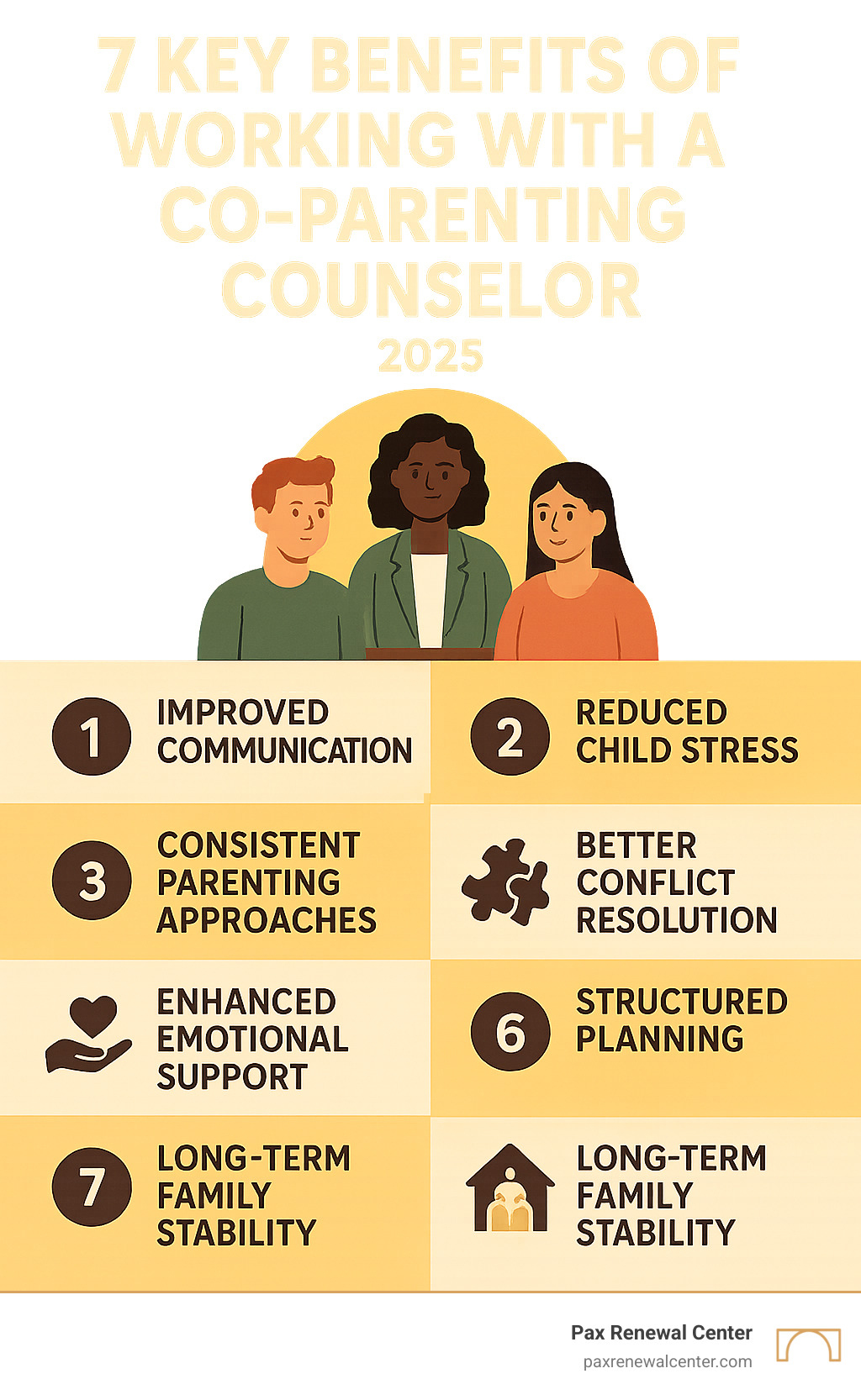
When families work with a skilled co-parenting counselor, the benefits extend far beyond reducing arguments. The ripple effects create stability that children desperately need during separation or divorce.
A cooperative co-parenting relationship minimizes stress for both parents and children, reducing the likelihood of children getting caught in adult disagreements. This creates an environment where children can thrive emotionally, academically, and socially.
The core areas where a co-parenting counselor makes a difference:
Conflict Resolution Skills: Learning to address disagreements constructively rather than letting them escalate into harmful arguments.
Communication Improvement: Developing business-like conversations about parenting matters without getting derailed by past hurts.
Unified Parenting Approach: Creating consistency in rules and expectations across both households so children feel secure.
Emotional Support: Processing grief and adjustment while maintaining focus on children’s needs.
Practical Planning: Developing detailed schedules and decision-making protocols that reduce daily friction.
Scientific research on cooperative parenting benefits consistently shows that children in cooperative co-parenting arrangements have better outcomes than those caught in ongoing parental conflict.
Child-Centered Goals Every Co-Parenting Counselor Targets
Every effective co-parenting counselor keeps children at the center of the work. The goals create conditions where children can flourish despite their parents’ separation.
Consistency Across Homes: Children need predictable routines and similar expectations at both houses. This means compatible approaches to bedtimes, homework, and discipline.
Secure Attachment Preservation: Maintaining strong relationships with both parents protects children’s emotional development and self-esteem.
Developmental Appropriateness: Understanding what children can handle at different ages helps parents make better decisions about schedules and information sharing.
Techniques You’ll Practice in Sessions
Active Listening: Learning to truly hear what the other parent is saying without immediately formulating your rebuttal.
“I” Statements: Instead of “You never pick up the kids on time,” learning to say “I feel frustrated when pickup times change because it affects our routine.”
Role-Playing: Practicing difficult conversations in the safety of the counselor’s office before having them in real life.
Solution-Focused Brief Therapy: Focusing on what’s working well and how to build on those successes rather than dwelling on problems.
Benefits for Parents & Kids
For Children:
- Higher self-esteem and better emotional regulation
- Improved academic performance
- Stronger relationships with both parents
- Reduced anxiety and depression symptoms
For Parents:
- Lower stress levels and better personal well-being
- Improved decision-making around parenting issues
- More effective communication skills
- Greater confidence in parenting abilities
The Co-Parenting Counseling Process: Step-by-Step
Starting co-parenting counseling can feel overwhelming when you’re already dealing with separation stress. Most co-parenting counselor sessions follow a clear, structured process that builds skills step by step.
Your journey begins with an initial assessment where your counselor understands your family’s unique situation – your children’s ages, current conflict areas, and what each parent hopes to accomplish.
Many counselors start with separate intake sessions because it allows each parent to share openly without triggering arguments. These individual meetings provide space to discuss sensitive issues and express concerns safely.
Once your counselor understands both perspectives, joint sessions begin. Your counselor will actively manage conversations to keep them productive and solution-focused. Early sessions concentrate on learning fundamental communication techniques and finding areas where you actually agree.
The skill-building phase involves practicing active listening, learning “I” statements, and developing conflict resolution strategies. Your counselor might have you role-play difficult conversations or work through specific scenarios.
Plan development comes next, where you’ll create detailed agreements about schedules, decision-making, holidays, and procedures for handling future disagreements. This creates a framework that reduces daily friction.
Progress reviews happen regularly, allowing you to assess what’s working and what needs adjustment. Co-parenting counseling is flexible, and plans can be modified as children grow and circumstances change.
Typical Format & Duration
Most co-parenting counselor sessions run 60 minutes and happen weekly or every other week. The total process typically involves 6-12 meetings, though some families find periodic “tune-up” sessions helpful.
Virtual sessions have become incredibly effective, especially for busy parents. Online meetings eliminate transportation challenges and waiting room awkwardness while being just as powerful for learning communication skills.
What Qualifications Should a Co Parenting Counselor Hold?
Your counselor should hold a core license such as Licensed Marriage and Family Therapist (LMFT), Licensed Clinical Social Worker (LCSW), or Licensed Professional Counselor (LPC) with significant family therapy experience.
Specialized training in co-parenting facilitation, family mediation, or child development adds crucial expertise. Look for counselors who’ve completed specific programs focused on co-parenting rather than general therapy approaches.
Experience with separation and divorce is essential. You want someone who regularly works with separated families and understands your unique challenges.
At Pax Renewal Center, our therapists combine clinical qualifications with faith-based approaches, integrating spiritual guidance with evidence-based methods like EFT, CBT, and family systems therapy.
Children’s Role in the Room
Younger children (typically under 8) rarely participate directly, though they might join for brief check-ins to express simple preferences about schedules.
Older children and teens may be included in some sessions to share perspectives on schedules or help parents understand how decisions affect them. However, skilled counselors ensure these conversations happen without putting children in loyalty binds.
The primary goal is protecting children from adult conflict while ensuring their age-appropriate needs are considered in your parenting plan.
Preparing for Your First Session & Choosing the Right Co-Parenting Counselor

Walking into your first session with a co-parenting counselor can feel overwhelming. Taking this step shows incredible strength and commitment to your children’s well-being.
Your mindset makes all the difference. This isn’t about proving who’s the better parent. Think of it as learning new business skills for the most important partnership you’ll ever have: raising your children together.
Come prepared to focus on solutions rather than problems. Your co-parenting counselor isn’t there to judge, they’re there to help you create a healthier dynamic for your family.
Safety always comes first. If there’s been domestic violence, discuss this with potential counselors before booking. Some situations need individual work before joint sessions can happen safely.
Budget considerations matter. While counseling requires investment, consider the long-term costs of ongoing conflict, court battles, missed work, and the impact on your children’s well-being, all of which add up.
For more information about our comprehensive counseling services, visit our services page.
Practical Prep Checklist
Your current custody arrangement tells the story of what’s working and what isn’t. Bring a copy of your schedule, including informal changes. Note which arrangements flow smoothly and which create tension.
A rough draft of your ideal parenting plan helps your counselor understand your priorities. What matters most? Consistency? Flexibility? Equal time?
Write down your top concerns before you arrive. Having your main 3-5 concerns written down keeps the session focused and productive.
Bring your insurance cards and any Employee Assistance Program information. Many people don’t realize their EAP covers counseling services.
Your children’s schedules, school, sports, and activities, all factor into creating realistic parenting arrangements.
Evaluating Counselors: Questions to Ask
Experience matters tremendously. Ask how many co-parenting cases they handle yearly and their typical outcomes. A counselor who occasionally works with divorced parents isn’t the same as one who specializes in this transition.
Understanding their process helps set realistic expectations. How do they handle confidentiality? What happens if parents disagree about goals? How do they keep sessions child-focused?
Practical considerations affect your ability to stick with the process. Do they offer virtual sessions? What’s their emergency contact policy?
If faith integration is important, ask about their approach to combining therapeutic techniques with spiritual guidance. At Pax Renewal Center, we understand how Catholic and Christian values provide strength during difficult family transitions.
Apps & Support Tools That Complement Counseling
Our Family Wizard keeps all communications documented and civil, provides shared calendars, and tracks expenses. Many parents find neutral platforms reduce emotional charge of everyday communications.
Simple shared calendars like Google Calendar coordinate schedules and reduce conflicts about timing.
Support groups – both online communities and local meetups – provide encouragement from other parents who understand your journey.
Cost, Insurance & Alternatives You Should Know
When families struggle with co-parenting challenges, professional help costs often feel overwhelming, especially when managing the separation’s financial strain. But the investment in working with a co-parenting counselor almost always pays for itself through reduced conflict and fewer legal battles.
Ongoing parental conflict costs families far more than counseling ever will. Consider hidden expenses: missed work for court appearances, decreased productivity from stress, potential therapy costs for children, and emotional toll affecting every life area.
Typical session costs range widely based on credentials, experience, and location. Many insurance plans recognize co-parenting counseling as essential mental health care, especially when provided by licensed professionals.
Most families find that 6-12 sessions over several months provide the foundation needed for better co-parenting, though some benefit from occasional “tune-up” sessions as children grow.
Insurance & Tax Tips
Many health insurance plans cover family therapy and counseling services when provided by licensed mental health professionals, which includes most qualified co-parenting counselors.
Call your insurance company to ask about coverage for family therapy or couples counseling – these categories often cover co-parenting work. Ask about pre-authorization requirements, in-network providers, and deductible amounts.
Employee Assistance Programs (EAPs) through your workplace can provide several free counseling sessions per issue, which might be enough to get your co-parenting relationship on track.
If you have a Health Savings Account (HSA), co-parenting counseling typically qualifies as a medical expense, giving you tax advantages.
Services provided by Registered Social Workers are often tax-deductible as medical expenses, and many extended health benefit programs specifically cover these services.
Alternatives if Counseling Isn’t Appropriate
Parallel parenting becomes necessary when cooperative co-parenting isn’t possible due to high conflict. Instead of collaborating on every decision, parallel parenting allows each parent to maintain their own style with minimal interaction.
For high-conflict situations, parenting coordination offers more structure and authority than traditional counseling. Parenting coordinators can make temporary decisions and monitor compliance with court orders.
Individual therapy sometimes needs to come first. If parents are dealing with depression, anxiety, trauma, or other personal issues, individual counseling might be necessary before effective co-parenting work can happen.
Family mediation works well for families who communicate reasonably but need help reaching specific agreements about custody or visitation.
At Pax Renewal Center, we help families determine which approach will serve them best, and we’re always honest about when different support might be more appropriate.
Frequently Asked Questions about Co Parenting Counselors
How is success measured in co-parenting counseling?
Success isn’t about warm feelings between ex-partners, it’s about measurable improvements in how your family functions daily. As a co-parenting counselor, I look for concrete changes that make life better for everyone, especially children.
Reduced conflict frequency is often the first progress sign. Parents have fewer heated arguments, particularly in front of kids. You’ll know this works when you can discuss pickup times without battles.
Improved communication quality shows up when parents use respectful language and actually listen. Instead of “You never…” statements, you’ll hear more “I feel…” conversations focusing on solutions.
Consistent parenting approaches across households create stability children need. This means compatible expectations about bedtimes, homework, and behavior.
Better decision-making happens when parents discuss children’s needs without dragging kids into adult conflicts. You’ll find yourselves problem-solving together.
Most importantly, children’s well-being improves noticeably. Teachers often report better behavior and academic performance, while children seem more relaxed and secure.
Most families see initial improvements within 4-6 sessions, with deeper changes developing over 3-6 months.
What if my ex refuses to attend sessions?
This question comes up in almost every consultation. You’re ready to make changes, but your ex-partner seems resistant to working with a co-parenting counselor.
Co-parenting counseling works best when both parents participate willingly, but you still have options when one parent is reluctant.
Individual sessions can be incredibly valuable for the willing parent. You can learn better communication skills and develop conflict-reduction strategies that often create positive changes motivating the reluctant parent to join.
Sometimes, court-ordered counseling becomes necessary if there’s an ongoing custody case. While this doesn’t guarantee enthusiastic participation, it ensures attendance, and I’ve seen many initially reluctant parents become genuinely engaged.
Focus on what you can control is always good advice. Even if your ex won’t participate initially, you can transform your side of every interaction. This often creates a ripple effect improving the overall dynamic.
Can virtual co-parenting counseling be as effective as in-person?
Virtual co-parenting counseling has become incredibly effective, offering unique advantages that busy parents really appreciate. Since the pandemic, we’ve learned online sessions can be just as powerful as face-to-face meetings.
Convenience is probably the biggest benefit for co-parents juggling work schedules, childcare, and transportation challenges. You can attend from home without worrying about traffic or babysitters.
Comfort levels often improve when people are in their own environment. Some parents find it easier to have difficult conversations in familiar, private spaces.
Technology integration actually improves the process. We can share screens to work on parenting plans together and access helpful resources in real-time.
Accessibility means you can work with a specialized co-parenting counselor who might not be available locally.
Research consistently shows virtual therapy can be as effective as in-person sessions for family counseling and communication skills training.
At Pax Renewal Center, we’ve found many families actually prefer virtual sessions because it removes stress and logistics that can interfere with the healing process.
Conclusion & Next Steps

The path from constant conflict to peaceful co-parenting isn’t always easy, but it’s one of the most meaningful journeys you can take for your children’s future. Every family that chooses to work with a co-parenting counselor is making a brave decision to prioritize their children’s well-being over past hurts.
Throughout this guide, we’ve seen how co-parenting counseling creates lasting change that ripples through every aspect of family life. When parents learn to communicate respectfully and focus on their children’s needs, the benefits extend far beyond fewer arguments. Children feel safer, perform better in school, and maintain stronger relationships with both parents.
The research consistently shows that children whose parents work together cooperatively experience better emotional and psychological outcomes. This isn’t just about making today easier, it’s about giving your children the foundation they need to build healthy relationships throughout their lives.
At Pax Renewal Center, we’ve witnessed countless families transform their relationships through faith-based co-parenting support. Our approach combines proven therapeutic methods with spiritual guidance, recognizing that true healing often involves both practical skills and renewed hope.
The investment you make in co-parenting counseling pays dividends for decades. Better communication skills serve your family as children grow. Conflict resolution techniques help you steer future disagreements without damaging your children’s security. Structured decision-making processes ensure your children’s needs remain central to every choice.
Your next steps begin with honest self-reflection about your family’s needs. Consider whether both parents are ready for collaborative work, or if individual healing needs to happen first. Research qualified counselors with specific training in family dynamics and co-parenting support.
Timing matters more than you might think. Conflict patterns become more entrenched over time, making early intervention crucial for the best outcomes. Every day you wait is another day your children experience the stress of ongoing parental conflict.
If you’re ready to begin this important work, we invite you to explore our comprehensive parenting resources and learn more about how our team can support your family’s journey toward healing and hope.
Seeking help isn’t admitting failure – it’s demonstrating the kind of love and strength your children need most during this difficult season. Every step you take toward better co-parenting is a gift to your family’s future, creating the peaceful and stable environment where your children can truly thrive.
Your journey toward effective co-parenting begins with reaching out – and that first step is often the most important one you’ll ever take for your children’s well-being.